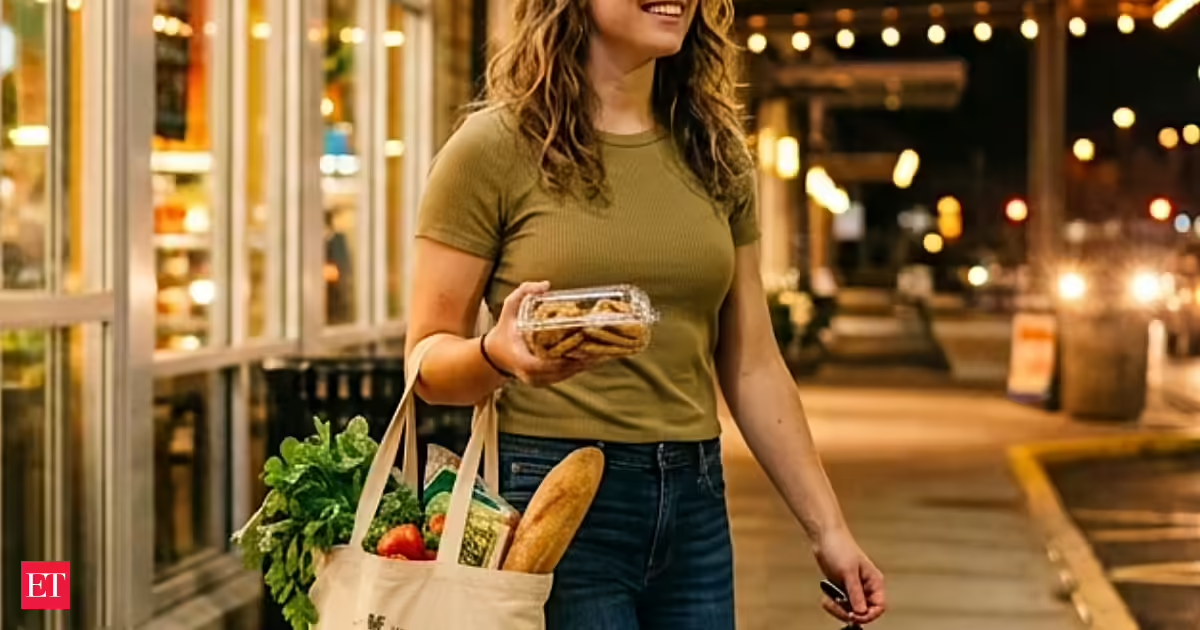
You’ve probably heard the classic advice: don’t go grocery shopping on an empty stomach, because you’ll leave with way more food than you meant to buy. According to the study, ‘Hunger promotes acquisition of nonfood objects,’ published in the Proceedings of the National Academy of Sciences, that pull doesn’t stop at the snack aisle. Researchers Alison Jing Xu, Norbert Schwarz, and Robert Wyer Jr. found in five different tests that hunger can also make people grab things that have nothing to do with food at all, from binder clips to USB drives.The paper reports five experiments with 379 participants, including a series of word-flash experiments, product-evaluation studies, and a field experiment. Across them, hunger increased people's desire for food and nonfood items, while having little effect on simple liking judgements.Why does an empty stomach make you want stuff in generalHunger does more than just make food look good, the researchers say. It also puts the brain in a general learning mode, as the search and reach for food is part of the hunger response. According to this study, in the first experiment, 69 participants briefly saw words flash on a screen and had to identify them. Those who were hungrier were faster at correctly identifying words about the acquisition of things (want, gain, obtain) and words about hunger itself, but hunger did not affect how well they identified neutral words that were unrelated. That difference suggested hunger was prompting a broader urge to acquire things, not just food.Even something as small as a binder clip can fall victim to hunger-driven grabbing. Image Credits: Google GeminiWanting more, even things you cannot eatFor this study, a second experiment was conducted with 77 people at a campus cafe, comparing those walking in hungry and walking out after eating. Hungry participants reported a stronger desire to purchase more things, both food and nonfood (such as a wireless mouse or a spa visit), than participants who had just eaten. Interestingly, participants preferred the food items more when they were still hungry than after they had eaten, but eating did not make much difference to how much they liked the non-food items. In other words, hunger influenced how much people wanted things in general, even though it only affected how much they liked food, but not nonfood objects.The now-famous binder clip experimentsAccording to the study, in two more experiments, college students were presented with a sample binder clip and asked how many they would like to take home for free. In one version, students who were hungrier asked for more clips than students who were less hungry, even though how much a person liked the clip had nothing to do with how hungry they were. In a follow-up version, some participants ate an entire loaf cake before the binder clip task, and some did not, and hunger was measured before and after. The participants who stayed hungry still asked for noticeably more clips than the ones who had just eaten cake, even though the two groups liked the clips about equally.Wanting and liking are not the same thingThis split between wanting more and liking the same amount is consistent with existing brain research. Neuroscientist Kent Berridge reviews food reward research and finds that wanting and liking are processed by different brain systems and can move independently of each other. This would explain why, when someone is hungry, they may grab more of an object even if that object doesn’t become more desirable to them.It held up in a real department store, tooThe most convincing part of this research is a field study. The study involved researchers approaching 81 shoppers leaving a department store that sold mostly clothes, shoes, and electronics, with few food items. Shoppers reported how hungry they were, and researchers checked their actual receipts. When shoppers were hungrier, they bought more nonfood items and spent more money overall, even when researchers controlled for their mood and the amount of time they were in the store.Skipping a meal before shopping could mean walking out with a heavier bag. Image Credits: Google GeminiAs the Smithsonian Magazine report on the research notes, shoppers in that study who were hungry spent up to 60 percent more than shoppers who were not hungry. Schwarz, one of the study authors, noted in comments that the effect held even when researchers accounted for how long people spent shopping and their overall mood.What this means for your next shopping tripFor American shoppers, this research lines up with something a lot of people already sense but cannot quite explain: that quick stop for milk and eggs that somehow turns into a cart full of candles, phone chargers, and a throw pillow no one needed. People may be more likely to buy extra items when they shop hungry or browse online before dinner.It is important to be clear about what this research does and does not demonstrate. It includes five studies with small sample sizes and doesn't mean hunger controls every purchase or that everyone reacts to hunger the same way. But it does suggest a simple, low-effort habit: eating something before you go out shopping, even a small snack, may be one of the easiest ways to protect your wallet.So next time you’re running errands with a growling stomach, you might want to pick up a granola bar first. Your bank account might thank you more than your stomach does.
Psychology of shopping hungry: Psychology says grocery shopping while hungry can affect more than the snack aisle; a 2015 study found hunger increased the acquisition of nonfood items, too
Discover how shopping on an empty stomach can lead to impulsive buying, influencing both food and nonfood purchases, and learn simple strategies to avoid overspending.
897 words~4 min read