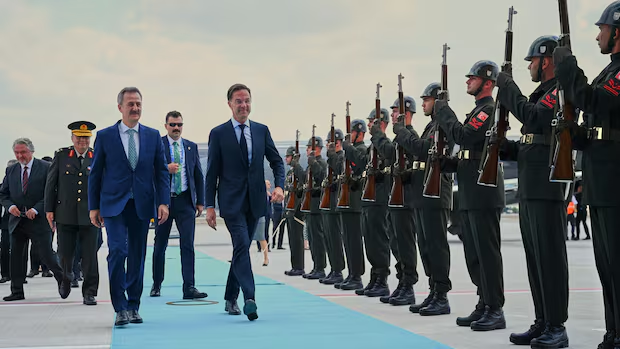
Politics·AnalysisEuropean leaders, including Prime Minister Mark Carney, arrive at the NATO summit walking a political tightrope — careful not to provoke U.S. President Donald Trump abroad while avoiding the appearance of yielding to him at home. As Washington signals a reduced military commitment to Europe, allies fear the greatest threat to NATO may come from inside the alliance.Leaders walk tightrope of not provoking U.S. president while avoiding appearance of bending to himMurray Brewster · CBC News · Posted: Jul 07, 2026 4:00 AM EDT | Last Updated: 2 hours agoListen to this articleEstimated 6 minutesThe audio version of this article is generated by AI-based technology. Mispronunciations can occur. We are working with our partners to continually review and improve the results.NATO Secretary General Mark Rutte arrives ahead of NATO's first face-to-face meeting since U.S. President Donald Trump threatened to take over Greenland. (Abdullah Güçlü/Pool/The Associated Press)Regardless of who you talk with in the defence community, there's a clear consensus that many European leaders are going to be treading lightly over the next few days as they wander the political minefield at the NATO summit in Turkey.On the one side, there is the desire to say or do nothing to aggravate the already aggrieved U.S. president. On the other side are their domestic audiences, including in Canada, where Donald Trump remains a deeply divisive and unpopular figure. It will be the first face-to-face meeting of allies since Trump threatened to take over Greenland, a semi-autonomous territory of NATO member Denmark — a crisis that caused a deep split between the United States and the rest of the Western alliance.Layered on top of that are recent American threats to withdraw current forces in Europe and limit what help the alliance could receive in a crisis.Hegseth orders review of U.S. troops deployed to NATO in fiery Brussels speechNATO wants 'credible' spending plans from members at next month's summitAnalysisThe 2029 warning: NATO's race to rearm ahead of Russia"I think Europeans view President Trump as quite combustible and are quite nervous," said Max Bergmann, the director of the Europe, Russia and Eurasia program at the Center for Strategic and International Studies in Washington, a respected think-tank."They're nervous that the summit could be more calamitous, especially now, as there's more domestic political pressure on European leaders to be seen as standing up to Trump."The argument can be easily extended to Prime Minister Mark Carney, particularly amid ongoing trade tensions including the absence of a CUSMA renewal and challenges to Canada's sovereignty.Federal officials have indicated there's likely going to be no bilateral meeting between Trump and Carney in Ankara. Without question, Carney is going into the summit in a stronger position than any Canadian prime minister in years after his government last spring hit NATO's two per cent of gross domestic product spending target. On Monday, he announced the multibillion-dollar purchase of up to 12 submarines from German shipyard TKMS — a measure that's expected to buoy allied solidarity. He's also announced major equipment purchases, including airborne early warning planes and U.S.-manufactured M142 High Mobility Artillery Rocket System (HIMARS).WATCH | Canada negotiating to buy airborne early warning planes:Canada negotiating to purchase Saab's GlobalEye radar planes, Carney saysMay 27|Duration 1:53Speaking at the annual arms trade show CANSEC in Ottawa, Prime Minister Mark Carney announced Canada is entering negotiations with Saab to buy its GlobalEye airborne early warning aircraft. Carney said the Swedish radar planes 'will be a key resource for Canadian Armed Forces to detect and deter threats across the Arctic.'The major sore point remains the ongoing review of whether Canada will buy a full order of Lockheed Martin-made F-35s or switch to the Swedish-manufactured Gripen — an issue that has openly irritated the Trump administration."It's going to be the same thing as every other summit when Trump is president, which is everybody's hoping that the alliance survives the summit," said Steve Saideman, the Paterson Chair in International Affairs at Carleton University.Saideman said we can expect to see "lots of performance to say that the alliance is doing the things that Donald Trump wants."The Trump administration has announced three significant measures to signal that it's stepping back from NATO and expects European countries and Canada to take larger roles.U.S. Secretary of War Pete Hegseth recently said that the Pentagon will conduct a global review of U.S. forces, which could indicate cuts to the number of American troops committed to Europe. He also said the amount of money Washington contributes to the common funding of NATO is being reconsidered.WATCH | Hegseth speaks to fellow NATO defence ministers:Hegseth blasts NATO members, announces review of U.S. forces in EuropeJune 18|Duration 4:46U.S. Secretary of War Pete Hegseth threatened to withhold some dues to NATO if 'free riding' allies did not meet their defence spending commitments. 'Europe was not supposed to be a dependency of the United States,' Hegseth said.Earlier in the spring, the Pentagon said the list of U.S. equipment and capabilities available to NATO in the event of a crisis or war would be reduced. Although the list hasn't been made public, published reports suggest there are deep cuts in strategic bombers, fighter squadrons, destroyers and submarines.European allies have been forced to backfill. NATO's Supreme Allied Commander in Europe, Gen. Alex Grynkewich, last week said that allies have either already matched the previous American contributions or provided alternatives.At the moment, Saideman said, it's not as much as the equipment as the political signal that the Trump administration is sending."It's always been about the American assurance that they would show up when needed," Saideman said. "The Canadians remember the Americans were late to the last couple of world wars and made a big difference in terms of how much suffering went on until that set of capabilities came into play." Canada's former top military commander, retired general Wayne Eyre, is also concerned about how the recent decisions are being seen in Moscow."This is a clear signal that there is a change in the relationship, a clear sign that Europe and Canada are going to have to continue to step up and do more," said Eyre.Carney chooses German submarines for Canadian navy fleet5 key takeaways from Canada choosing Germany's submarine bid"My concern is that this could contribute to future miscalculation. If there's a signal of limiting U.S. involvement in any future European war, could that embolden Russia?"While saying history is an imperfect guide, Eyre pointed to how a U.S. decision following the Second World War to initially exclude South Korea from its defensive perimeter possibly helped contribute to the 1950 invasion by North Korea. Others, such as Rachel Ellehuus, the director general of the U.K.-based Royal United Services Institute, are concerned that global review of where and how U.S. forces are employed will weaken NATO's position, particularly in Eastern Europe and the Baltic states.That review is troubling, Ellehuus said, because it's looking at what's in place now — not what could be provided in an emergency."What's in place is the backbone of NATO's deterrence and defence posture," said Ellehuus. "Think about the forces in Poland, think about the forward presence in the Baltic states. All of those are extremely important for deterrence now."WATCH | Trump 'surprised' NATO allies decline Iran war participation:Trump says NATO making 'very foolish mistake' on IranMarch 17|Duration 1:41U.S. President Donald Trump on Tuesday said NATO countries were supportive of the joint U.S.-Israeli military operation against Iran, even as they decline to get involved. 'All of the NATO allies agreed with us ... and they don't want to help us, which is amazing,' he said during an unrelated Oval Office event with Irish PM Micheál Martin.
ANALYSIS | NATO heads to Turkey hoping to avoid a Trump blow-up | CBC News
European leaders, including Prime Minister Mark Carney, arrive at the NATO summit walking a political tightrope — careful not to provoke U.S. President Donald Trump abroad while avoiding the appearance of yielding to him at home. As Washington signals a reduced military commitment to Europe, allies fear the greatest threat to NATO may come from inside the alliance.
1,443 words~7 min read