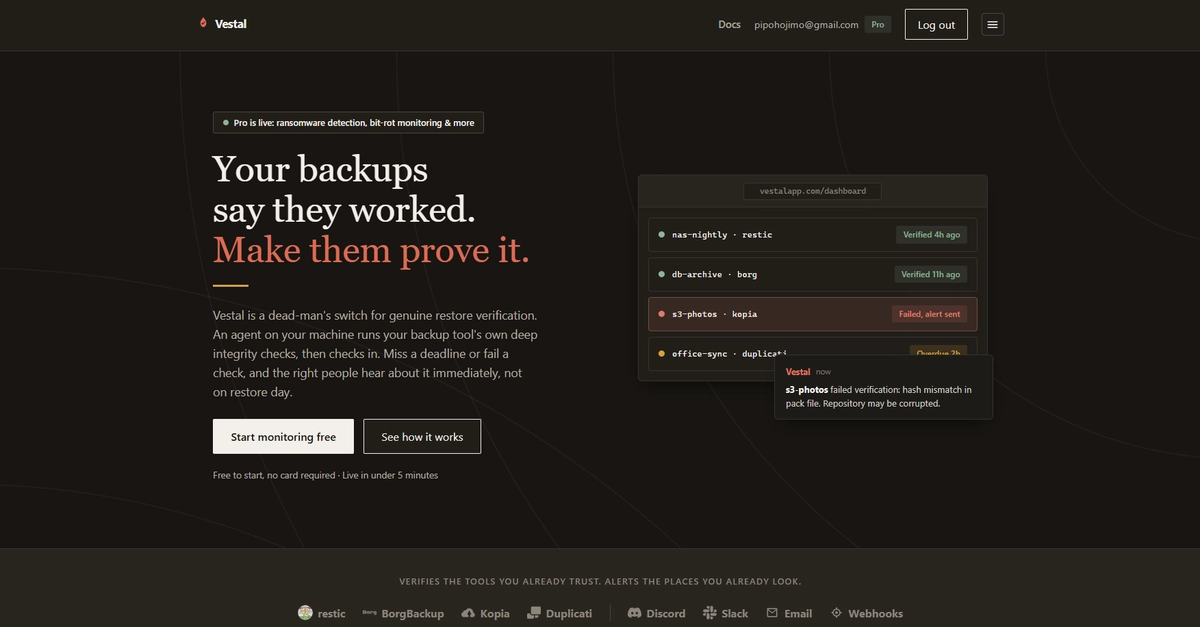
For most of my career I had backups I had never restored. The backup job ran every night. The green checkmark appeared every morning. The storage bucket filled up with files that had the right names and roughly the right sizes. I looked at all of that and told myself the data was safe. What I never did was take one of those files, restore it into a clean database, and confirm that the result was a working copy of production. I trusted the checkmark, and the checkmark was measuring the wrong thing.
The checkmark was measuring whether the backup job ran, not whether the backup could be restored. Those are completely different questions, and the gap between them is where disaster lives. A backup job can run perfectly every night for a year and produce a year of files that cannot be restored, because of a subtle format change, a missing table, a permissions issue in the restore path, or an encryption key that no longer exists. The only way to know a backup works is to restore it, and almost nobody restores their backups until the day they have no choice.
Claude Code let me close that gap by making restore verification a routine, automated part of the backup workflow rather than a heroic effort that happens once a year during a disaster recovery drill, if it happens at all. The backups are still taken by the usual tools. What changed is that every backup is now proven restorable shortly after it is taken, and the proof is captured as evidence rather than assumed. Here is the workflow.