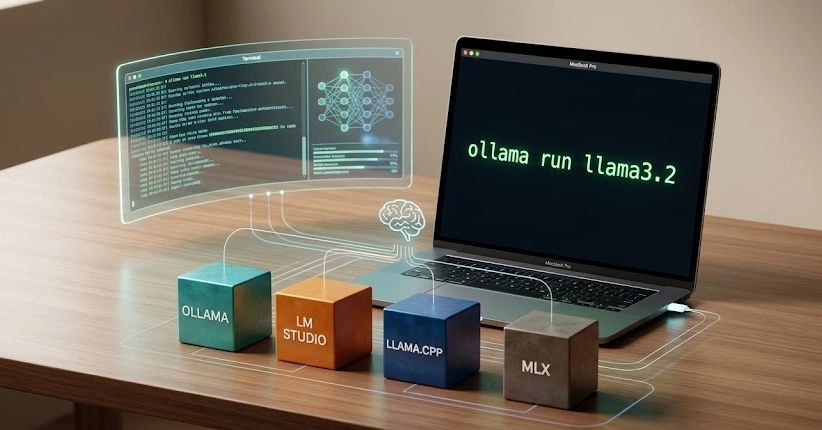
A few years ago, "running an LLM on your own machine" mostly meant a slow, low-quality toy. That's no longer true. In 2026, open-weight models routinely match or beat mid-tier cloud APIs on coding and reasoning benchmarks, consumer GPUs have enough VRAM to host 70B-parameter models, and tools like Ollama make the whole process feel closer to docker run than to a research project.
This guide walks through what local inference actually is, why (and when) it makes sense, the current tool and model landscape, and hands-on examples you can run today.
What "local inference" actually means
Local inference means the model weights, the tokenizer, and the compute all live on hardware you control — a laptop, a workstation, or a server you own — instead of a request going out to api.openai.com or api.anthropic.com. Nothing about your prompt or the model's response ever leaves your network unless you decide to send it somewhere.
Practically, this involves three moving parts: