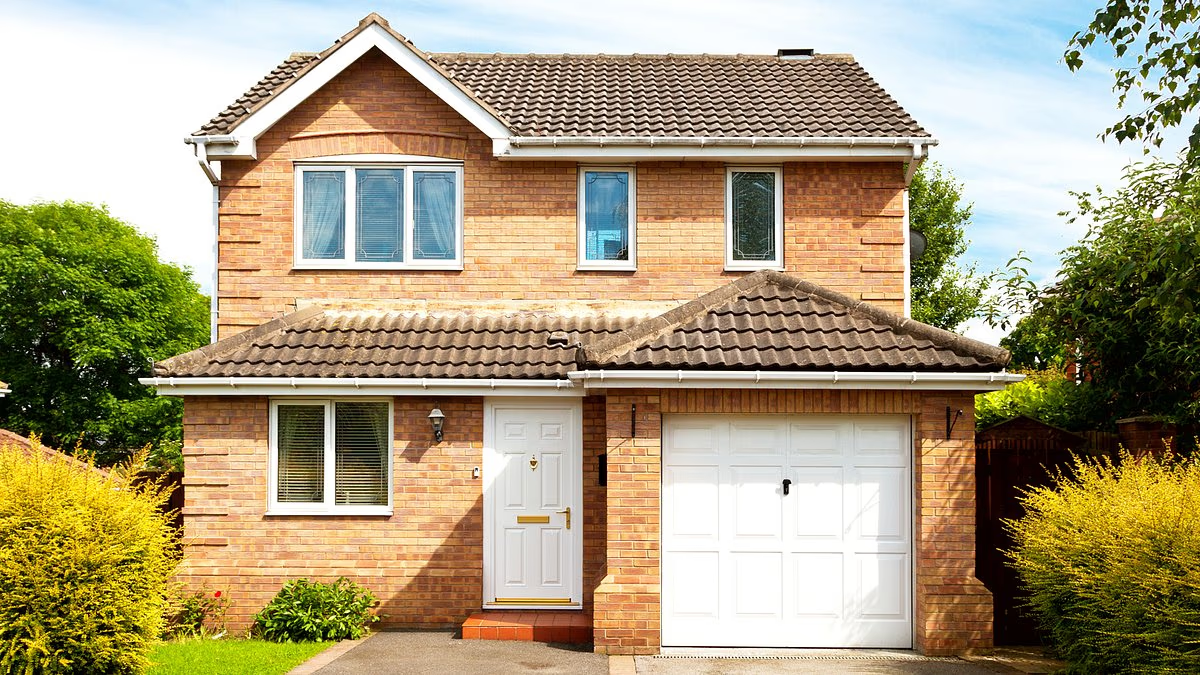
We bought our first house in 2010 for €220,000, and then we bought our second house in 2015. Since December 2017, we started renting out our first property. Now we would like to sell it as the price has gone up to €410,000. I understand that we can only benefit from not paying capital gains tax on one property. But can we pick this one as having no capital gains tax? And if we ever sell the other one, would we pay capital gains tax? If that’s impossible, please can you help to estimate how much tax we need to pay based on the above? NYIt’s an appealing idea all right – to be able to choose which property you pay capital gains tax on when you own more than one – but that’s not the way it works.The default position is that a person is liable to pay capital gains tax on the difference between the price at which they bought an asset and the price at which it is subsequently sold.You do get some tax relief but only on the first €1,270 of any gain crystallised by a sale in any tax year. That won’t get you far when you are talking about property prices.And, in case you are wondering, the odd figure is accounted for by the fact that, when the euro became reality, Revenue simply converted the £1,000 punt exemption at the time using the standard punt-to-euro formula.[ Vulnerable customers need not suffer in silence when dealing with their financesOpens in new window ]The capital gains tax exemption was just £500 when it was first introduced under the 1975 Capital Gains Tax Act. That jumped to £2,000 in the 1982 Finance Act before being reduced to £1,000 10 years later. It has not moved in the intervening 34 years which, of course, means it is worth just a fraction of what it was at the outset. If it had kept pace with inflation, that exemption would have risen to almost €2,650 by now, but there you go.Principal private residence More importantly, there is an exemption from capital gains tax on the sale of your principal private residence – your main family home. However, this first home is no longer your family home.You bought the first home in 2010 and it has now nearly doubled in value. But you only lived there as your family home from 2010 to the end of 2017. Since then it has been rented.So, for some of your ownership it is capital gains tax free and for the balance, tax is due.You need to work it out pro rata. So, if you have owned the house for 16 years (assuming you bought at the start of 2010 and sell it at the end of this year), you will be liable to capital gains tax on half the increase in value.This is because you lived there for seven years and the final year of ownership is also considered as owner occupied, regardless of whether it was rented out or not, bringing it to eight.Of course, you will need to work out the precise pro rata with the actual purchase, moving out and sale dates when filing your tax return.[ Why are we paying €3 charge for online shopping items that are not subject to customs duty?Opens in new window ]For the second house, where you now live, if you sell this down the line you will need to allow for the first year and a bit when it was not your main family home. Tax will be due on that time, even if it was not rented at the time. Again, you will need to work out what percentage of your period of ownership is accounted for by this one-to-two years before you moved into it as your family home.You are a little unlucky as there was a special seven-year capital gains tax dispensation on property bought between December 7th, 2011, and the end of 2014 when the government was trying to kick-start what was then a moribund housing market.Any capital gain in the first seven years of ownership for these properties was discounted – ie you were exempt from tax. And even if you only owned it for four years and got rid of it after the end of 2017, you got a pro rata exemption.But all of that is no use to you as you bought your first house before this window and the second one after it had closed.The bottom line is that you cannot choose which property should be subject to relief and which is subject to tax: the law determines that.Please send your queries to Dominic Coyle, Q&A, The Irish Times, 24-28 Tara Street Dublin 2, or by email to dominic.coyle@irishtimes.com with a contact phone number. This column is a reader service and is not intended to replace professional advice
Can we choose which of our two properties is exempt from capital gains tax?
Couple has owned and lived in two separate properties as their family home at different times over a number of years
812 words~4 min read