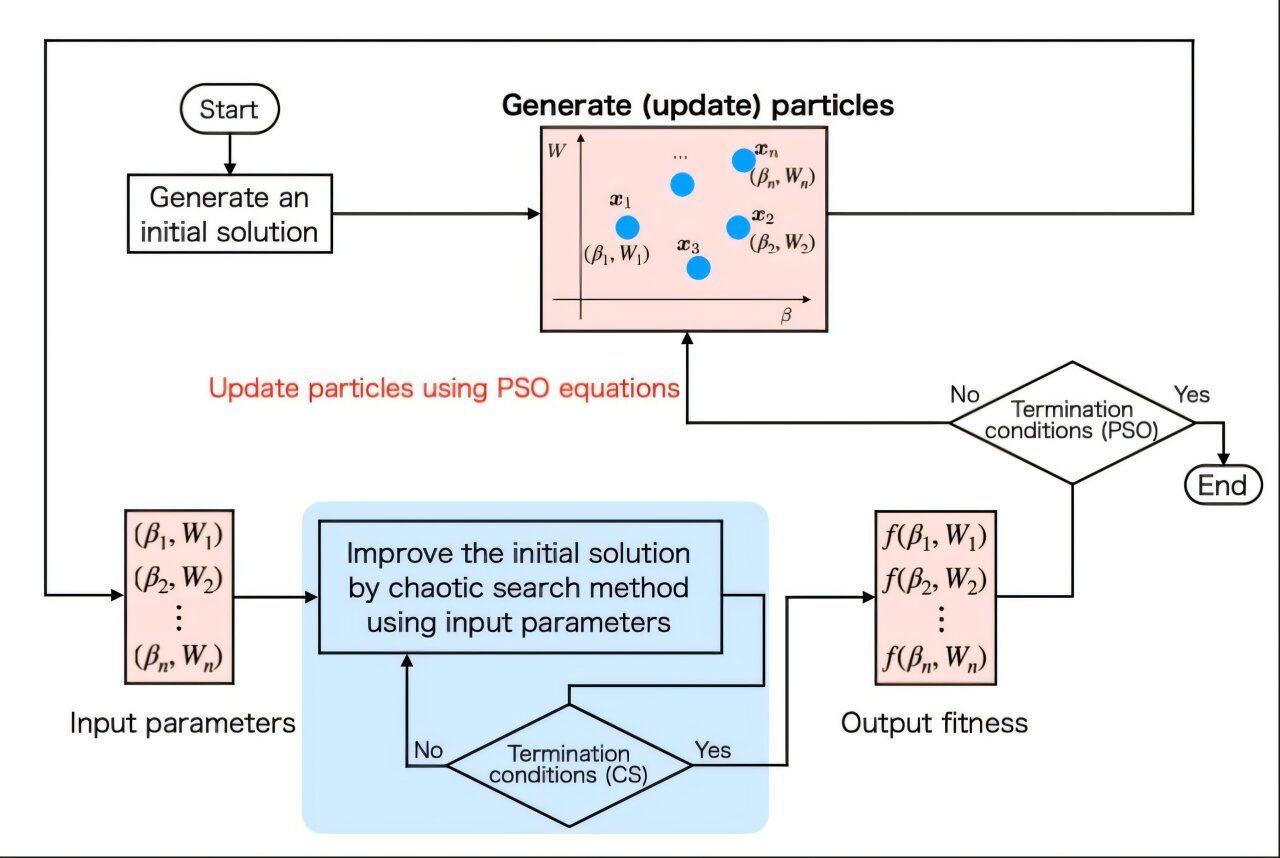
The proposed approach forms a two-layer optimization framework: the outer particle swarm optimization layer handles parameter tuning, while the inner chaotic search improves the solution using the tuned parameters. Credit: Professor Tohru Ikeguchi from Tokyo University of Science, Japan Source link: https://www.jstage.jst.go.jp/article/nolta/17/3/17_1062/_article
Combinatorial optimization problems are often encountered in real-world applications, including logistics, scheduling and network design. These problems involve finding the best possible solution from a finite set of discrete options by maximizing or minimizing an objective function subject to specified constraints. In such problems, the number of feasible solutions increases exponentially with the problem size, making it nearly impossible to find optimal solutions.
To tackle these problems, many heuristic and metaheuristic algorithms have been developed to efficiently obtain approximate solutions. Chaotic search (CS) is one such algorithm that uses chaotic dynamics to search for solutions.
Chaotic dynamics follow precise rules but can appear unpredictable because of their extreme sensitivity to minuscule changes in initial parameters. Unlike purely stochastic methods, CS generates deterministic yet highly irregular search trajectories that can promote thorough exploration of the solution space. This approach can help the search process avoid becoming trapped in local solutions.







 aws.amazon.com