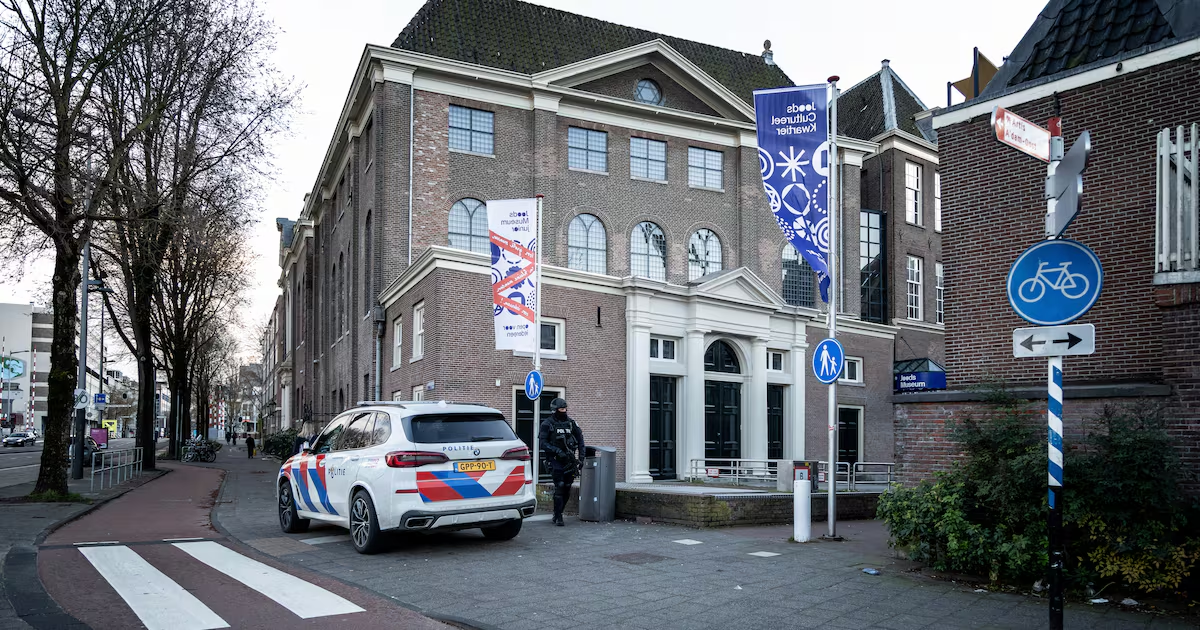
Museum directors say they face a misconception: cultural institutions funded by local taxpayers are often associated with IsraelA police officer stands guard in front of the Jewish Museum on Nieuwe Amstelstraat in Amsterdam. Photograph: Mexx Van Der Lieuw/ANP/AFP via Getty Images Nina SiegalMon Jul 06 2026 - 16:00 • 3 MIN READIn the autumn of 2023, the Jewish Museum of Belgium was drawing crowds to its show of photographs by fashion portraitist Erwin Blumenfeld. Then came October 7th.Attendance at the museum dropped precipitously in the days after the Hamas-led attack on Israel and Israel’s subsequent bombardment of the Gaza Strip.Barbara Cuglietta, the museum’s director, said the building was soon as empty as it had been during the Covid-19 pandemic. School groups stopped visiting, and the public stopped showing up.“I don’t like to use the word ‘boycott,’ but it was like isolation,” she said recently by phone. The next year, attendance plunged to 9,000 visitors.Across Europe, many Jewish museums have seen visitor numbers drop, patrons back away and security threats rise since the autumn of 2023, according to a recent report by the Amsterdam-based Association of European Jewish Museums, a non-profit network of 55 institutions. The association’s members also reported online harassment, vandalism and aggression against staff members.An installation, depicting Jewish historical sites in Munich at theJewish Centre. Photograph: Johannes Simon/Getty Images The root of the problems, said Mirjam Wenzel, the association’s chair, was that many people perceive Europe’s Jewish museums as somehow tied to Israel, when in fact they are largely publicly funded by local governments, ticket sales and sponsorships, and typically focus on the history of Jews on the continent.“We are being attacked as Israeli institutions and identified with the state of Israel,” Wenzel said.In interviews, 10 directors of Jewish museums throughout Europe said their institutions had all felt shock waves after the October 7th attacks. Many agreed that a perceived association with Israel was damaging their institutions. But there were differing opinions on how, or whether, Jewish museums should respond. Museum directors in Amsterdam, Brussels, Copenhagen, Frankfurt and Vienna said they were struggling with lower attendance. But not all museums have experienced the same drop. The directors of similar institutions in Berlin, Paris and Prague said their attendance was flat or had even increased since October 7th, 2023.Paul Salmona, director of the Museum of Art and History of Judaism, in the Marais district of Paris, said his museum’s attendance rose slightly last year and that membership was now at the highest level since its 1998 opening. He noted that France’s Jewish population is the third largest in the world, after the United States and Israel, and said he wanted his programming to reflect the diversity of opinions among French Jews – including about Israel.The Jewish Museum Berlin. Photograph: Nina Ruecker/Getty Images “Of course we are in the centre of Paris in a traditionally mixed Jewish neighbourhood, where Jewish people have lived since the 18th century,” he said. “It might be different in the Paris suburbs.”It is also different in places with smaller Jewish populations. Denmark, for example, has about 2,500 Jewish residents, according to Janus Moller Jensen, director of the Danish Jewish Museum in Copenhagen.Immediately after October 7th, 2023, “there was a huge support for the museum”, he said, but “quite soon after the attack it turned into a very anti-Jewish sentiment, if not outright anti-Semitic attacks”. In 2024, attendance dropped by 37 per cent, he said, and in 2025 it was down by 32 per cent from 2023 levels.“People chose to stay away because they felt that visiting would be a support for Israel, and they associated all Jewish life with Israel,” he said. “We try to explain that we are a state-funded museum of culture dealing with 400 years of Jewish life in Denmark. They make a connection between us and Israel that isn’t there.”A year after the October 7th attack, the Jewish Museum of Belgium closed for a planned restoration . But the construction, organised by the local government, has since stalled.Then came the vandalism. One day in March 2025, Cuglietta, the director, arrived at the museum to find the words “Queers for Palestine” scrawled about 40ft long across the building’s facade.Cuglietta said it only made her want to reopen the museum and get back to her mission of supporting Jewish life in Belgium. She plans to do so in the spring of 2027.“We feel the same level of urgency to be open again and to speak our truth,” she said. “We are not going to be shut down. We are not going to be cancelled.”This article originally appeared in The New York Times.2026 The New York Times CompanyIN THIS SECTION
Fewer visitors, more threats: a new reality for Europe’s Jewish museums
Museum directors say they face a misconception: cultural institutions funded by local taxpayers are somehow associated with Israel
776 words~4 min read