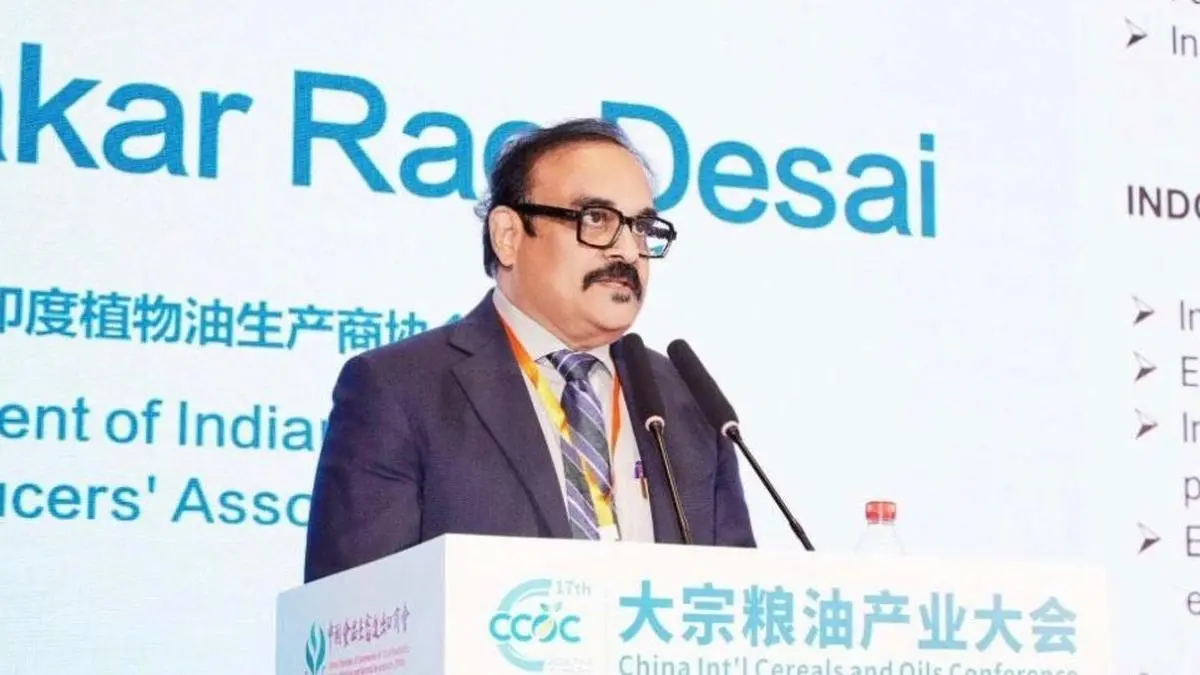
Sudhakar Rao Desai, President of IVPA, speaks at the 17th China International Cereals and Oils Conference (CCOC 17) in Shanghai.
The global vegetable oil industry is entering a new phase where policy decisions, energy markets, climate developments and geopolitics are increasingly influencing production, trade flows and price formation, according to Sudhakar Desai, President of the Indian Vegetable Oil Producers’ Association (IVPA).Speaking at the 17th China International Conference on Oils and Oilseeds (CCOC-17) in Shanghai, he said production of the four major global vegetable oils is projected to increase by 3.1 per cent to around 212.5 million tonnes (mt) in marketing year 2025-26, while global consumption is expected to grow by 1.9 per cent to nearly 211 mt. Although the global supply balance remains broadly comfortable, market direction will increasingly be shaped by policy developments and external macroeconomic factors.Global outlookPresenting his outlook for 2026, Desai said Malaysian palm oil production is expected to reach 19.8 mt, while Indonesian production is projected at 49.3 mt, representing a combined decline of about 900,000 tonnes from the previous year.However, Indonesia is expected to divert around 14.6 mt of palm oil towards biodiesel, assuming implementation of the B50 mandate from July 1, 2026. This would translate into an additional 1.5-1.8 mt of palm oil being absorbed by the biofuel sector compared with the previous year, significantly influencing global trade flows and supply availability.Market direction over the coming months will largely depend on Indonesia’s B50 biodiesel programme, evolving US biofuel policies, crude oil prices, currency movements, weather developments and export policies of major producing countries. While the outlook for the 2026-27 sunflower oil crop remains encouraging, the evolution of El Nino continues to be a key variable influencing global oilseed production and vegetable oil prices, he said.According to Desai, price behaviour is increasingly being driven by macroeconomic developments and policy interventions alongside traditional supply-demand fundamentals. He emphasised that timely market intelligence, effective risk management and continuous monitoring of policy developments will be critical for businesses operating in an increasingly dynamic global marketplace.Price outlookOn the price outlook for the second half of the year, Desai said Bursa Malaysia Derivatives (BMD) crude palm oil futures are expected to trade within a range of RM4,200-4,700 per tonne. He added that palm oil and soybean oil are likely to trade within a relatively narrow price spread. However, supported by favourable global sunflower seed plantings, sunflower oil is expected to lose its current premium of $150-200 per tonne and normalise to a premium of around $50-70 per tonne over soybean oil.Indian scenarioDesai said India consumes nearly 25 mt of edible oils annually, with imports meeting around 60 per cent of domestic demand. He emphasised that improving farm productivity and oilseed yields will be critical to enhancing domestic production, while the southwest monsoon will remain a key determinant of the upcoming oilseed season. He also highlighted the long-term potential of oil palm cultivation in strengthening India’s edible oil security.Desai expects India’s edible oil imports to reach 16.8 mt in 2025-26, comprising 8.5 mt of palm oil, 5.1 mt of soybean oil, 3 mt of sunflower oil, and around 200,000 tonnes of other edible oils.Stating that India and China have significant opportunities to deepen cooperation across the vegetable oil value chain, he said stronger engagement through efficient logistics, complementary market strengths and enhanced commercial partnerships can contribute to more resilient regional supply chains and sustainable growth for both countries.He said that the global vegetable oil industry is entering a more interconnected and dynamic phase where informed policymaking, innovation and international collaboration will play an increasingly important role in shaping future trade and investment opportunities across vegetable oils, oilseeds, de-oiled cakes and other agricultural commodities, including rice, spices and aquatic products.Published on July 6, 2026