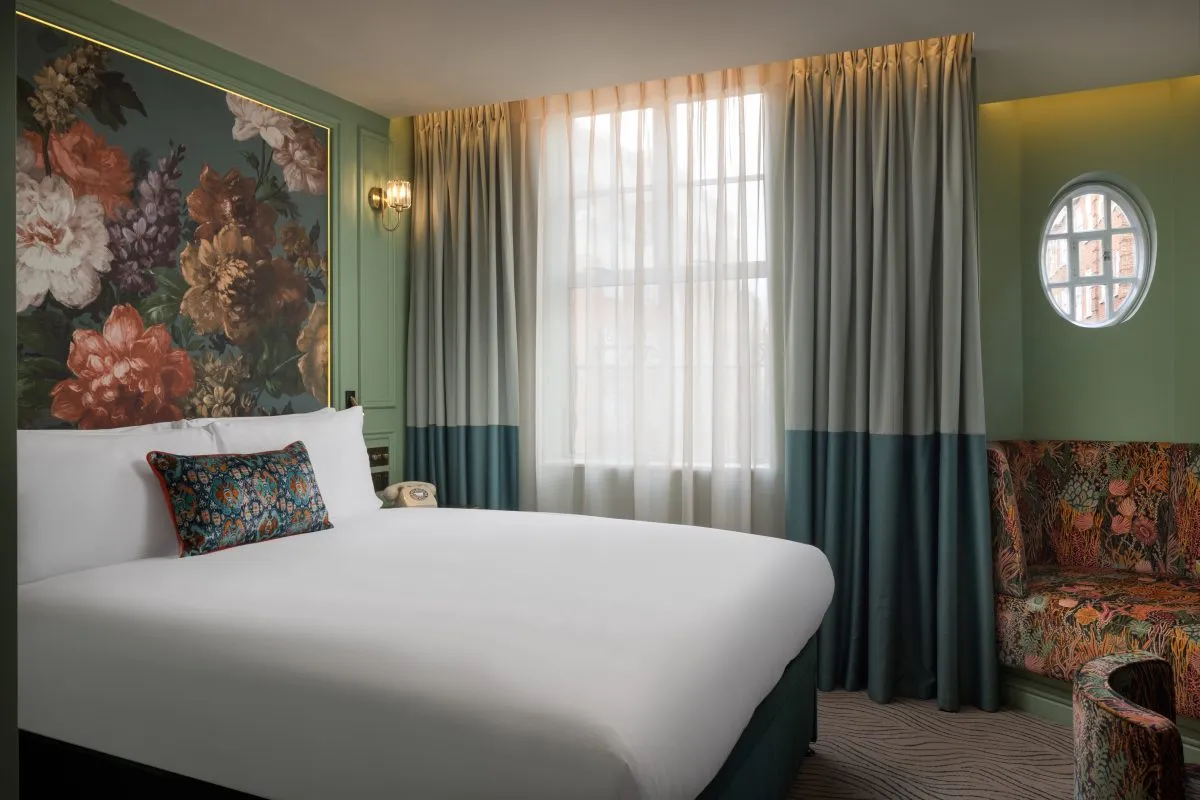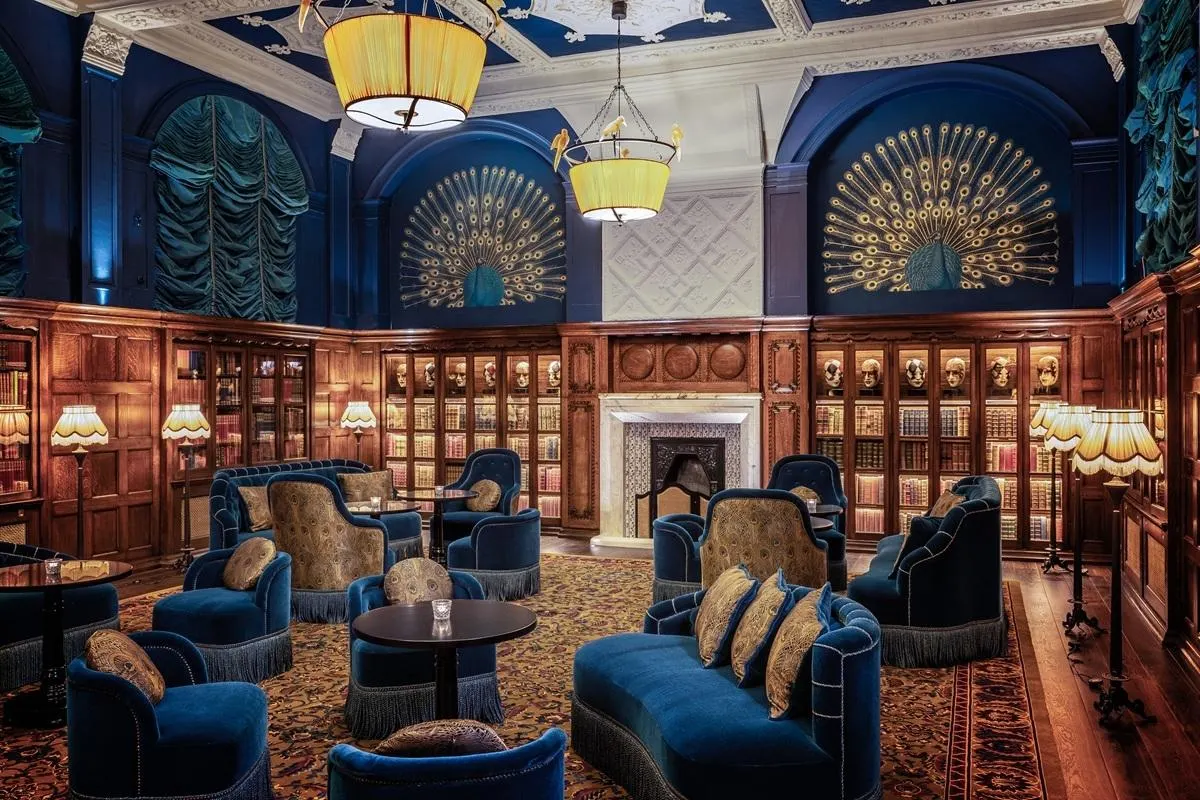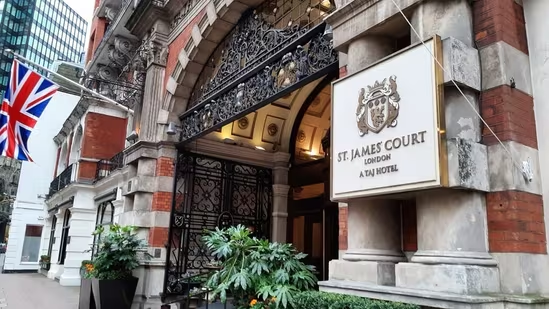
It’s the one London hotel where, over the last four decades, nearly every Indian of consequence from Prime Ministers to superstars like Amitabh Bachchan has stayed. It is also the most successful hotel enterprise ever run by an Indian company in a western country. And yet most of us are unaware of the story of London’s St James Court hotel and its many trials and triumphs.St James Court, a prestigious London hotel, was once in disarray but transformed by the Taj Group. (St James Court)My earliest memories of the hotel are not happy. In 1982 I was flying back to India from New York on Air India. In those days Air India operated one flight a day to Mumbai from New York which stopped in London. You had the option, with certain categories of fare, of breaking your journey in London and getting one or two free hotel nights in London.That was the option I chose, and Air India said I could stay at a new Taj hotel called St James. I had stayed, the year before, at the Taj-run Bailey’s Hotel in London and found it quite acceptable. I imagined that St James, which had a better location than Bailey’s, would be the same sort of establishment.I was very wrong. The hotel was a complete dump; the sort of place that made Fawlty Towers seem like the epitome of luxury. It looked like a two-star property. The rooms were cheaply furnished and hardly ever serviced. The people at reception made it their mission to treat guests badly. Each floor had dirty, dark, interminably long corridors and the staff were crooks.I had booked a taxi to take me to Heathrow for my morning flight to Mumbai. But when I came down to check out, I was told that the car had not turned up. I called the cab service. They said the driver had come to the hotel but had been sent back by the bell desk on the grounds that there was no one of my name staying there.I asked the guys at the bell desk what had happened and they shrugged and denied all knowledge of any taxi. As the minutes ticked away and I risked missing my flight, a bell boy stepped in to tell me that there were no taxis to be had in that area. Fortunately, he said, he had a friend with a cab who could take me to the airport. But, of course, it would cost much more given the scarcity.Also Read | The Taste by Vir Sanghvi: The culture of queuing up outside a restaurantI made my flight but complained to people I knew at the Taj when I got to Mumbai. They were astonished when I said I had stayed at St James. They had just acquired the hotel, they said, and intended to close it down completely for two years during which they would restore and refurbish it. The existing staff (who had been hired when the property was run by Crest Hotels) would be sacked and a new team would be put in place when the hotel reopened.That explained why the staff did not give a damn about service when I stayed there. But it was such a depressing hotel that I doubted that the Taj could do much with it and I told them so.I am not sure when it reopened as a full-fledged Taj hotel, but in 1987 when I could not find a hotel room in London, I called and asked the Taj if they had room. Yes, they did, they said, and they would upgrade me to an apartment at St James Court.St James Court? Yes. They had changed the name. Apartment? This dump had apartments? Indeed, it did.I went to London, stayed in an apartment and ate humble pie. The hotel was unrecognisable from the one I had stayed at five years before. I had a lovely apartment (with a working kitchen, etc) that was not in the main hotel block but in a restored 19th century town house that overlooked a wonderful courtyard behind the main hotel.The food was terrific. The chef and manager from Delhi’s House of Ming were installed at a Chinese restaurant called Inn of the Sixth Happiness and Jean Andre Charial chef-owner of the legendary Baumaniere restaurant in Provence (which had held on to its three Michelin stars for years) ran the first restaurant his team had ever run outside of the mother ship. (In those days, great chefs usually only ran a single restaurant.)Against the odds, the Taj had pulled it off.It’s hard to explain to a new generation what a stupendous achievement this was. In that era the only Indian hotel company to succeed abroad was the Oberoi group which had management contracts for various properties, most of them in the then emerging Middle East. Nobody had succeeded in the West, and certainly no Indian company had actually owned a hotel of this calibre abroad.It was a struggle for any Indian company to pull anything like this off especially because our laws seemed designed to treat anyone who opened a business abroad as a potential criminal.In those days, Indian Hotels (which owns the Taj) was not the large, immensely profitable company that it is today, and it was difficult for an Indian company to remit money abroad anyway. So, the Taj approached private western investors and British banks to supplement its investment which was also not easy.The Taj could not afford to buy a luxury property in the West. So, its aim, as I later discovered, had always been to find a large, undervalued hotel in London, to let Indian architects, designers and engineers do their best with the property and to increase its value as a result of the refurbishment. In the case of St James this was a long and complicated process but Indian ingenuity ultimately won out to the extent that even JRD Tata who had been sceptical about the project from the beginning conceded that the final result was a triumph. The Taj finally had a luxury hotel in London.The years that followed were not always easy. The rich Indians who were the only people who travelled abroad regularly in that era saw no reason to abandon their swish Park Lane hotels. The Taj did not have the international reservations network required to fill such a large hotel with western guests. Nor did the idea of Indian hospitality find much resonance with global luxury travellers. (It is hard to believe now but even three decades after St James Court opened, Orient Express Hotels refused to collaborate with the Taj, which had made a huge investment in their company, on the grounds that its luxury clientele would not be comfortable with a tie-up with an Indian hotel company.)But bit by bit, St James’s Court broke through. Bollywood flocked to the apartments after Amitabh Bachchan took one for an extended period. The Indian High Commission began booking visiting politicians into St. James Court. A succession of Indian Prime Ministers took to staying there on official visits. More and more Indians began travelling abroad and the Taj name attracted them to St James Court.It took a little longer to get international visitors to flock to the hotel and - in my view- the Taj management at the time made very poor decisions. The hotel part of the property (as distinct from the apartments) became a Crowne Plaza. As Crowne Plaza is a mid-market brand aimed only slightly higher than Holiday Inn (which it was a part of), this struck me as being a repudiation of everything the Taj had hoped to do with the property. The F& B operation was partly outsourced to Bank, a London restaurant of no great standing which also aimed at a Crowne Plaza type mid-market clientele. It was as though the Taj management had thrown in the towel.On the other hand, one welcome development was the spinning off of the apartments into a separate brand called 51 Buckingham Gate which remained a Taj-managed luxury operation. The result was that everyone of note flocked to 51 and pretended that the Crowne Plaza operation did not exist.I don’t want to be too judgmental about these decisions because I don’t know what the financial pressures were, but the consequence was that, for several years, I moved out of St James’s Court.I have been back for a while now. The Crowne Plaza arrangement was, fortunately, not renewed and the hotel part of St. James Court has recovered its standing after it resumed being a Taj hotel. The disastrous decisions about F& B have also been revisited.For some years, the only place where you could eat well there was the excellent Quilon which oddly enough is also outsourced: It’s owned by a different Tata company which also owns Bombay Brasserie a standalone restaurant and is not considered part of the hotel’s F&B operations, though it is a part of the larger Taj group.Quilon is still flourishing but Bank and the others are out. In a (perhaps unintentional) nod to the opening philosophy The House of Ming is back, this time under its own name. The hotel has taken back the space leased to Bank and runs its own casual restaurant. There is a new bar and a Chambers has opened.For me though the highlight of the F&B operation are the South Indian breakfasts. I always get into trouble when I say this, but I believe they are better than the breakfasts the Taj serves at its Indian hotels.I know Indians who resist the charms of the St James Court complex. The most common argument is that you run into too many high-profile Indians in the courtyard outside 51. That’s probably true. (Though many people see this as an advantage.) But they are the same sort of people you bump into in the premium cabins on the Emirates flight to London. And I don't know anyone who would rather travel British Airways as a consequence.I stay at 51 Buckingham Gate now for two primary reasons. The first is that it offers personalised luxury service which must be hell to manage in a country like the UK with its own not-so-great service culture and with a smaller number of employees than an Indian luxury hotel would have.The second is that the apartments are well designed with their own kitchens and comfortable bedrooms. I haven’t stayed in the hotel part for a while, but I used to like the rooms there except for a small number of ‘petite’ rooms ( much cheaper than normal rooms) which I found cramped.I was back there last week and 51 was as good as ever. I have stayed in most of the Park Lane hotels that Indians used to frequent (the Four Seasons, the Intercontinental, the Dorchester, Grosvenor House etc) and not one of them offered as comfortable and enjoyable an experience as 51.The buildings that make up St James Court were built in the 1890s at almost the same time as the Taj Mahal Hotel in Mumbai. Sir Jamsetjee Tata built the Taj to show the Brits, who would not allow Indians to enter their fancy hotels in Mumbai, that we could do a better job than them. He succeeded and most of the great British-only hotels in India went bankrupt and closed down. But the Mumbai Taj has remained the greatest hotel in South Asia.In London too, the original St James hotel hit hard days. Its beginnings as a place for the smart set were gradually forgotten and it became a badly run, inexpensive hostelry.It’s a fitting tribute to the spirit of modern India that it took the Tatas to come to London to rescue the St James hotel. It was the Brits who ran it to the ground. And it was Indians who resurrected it.I won’t pretend that I stay at St James Court only out of patriotism. I stay there because it offers a great experience. But it’s hard to walk from Buckingham Palace, which is a stone’s throw away, to St James Court, to see the tricolour flying majestically over a grand 19th century British building and to not feel a tinge of national pride.
The Taste by Vir Sanghvi: The resurrection of St James Court, how Taj transformed a London hotel into a luxury icon
London's St James Court hotel's resurgence reflects the triumph of Indian hospitality in the West and serves as a symbol of national pride.
2,037 words~9 min read