Every time I get an opportunity to speak on artificial intelligence (AI) at a conference, I run away because I feel hollow and inadequate. Then I see some of my industry peers telling the world how they are acing it, even though the reality is different. The need to sound AI-savvy has gripped the ecosystem so much that we have made the saying “fake it till you make it” our motto. You cannot really blame people as the AI pioneers, Wall Street influencers, Silicon Valley startups, and prominent VCs have collectively caused a lot of fear-mongering.The Silicon Valley pactThe founders of the two frontier AI giants, on which collectively $312 billion has been invested, began by forecasting that millions of jobs would be lost in the future. Maybe Anthropic and OpenAI know better about the future of what they are developing; however, between them, they have added about 4,000 employees in the last 12 months, of whom a majority are engineers. Some prominent voices in Silicon Valley, such as Vinod Khosla, have said that by 2030 there will be no such thing as IT services or BPO.Perhaps Silicon Valley startups, VCs, large MNC honchos, and Wall Street bankers have their own financial interests to protect and promote. After all, corporate America’s investments in AI over the last three years have been steadily increasing.Picture this: In 2024, enterprises spent over $252 billion on AI; in 2025 it rose to $427 billion, and in 2026 it is estimated to reach $725 billion. Over the last three years, VCs have invested $560 billion in AI startups — that’s about 75 per cent of their total investments. Obviously, they will tell the world that AI will do almost everything a human can.However, Palantir CEO Alex Karp’s recent outburst on CNBC was one of the first major voices of dissent against these frontier companies. Palantir has been a major beneficiary of the AI boom, with its market cap exploding from $20 billion two years ago to about $270 billion now.Karp criticised major AI labs for utilising token-based pricing models that extract enterprise value without delivering measurable business results. He contended that this “tokenmaxxing” model forces businesses to overspend while relinquishing proprietary data, and advocated for the use of open-weight models to maintain in-house control. He went on to say that leading Fortune 500 CEOs have privately shared their frustration over the business model of frontier AI companies.IT services conundrumEvery new version release from LLM companies has sent the stock prices of large global and Indian IT services companies plummeting, eroding our trust in these system integrators’ business model.Such is the power of the trillions of dollars of AI narrative that we no longer want to believe in the Indian software industry, which exported over $200 billion worth software services in 2025.Then we heard the counter: Mark Cuban, the billionaire investor of business reality TV show Shark Tank fame, said the biggest financial opportunity in AI is not in building the base models but acting as an “integrator” that implements and customises AI for small and medium enterprises and the unique workflows of businesses. He highlighted that out of 33 million businesses in the US, many millions lack dedicated AI budgets or in-house experts.This was corroborated by current Infosys Chairman Nandan Nilekani, who views AI as a massive “force multiplier” rather than an existential threat to the IT industry. He recently commented that AI is a catalyst that makes IT firms more relevant and predicts a $300–400 billion AI-first services opportunity by 2030. Do you want to trust the analysts and investors who have caused the leading IT services market cap to halve from its peak, or the industry doyens who are confidently holding on to their services model, knowing their customers better?The boomerangOf late, there has been a change in the discourse around AI. For instance, Microsoft CEO Satya Nadella, on a podcast with LinkedIn co-founder Reid Hoffman, pointed out that “saying all economic opportunity will go away for white-collar workers” while simultaneously asking the public to embrace the technology is a massive social misstep. He mentioned that the industry needs to stop making broad, threatening claims about the future of work and instead demonstrate tangible, positive benefits.American automaker Ford recently brought back roughly 350 veteran engineers after its automated quality control systems failed to deliver expected results. Charles Poon, Ford’s vice-president of vehicle hardware engineering, told reporters the firm’s AI-driven checks had failed to live up to expectations.Venture firm SignalFire’s latest ‘State of Talent’ report shows engineers comprised 55 per cent of all new hires in 2025 across the 12 “tech majors” — Alphabet, Meta, Apple, Amazon, Microsoft, Netflix, Nvidia, Tesla, Uber, Airbnb, Block, and Stripe. This is a significant jump from 46 per cent in 2019.It definitely isn’t a good time to be an employee in the AI world.Think of an entry-level employee at an IT firm and how secure they would feel about their job after the AI-attributed layoffs at brands like Coinbase, Block, Meta, Atlassian, Intuit, and Cloudflare, to name a few?I was listening to a podcast where Nitesh Arora, CEO of Palo Alto, said it’s like a Darwinian moment: everybody has to figure out how good they are and learn on their own. He added that 90 per cent of employees at large companies aren’t AI-savvy.Employer vs employeeAI has increased distrust between employees and employers. Maybe employees think the employer has to train them, and the employer believes the onus is on employees to learn for their own survival.McKinsey’s 2026 AI Trust Maturity Survey shows that Responsible AI (RAI) maturity scores are still at 2.3 out of 4. It added that organisational governance and strategy lag the rapid shift toward “agentic AI”. Only one-third of enterprises have mature governance in place. According to Gallup, between 2025 and 2026, the share of Gen Z respondents who said AI made them feel angry rose by nine percentage points, while feelings of excitement and hopefulness declined.AI’s context for enterprises and employees has turned into a ‘Truth or Dare’ game. Your appetite for risk will allow you to explore this puzzle till some convincing case studies of transformation enlighten us. For now, we are all enamoured by the technological marvel of AI. Trust remains absent from the ecosystem!(Kamal Karanth is the co-founder of Xpheno, a specialist staffing company)Published on July 6, 2026
Corporate trust in AI declines
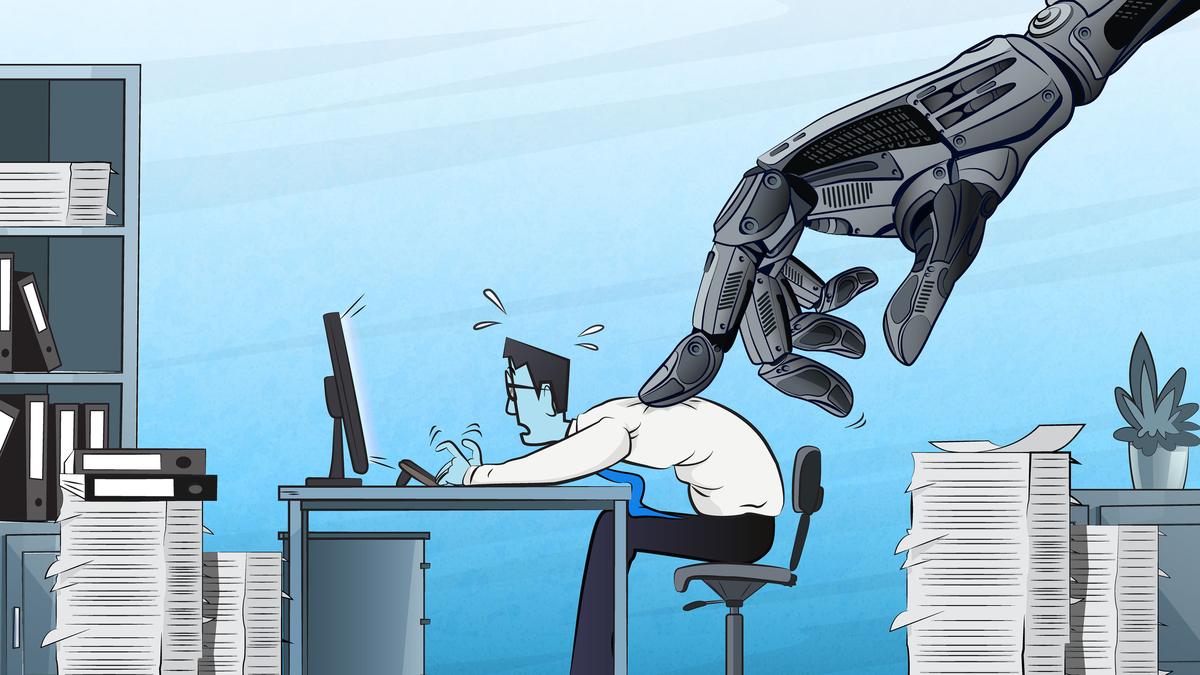
Corporate trust in AI is declining as businesses reassess investments amidst concerns over job security and unfulfilled promises.
1,058 words~5 min read