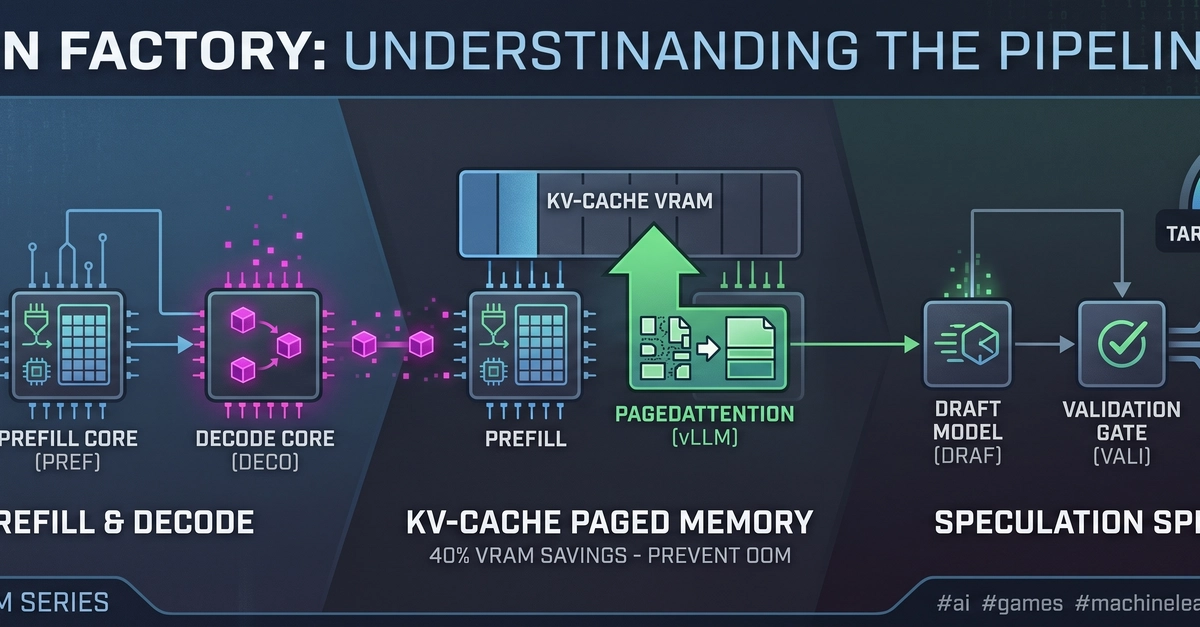
Have you ever wondered how high-performance LLM deployment frameworks like vLLM, TensorRT-LLM, or Hugging Face TGI actually optimize model serving? While you wait for tokens to stream into your chat window, the infrastructure under the hood is executing a fragile balancing act: scheduling prompt pre-computation, paging memory segments, verifying speculative token chains, and dodging system-stalling bottleneck crashes.
To teach you how LLMs are deployed, optimized, and served under high concurrent loads, I built an interactive factory simulation game:
Play in Fullscreen Mode (if the embed sizing is tight)
Your journey as an infrastructure architect is split into three distinct serving terminals, each introducing advanced optimizations:
This isn't just a basic puzzle game—every component, routing direction, and memory rule represents a real-world concept in modern machine learning infrastructure. Here is how the in-game mechanics map directly to how large language models are optimized and served in production: