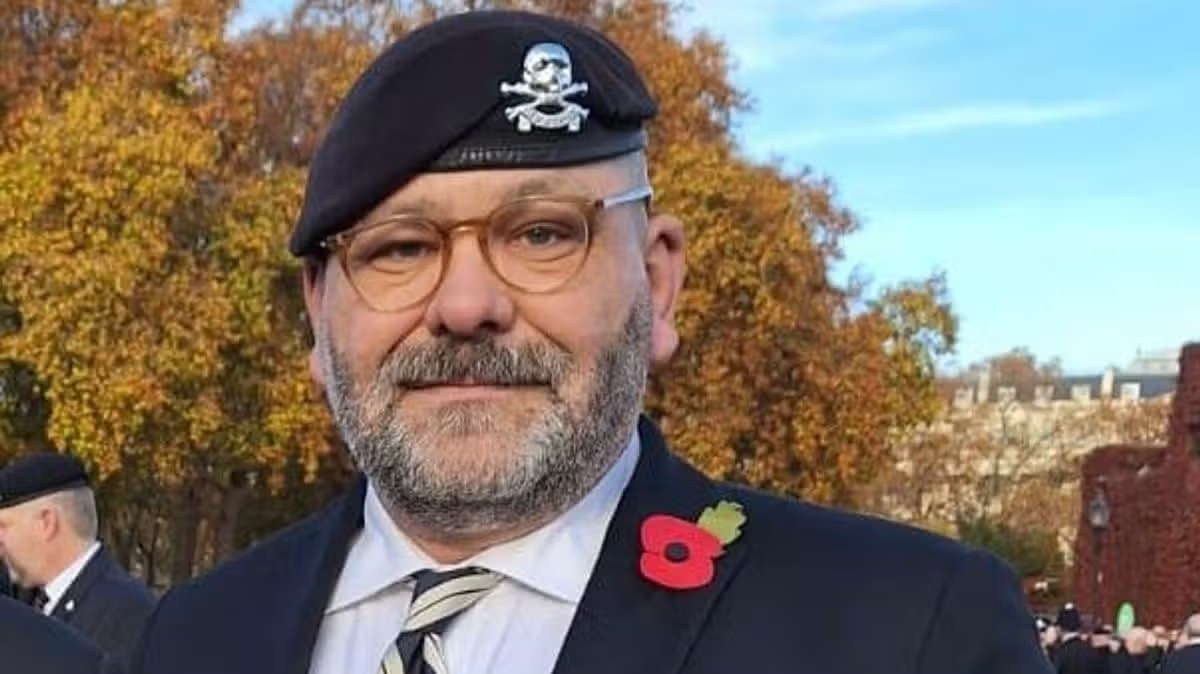
A cruel armed forces 'gay ban' saw thousands forced out before 2020. Now veterans are being warned a deadline for compensation is looming17:43, 05 Jul 2026Veterans driven out of the armed forces for being gay are being urged to apply for compensation before the deadline.The Royal British Legion and veteran Lee Buss-Blair, are urging former services personnel to get their applications into The LGBT Veterans Financial Recognition Scheme before the December 12th cut off.There was a ‘cruel’ and ‘unjust’ blanket ban on homosexuality in the UK Armed Forces until 2000, which left those serving facing intrusive investigations, bullying, abuse, dismissal or even jail.Now those personnel who were hurt during their time in the armed forces because of their sexual orientation or gender identity between July 27th, 1967, and January 11, 2000 can get a payout of up to £50,000.Veteran Lee, now 55, who works for Riverside Housing, joined the army in 1986 - 14 years before homosexuality was decriminalised.“I loved my time in the service, but it came with the very real fear of not only losing a job I loved because of my sexuality but going to prison for it as well.”For 25 years after he was dismissed he lost contact with the forces, feeling he “didn’t belong” and “ wouldn't be welcomed”.But Lee’s involvement with the Etherton Report, commissioned by the Government to look at the treatment of LGBT+ veterans who served under the ban, ended up with him reconnecting.It made Lee, who was dismissed from the army for being gay - or ‘services no longer required' - realise he wasn’t alone."I used to say for years, I'm too gay to be a squaddie, but too much of a squaddie to fit in in the gay scene. I never felt that I truly belonged anywhere," Lee said.But about four years ago he attended Brighton Pride, marching with the RBL, serving personell and behind the band of the Royal Marines in front of us."I'm getting goosebumps just speaking about it now. I realised there was a huge chunk of me missing, that was suddenly whole again," he said, speaking during Pride month.“It had a real impact. I started to come back into the fold of my military family and from a psychological point of view it’s had such an amazingly positive impact on me. It was so healing.“Do you know, for decades, I had felt that my identity as a veteran and my identity as a gay man were two separate identities that didn't necessarily gel, but for the first time, marching in Brighton, I didn't feel like there were two competing identities.“I felt like I was a gay veteran. For the first time, I felt like a whole person.”Hannah Pearce, the Royal British Legion’s Director of Campaigns, Policy and Research, said: “The ‘gay ban’ was cruel, unjust, and led to the discrimination and abuse of thousands of LGBTQ+ people in the Armed Forces community who had dedicated their lives to serving their country and were forced to leave the military.“The Royal British Legion condemned this mistreatment believing their service and sacrifice should be rightfully recognised and honoured.“We were pleased the Government accepted Lord Etherton’s Review recommendations including a formal apology from the Prime Minister, restoration of medals, uniforms and berets, and the creation of a memorial at the RBL’s National Memorial Arboretum honouring LGBT Serving and ex-Serving personnel.“The Financial Recognition Scheme is one of Lord Etherton’s key recommendations addressing this injustice and we urge anyone who served under the ban to contact the Royal British Legion or Fighting with Pride, we can help them to apply to the scheme before it closes in December.”Lee was deployed to the Gulf War in 1990, where he served in the reconnaissance troop close to Iraqi front lines in a lightly armoured Scorpion vehicle.Lee reflected “you're in an exposed area without a huge amount of, like, protection. I can't remember the life expectancy they'd given us, but it wasn't long.”Lee left the army in 1992 without revealing he was gay and became a hospital healthcare assistant.Four years later he was called up as a reservist and volunteered “in a heartbeat”. He was sent to Bosnia, where he drove an armoured ambulance.Lee had been living as an openly gay man for five years, but the ban was still in place in the Armed Forces.“I promised myself that I would not deny my sexuality, but at the same time, I wouldn’t necessarily discuss it,” he recalls.There his Commanding Officer threatened to charge him for wearing a tongue piercing. Lee decided he’d given up enough of his identity for the army, and refused and suggested “he charge me for something worthwhile and told him I was gay.“He was just like, ‘oh, okay, well stop the meeting’ and then later that day I got called into the commanding officer, who asked me to repeat what I had said…It took quite a while to process my discharge and in that time everyone knew and the people I served with, the ordinary soldiers, no one seemed to care.“I didn't experience any homophobia, any aggression, quite the opposite actually. People were genuinely interested…Apart from the officers. “His discharge stated: ‘Services No Longer Required’ (SNLR) - wording which held a stigma and meant he was struck off the reserve list.“The injustice continued because my opportunity to serve was taken from me. This basically means that there is something which makes you unsuitable for military service, you're not good enough to be a soldier.”He has now had his military records updated which meant he could go back on the Reserve List and, despite being 54, with only a few months until he would reach the upper age limit, he did.“The issue that I experienced serving as a gay man was living in constant fear of getting caught and going to Colchester the military prison because you’d heard some really hideous stories about the nature of the treatment. Physical assault and psychological torture.“So you live in constant fear so you kind of knew that there was a risk of harm, a risk of physical psychological harm from being caught.Article continues below“When I started to engage more and be around more veterans who had been discharged, I started to realize just how lucky I was.“Some people’s experiences are truly shocking not just from the psychological point of view but from the physical and even sexual assaults, just truly horrific.“This is why I think that financial reparations are really important…that level of psychological and physical impact deserves to be recognised with a financial form of compensation. "
LGBT veterans warned about a deadline for compensation
A cruel armed forces 'gay ban' saw thousands forced out before 2020. Now veterans are being warned a deadline for compensation is looming
1,093 words~5 min read