See more Daily Mail on Google - save us as a Preferred SourceBy JAMES TAPSFIELD, UK POLITICAL EDITOR Published: 15:27 BST, 5 July 2026 | Updated: 15:38 BST, 5 July 2026
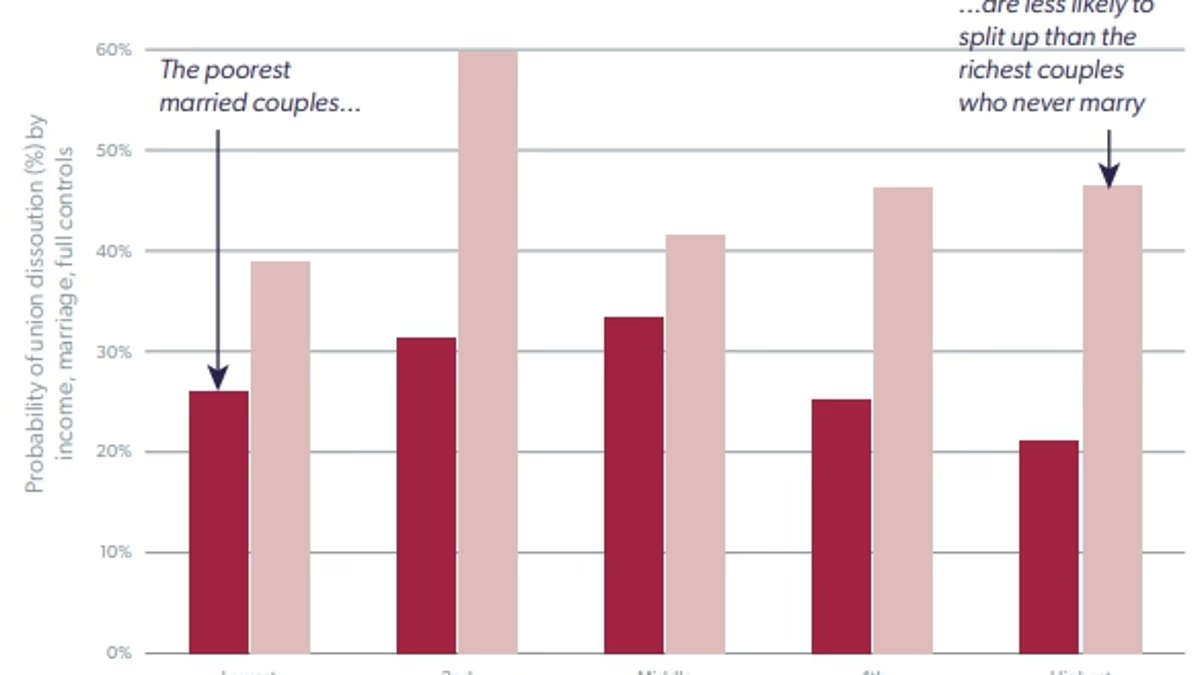
Single mothers are around £10,000 a year worse off if they marry due to a 'couple penalty' in the benefits system, according to a think-tank.Welfare rules can mean people take a significant financial hit if they choose to wed or even just move in with a partner.A report from the Centre for Social Justice looked at scenarios including a single mother aged 30 who is out of the workforce looking after a one-year-old child. It found they would be around £5,700 a year poorer from living with someone who earned a £20,000 salary. If the partner was on £30,000 the impact would be even larger at £9,600. The change happens because most benefits are based on household incomes, instead of individual incomes. A lone parent would be eligible for the standard Universal Credit (UC) allowance, as well as the child element and housing support. After analysing the Millennium Cohort Study, the CSJ report concluded that over the first 14 years of parenthood 26 per cent of couples in the poorest fifth of households who marry split. That was lower than the 46 per cent who separate among the richest fifth who never marry.Dr Harry Benson, a researcher who wrote the Stability Advantage report, said the system 'is effectively discouraging the very behaviour that could reduce long-term poverty'. Policymakers needed to recognise that 'marriage itself is associated with a substantial reduction in the risk of union dissolution', he argued.After analysing the Millennium Cohort Study, Dr Benson concluded that over the first 14 years of parenthood 26 per cent of couples in the poorest fifth of households who marry split.That was lower than the 46 per cent who separate among the richest fifth who never marry.'The finding that poorer married parents are more stable than richer unmarried parents challenges a deeply embedded assumption in policy thinking,' Dr Benson said.'It suggests that family structure is not merely a consequence of economic conditions but an important determinant of them. 'It also demonstrates that family stability is closely linked to economic mobility, with separation acting as a key driver of downward movement and stability supporting upward progress.' The report looked at the influence of couples stay together on their economic fortunes Dr Benson said a poverty-reduction strategy that ignores family stability 'will remain incomplete'. 'The task for policymakers is therefore to ensure that the system supports, rather than undermines, long-term commitment,' he wrote. 'Addressing the 'couple penalty' and redesigning early years support are practical steps toward that goal. In doing so, the Government can help create the conditions in which more families are able to form, endure, and thrive.'