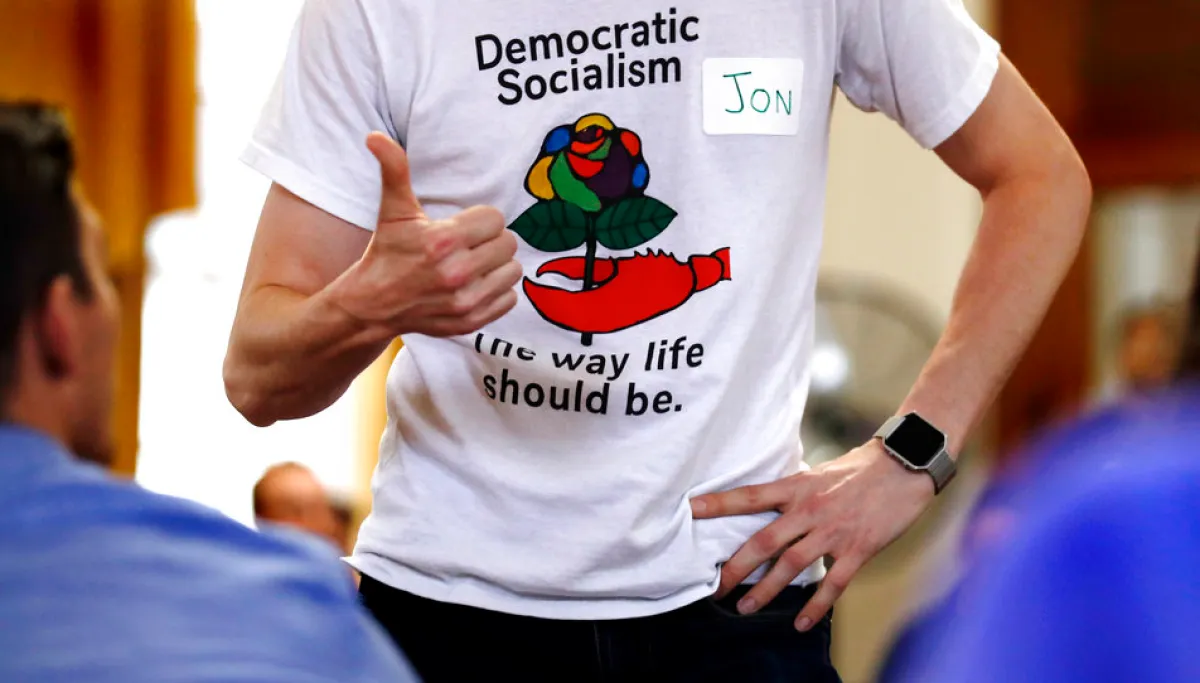
President Donald Trump has repeatedly referred to New York socialist candidates as communists, and House Speaker Mike Johnson (R-LA) has warned that Marxist ideology is becoming more influential inside the Democratic Party. Other Republicans and political commentators have also referred to socialist candidates with the same distinctions. A slew of socialist victories in recent Democratic primaries has sent a ripple of fear through both major political parties, with “socialism,” “communism,” and “Marxism” being thrown around in equal measure, but how is each defined?
One family tree
Modern socialism, Marxism, and communism all trace their origins to the writings of 19th-century German philosopher Karl Marx and his collaborator, Friedrich Engels.Marx argued that capitalism concentrated wealth among owners while exploiting workers. He believed that history advanced through conflict between economic classes and predicted that capitalism would eventually give way to socialism before ultimately reaching communism. Eric Patterson, president and CEO of the Victims of Communism Memorial Foundation, said Marxism is best understood not simply as an economic theory but as a comprehensive worldview. “Marxism is a — it’s a worldview,” Patterson told the Washington Examiner. “It’s an ideology, and what I mean by that is they have a theory for everything. They’re not saying we just explain economics. They say we explain politics, economics, human anthropology, the meaning of life in the universe, everything. They’re a fully fledged ideology.” Patterson said that Marx envisioned socialism as an intermediate stage in a broader historical process. “We’re going to change socio-political systems from old agrarian feudal systems to a modern capitalist system, then to a socialist system where government takes over all of the economic parts of life, and then over time, government will take over all parts of civic life, and that is communism,” Patterson said. In Marx’s writings, communism represented the final stage of society: a classless, stateless system without private ownership of the means of production.Modern experts, however, generally distinguish between Marx’s theoretical writings and the many forms that socialism has taken over the past century. Today’s socialist candidates typically advocate expanding labor protections, strengthening unions, increasing public spending on housing and healthcare, and reducing economic inequality through elections rather than revolution. Communism, meanwhile, has become associated with governments that claimed to pursue Marx’s vision, including the Soviet Union, Maoist China, and Cuba. That distinction helps explain why politicians often disagree over terminology. Socialists in 2026 generally reject being described as communists, arguing they support constitutional democracy and competitive elections. Republicans frequently counter that socialism and communism exist on the same ideological continuum because Marx himself described socialism as a transitional stage. Why Republicans make the connection