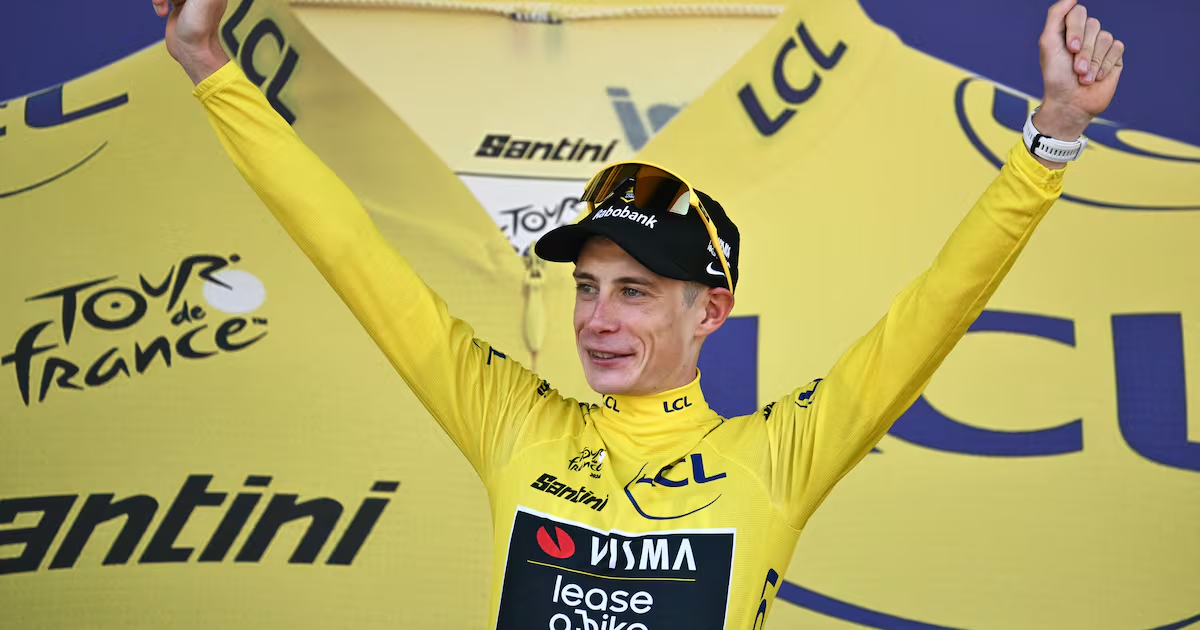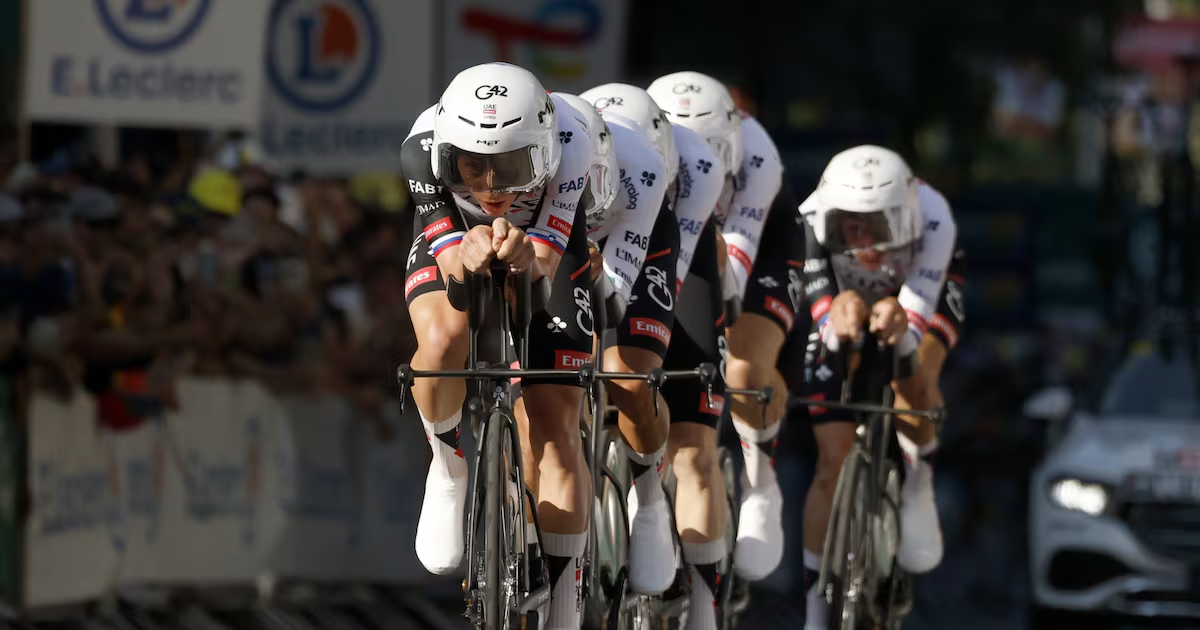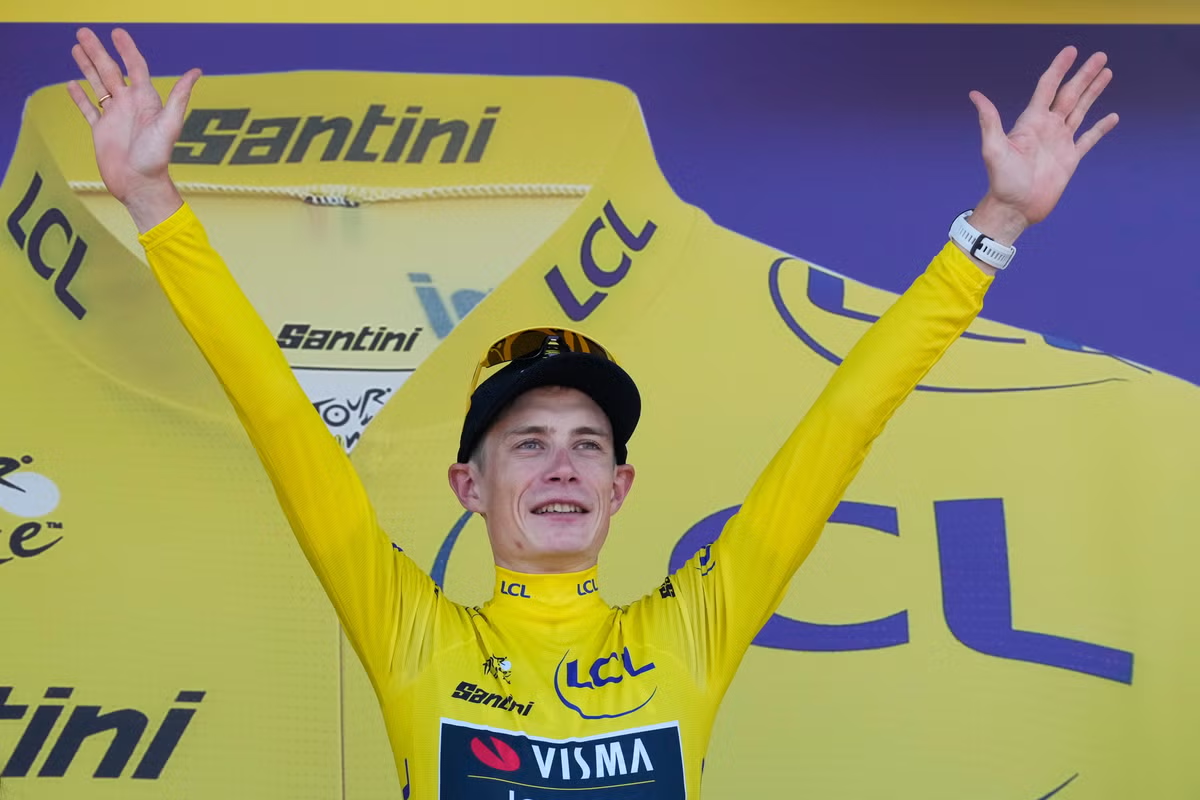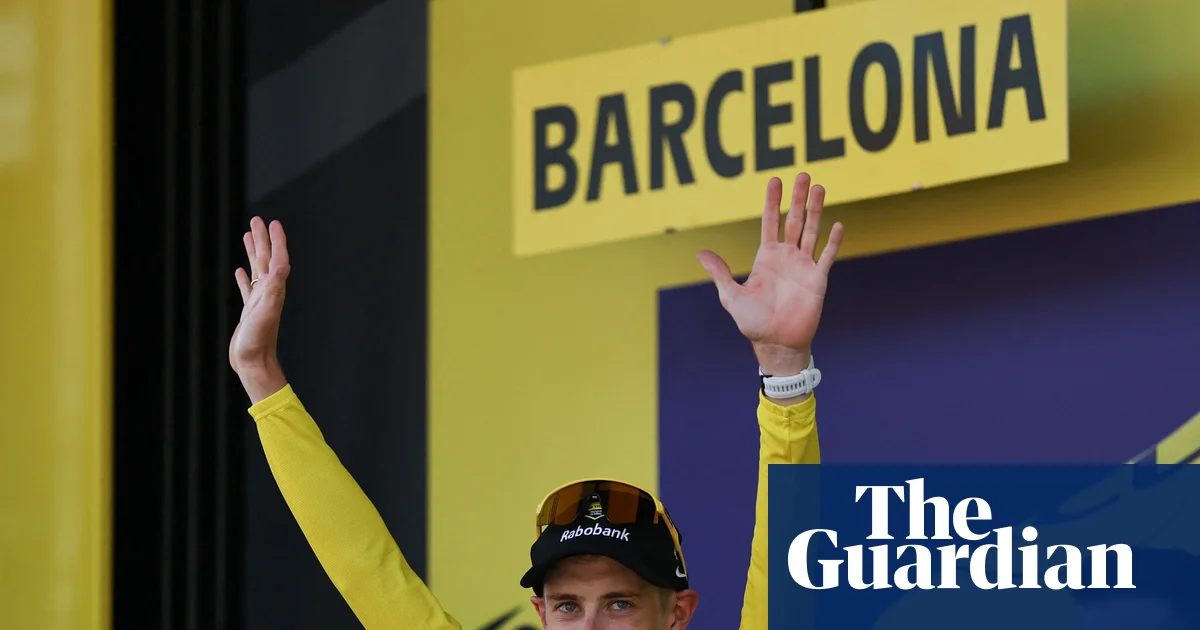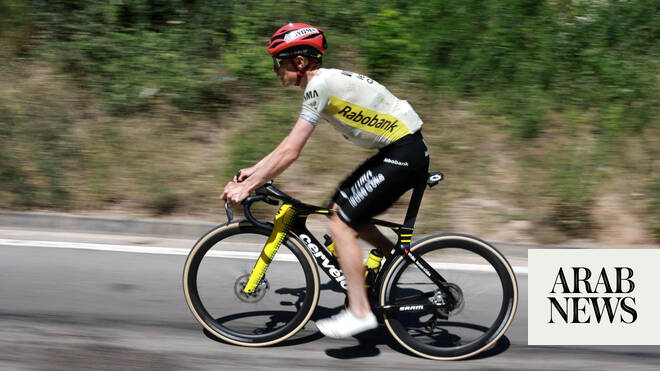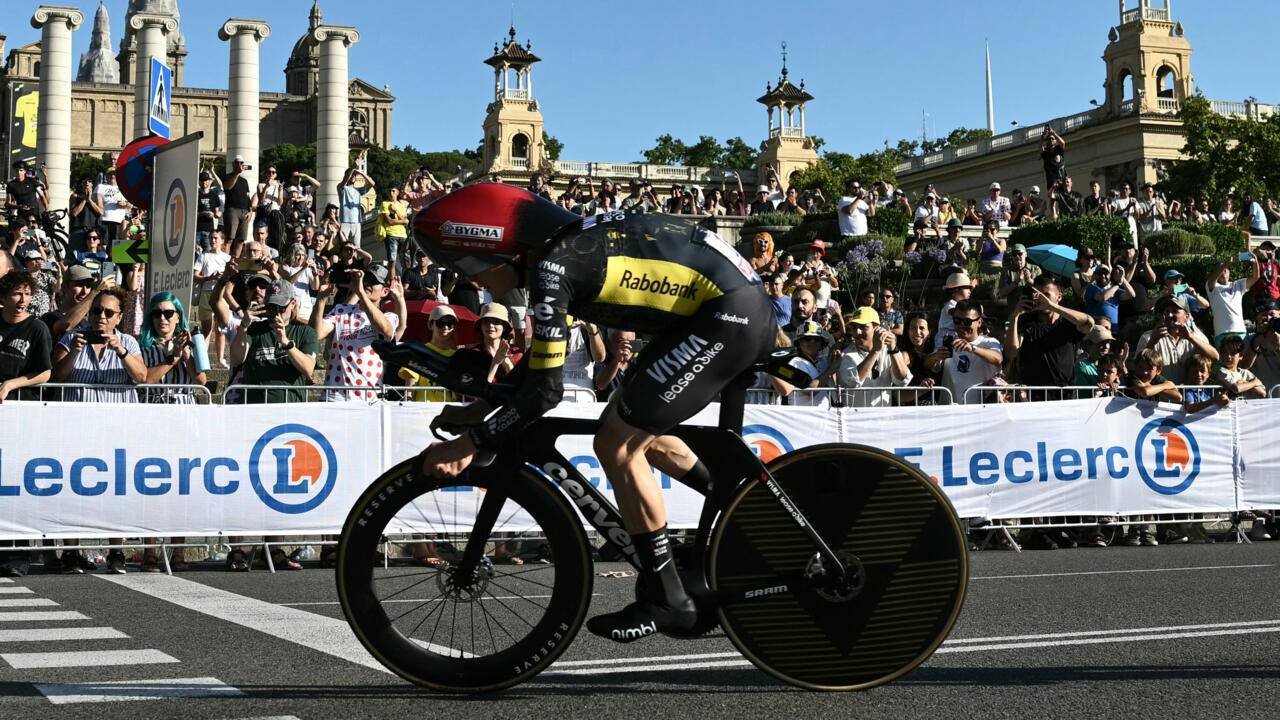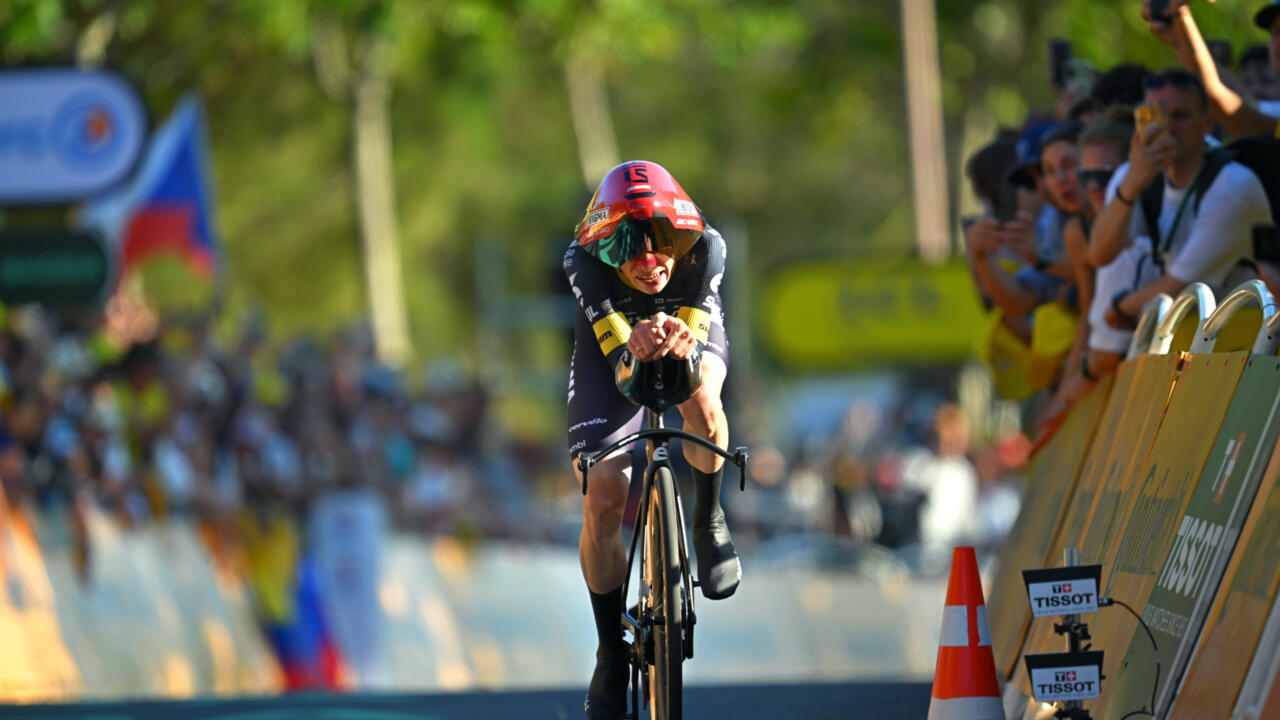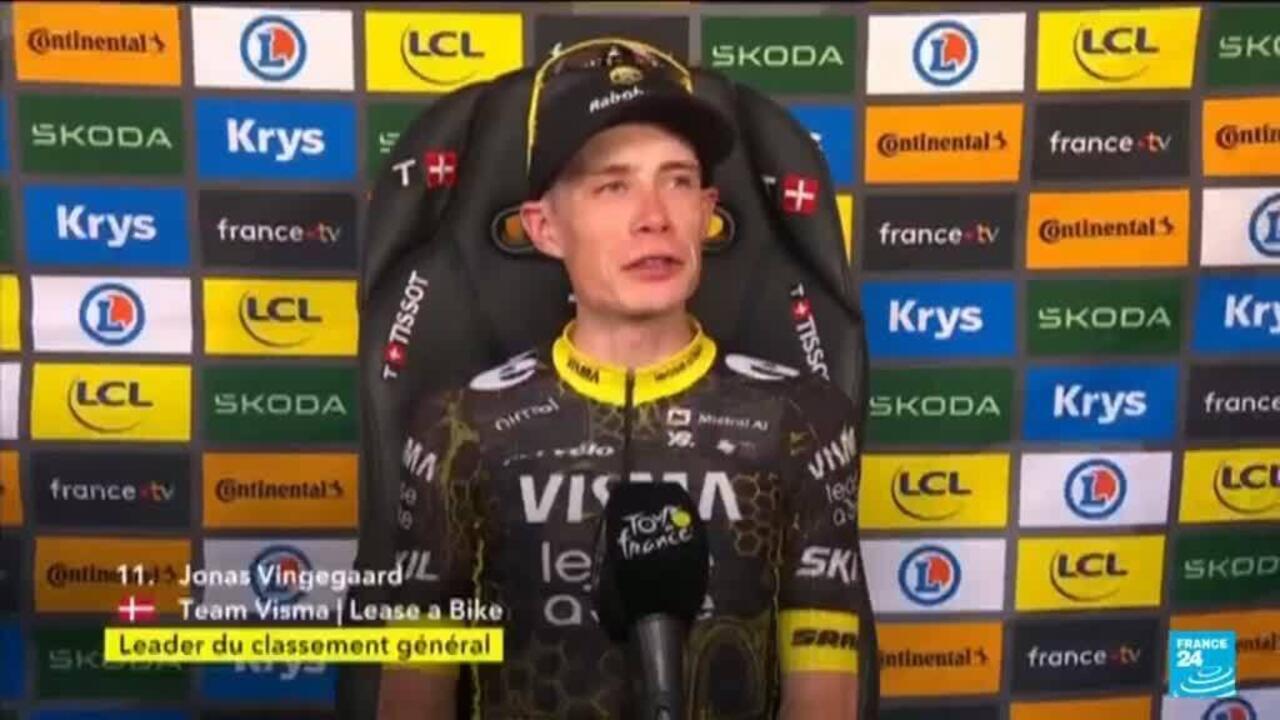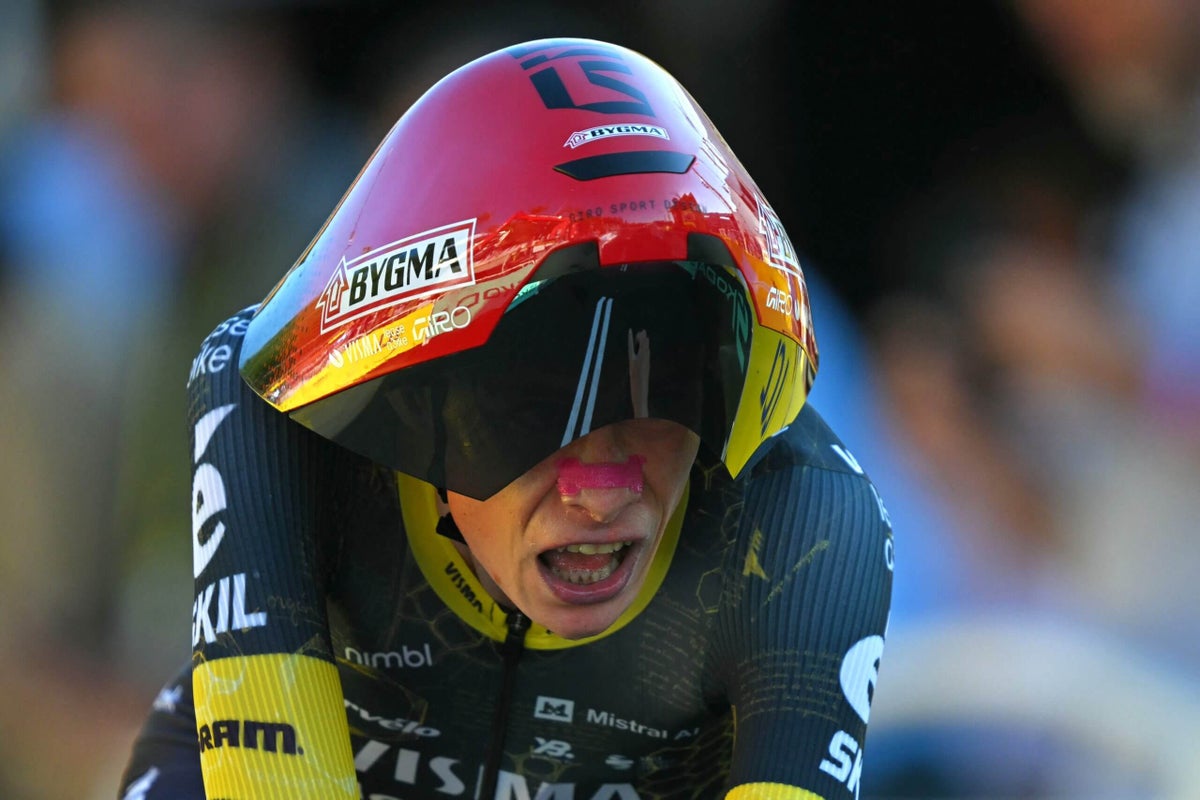
Jonas Vingegaard has won his first battle of the summer with Tadej Pogačar, taking the yellow jersey with an 12 second advantage over his old adversary after Saturday’s opening team time trial in Barcelona.Featuring two short climbs on the famous Montjuic hill, and finishing at the Olympic Stadium, the 19.5km course took Vingegaard’s Visma-Lease a Bike squad in 21 minutes and 47 seconds, with Netcompany-INEOS seven seconds back in second, and UAE Team Emirates in third.Elsewhere, general classification contenders Juan Ayuso (Lidl-Trek), Remco Evenepoel and Florian Lipowitz (Red Bull-BORA-hansgrohe) and Paul Seixas (Decathlon CMA CGM) all produced good performances to stay within forty seconds of the leading pair.It is Vingegaard’s first time in yellow since his last Tour de France win in 2023 — and comes with hilly terrain to come across this Catalan Grand Depart in stages two and three.Jacob Whitehead analyzes a fascinating first day at the 2026 Tour de France.Vingegaard into yellow after dominant Visma performanceThere was a bullish mood at the Visma-Lease a Bike team bus before the race — team officials openly talking up Vingegaard’s condition, and the Dutch squad’s chances of delivering him to his third Tour de France title this summer.This has been a mixed season for them. Vingegaard’s victory at the Giro d’Italia in May, allied with Wout Van Aert’s cathartic win at Paris-Roubaix, has delivered two key objectives but the surprise departure of head of racing Grischa Niermann to Lidl-Trek was a blow.Internally-promoted Marc Reef is highly-rated however, whilst Visma’s development and research programme is still the envy of much of the peloton. It means that a team time trial is a race in which they are expected to excel, having won the TTT at Auvergne-Rhône-Alpes (the renamed Criterium du Dauphine) last month.Behind Netcompany-INEOS at the first checkpoint after five kilometres, Visma then led the rest of the way, exploding up Montjuic with Vingegaard in the closing kilometres, with the 29-year-old Dane overtaking Red Bull’s Nico Denz in the final metres. After a couple of disappointing individual time trials in recent Grand Tours, this was a marker of his condition, one that needed to go up a further step from his Giro win.Visma Lease a Bike rode almost the perfect race on Saturday (Anne-Christine POUJOULAT / AFP via Getty Images)His stage win is a historic moment, having taken yellow as the reigning Giro and Vuelta a España champion, the first time a Giro winner has taken yellow on stage one since Miguel Indurain in 1993. The legendary Spaniard went on to win the Tour — his third of five.Vingegaard’s 12-second margin over Pogacar is not going to be decisive in this race, but still carries some Catalonian cachet. Pogacar’s superior acceleration means he is more likely to pick up bonus seconds than Vingegaard, this win effectively wipes a couple of those future sprints from the ledger.But perhaps more importantly, it sends a psychological message to UAE Team Emirates, who significantly outperformed Visma at last year’s Tour. This time, the fight looks like it could be on.“I would say it’s the perfect start,” said Vingegaard. “It’s still a long Tour obviously, but it’s a perfect start and my teammates did an amazing job today, they were so strong. I didn’t have to do much, to be honest.“They just drove me all the way to the finish, and to take the stage win for us, and to take the yellow jersey, also for me personally after a few years without it, a few hard years, it’s nice for me to experience it again.”He also said, “I can close that chapter of my book. Of course it will always be part of my book, lying there on the ground and thinking that I’m going to die. Of course, you don’t think about cycling then, you think about trying to survive. But it’s a dream to be back in yellow.”How did the new format work?It has been seven years since the last team time trial in the Tour de France. It was a different time, back then, a race which saw Julian Alaphilippe take a tilt at yellow, heartbreak for Thibaut Pinot, and an eventual victory for Egan Bernal.More significantly, it took place one year before Pogacar’s Tour debut; two months later, the 20-year-old won three stages of the Vuelta a Espana, ushering in the sport’s current era.Now, the Tour’s organisers have decided to update the format — which generally used to see the team credited with the time of their fourth rider across the line (sometimes the fifth), which emphasised the need to keep the team together.Under the new ‘Paris-Nice rules’, first trialled in the Race to the Sun back in 2023, riders will be credited with their individual time across the line. This means they don’t need to finish with a group — instead, the focus was on guiding general classification (GC) contenders to the line in the fastest time possible.Pogacar’s UAE squad speed past the Sagrada Familia on Saturday (Josep LAGO / AFP via Getty Images)In general, most teams opted to attack the final climb, or pair of climbs, with two fresher riders — the pair pacing each other before one sped away to the line in the final metres. Netcompany-INEOS, for example, left Ganna and Tobias Foss, after utilizing Josh Tarling’s big engine on the flat in the first part of the stage.Eventual winners Visma-Lease a Bike opted to attack it with a final three, however, with Matteo Jorgenson and Davide Piganzoli leading out Vingegaard — a luxury that other teams likely did not have due to the strength of both those climbing options, plus Visma’s rouleurs (Edoardo Affini, Bruno Armirail, and Victor Campenaerts) who saved those climbers’ legs for the end with their efforts on the flatter early section.Stage one winners and losersIn general, as Tour organisers probably hoped for, no realistic podium contenders lost significant time — with Ayuso (+0.16), Evenepoel (+0.19), Isaac del Toro (+0.26), Lipowitz (+0.35), and Seixas (+0.39) all finishing in touch with Vingegaard.All, for their own reasons, will be pleased with the day’s work. Evenepoel, as he battles for Red Bull supremacy with Lipowitz, will have been desperate to drop his young German teammate — but for Lipowitz, only ceding 16 seconds to the world’s best time-trialist is no bad thing.Del Toro was protected by Pogacar for some of the ride, a sign UAE Team Emirates are targeting the podium for the Mexican debutant, while Ayuso’s Lidl-Trek team looked strong in delivering the Spaniard to the base of Montjuic.Seixas, meanwhile, definitely possesses the weakest team of that group, but still looked deeply impressive up the final climb, as did his key American domestique Matthew Riccitello.Paul Seixas rode strongly in the hilly final section of Saturday’s stage (Loic VENANCE / AFP via Getty Images)Given their expectations entering the day, Netcompany-INEOS will be deeply disappointed with Kevin Vauquelin’s puncture, their French leader having enjoyed such an impressive Tour last year. They opted not to wait and to remain chasing the stage win.“He was our guy to finish it off,” explained director of racing Geraint Thomas. “He was sitting on to save his legs for the last effort — but the boys adapted really well.”Ganna delivered a titanic turn, with the British squad in the hotseat for the majority of the race’s second half — but were pipped by the penultimate starters Visma. Could those seven seconds have been delivered by Vauquelin, a superior climber, sitting on Ganna’s wheel? Quite possibly — it means we may face a wait to see a Frenchman in yellow this year.The most high-profile GC rider to lose significant time was Movistar’s Cian Uijtdebroeks, who has endured a difficult few years since breaking through as a teenager. He appeared to suffer a mechanical, was paced back by his team, but still lost almost one minute 53 seconds to Vingegaard.Astana finished last, well over two minutes down, while Picnic PostNL’s difficult season continued after they splintered following former Tour polka dot winner Warren Barguil’s mechanical, eventually rolling in 22nd of 23 teams. No rider, though, suffered the ignominy of being eliminated by missing the time cut on the opening day.Cycling’s remarkable collarbone break recoveriesJust over two months ago, Visma-Lease a Bike’s Matteo Jorgenson broke his collarbone after a nasty fall at Amstel Gold. For any normal individual, that would have been their Tour de France over. After surgery, Jorgenson was back spinning his legs indoors just five days later, and it was all worth it — he was able to celebrate a stage win on Saturday.Even more remarkable was Josh Tarling’s recovery, the Welshman having broken his own collarbone just three weeks ago at the Tour Auvergne-Rhone-Alpes. Somehow, the 22-year-old was able to contort himself into an uncomfortable TT position to complete the course — and not only that, help Netcompany-Ineos to an impressive second place.Last year, Jonas Abrahamsen broke his collarbone nine days before the start of the race and won a stage midway through the race in Toulouse. Even amidst cyclists’ extraterrestrial feats, their ability to recover defies belief.Josh Tarling contemplates a broken collarbone on June 12, today he helped his Netcompany-INOES squad to second place in the team time trial (Anne-Christine POUJOULAT / AFP via Getty Images)So how do riders do it? Almost always, their teams will pay for the collarbone to undergo surgery — having pins or a plate inserted to lock it in place. Ordinarily, unless a complex break, most members of the public would let it heal naturally instead.“You don’t actually need to have your collarbone fixed,” explains Jon Greenwell, team doctor for American squad EF Education-EasyPost. “But if you don’t, it will take you six to eight weeks for it to be strong enough to be able to ride a bike again.“But if we fix it — and when you see some of the guys’ plates, the plate is as big as the collarbone is probably — and as long as you’ve got a secure fixation, then essentially the plate is now doing the work of the collar bone.“And because the collarbone isn’t actually a load-bearing bone, if you’re sitting up on a bike then there’s no force going through it, so it shouldn’t be painful. The only risk, which we tell the rider, is that if you crash the plate might move, and that becomes complicated from a surgery perspective.”Teams can then employ a series of accelerated rehab programmes to develop a wider range of movement around the collarbone — aided by inherent shoulder strength that riders have as professional athletes. One of EF’s riders, former Tour of Flanders winner Kasper Asgreen, crashed in late May and underwent this process to return for the Tour.With riders increasingly able to return in fewer than ten days, he explains, the major delay can actually be waiting for the skin to heal post-surgery rather than the bone itself — with large scars at risk of infection from the pools of sweat that can collect in the collarbone. A time-trial, however, presents further challenges.“You need to be able to externally rotate your arms to tuck your arms into an aerodynamic position,” adds Greenwell. “It’s harder for your shoulder because you need a wider range of movement, so you might need to adapt your position slightly — or you’ll really suffer.”Stage one top 10
Tour de France stage one: Vingegaard seizes yellow jersey in team time trial, Pogacar trails by 12 seconds
Analysis of stage one of the 2026 Tour de France, a team time trial in Barcelona
2,031 words~9 min read