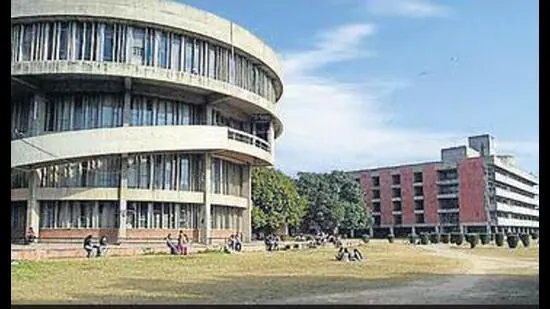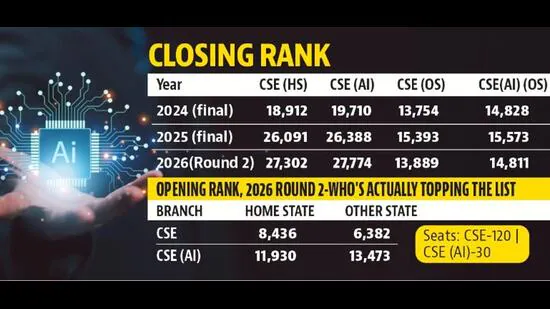
Traditional computer science engineering (CSE) continues to be the most sought-after BTech branch at Punjab Engineering College (PEC). However, its newer computer science engineering (artificial intelligence) programme is steadily closing the gap, according to the data from the first two rounds of joint seat allocation authority (JoSAA) counselling 2026.For at least the past two admission cycles, CSE has remained PEC’s most preferred branch, followed by CSE (AI), CSE (data science) and mathematics and computing. (HT File)PEC introduced the BTech CSE (AI) programme in 2023, expanding its computer science offerings in response to growing demand for AI focused education.The closing rank of the last student admitted-shows that the difference between CSE and CSE (AI) has become remarkably small. After round 2 of JoSAA 2026, CSE closed at 27,302 for home state (HS) candidates and 13,889 for other state (OS) candidates. In comparison, CSE (AI) closed at 27,774 (HS) and 14,811 (OS), leaving a gap of just 472 and 922 ranks, respectively.The picture is different at the opening rank, which reflects the highest ranked student who chose a particular branch. Here, traditional CSE continues to dominate. The best ranked student to secure a CSE seat had an All India Rank (AIR) of 8,436 (HS) and 6,382 (OS), while the corresponding figures for CSE (AI) were 11,930 (HS) and 13,473 (OS). This indicates that although AI is becoming increasingly attractive lower down the merit list, the highest ranked candidates still overwhelmingly prefer conventional CSE. Round 3 of JoSAA counselling is scheduled to be announced on July 6. PEC offers 120 seats in CSE, compared to 30 seats in CSE (AI).The trend over the yearsPEC’s final JoSAA cut off data from the past two admission cycles reflects a similar pattern. In 2024, CSE recorded final closing ranks of 18,912 (HS) and 13,754 (OS), while CSE (AI) closed at 19,710 (HS) and 14,828 (OS)-- a difference of 798 and 1,074 ranks. By 2025, that gap had narrowed considerably. CSE closed at 26,091 (HS) and 15,393 (OS), while CSE (AI) closed at 26,388 (HS) and 15,573 (OS), reducing the difference to just 297 and 180 ranks. At the opening end, however, the trend has fluctuated. In 2024, CSE’s opening rank was ahead of AI’s by more than 7,000 ranks in the other state category. That gap narrowed to under 700 ranks in 2025 before widening again in the first two rounds of JoSAA 2026.Branch preferences remain unchangedFor at least the past two admission cycles, CSE has remained PEC’s most preferred branch, followed by CSE (AI), CSE (data science) and mathematics and computing. While the gap between CSE and AI has narrowed at the closing ranks, the overall order of branch preference has remained unchanged since 2024. At the other end of the spectrum, metallurgical and materials engineering remained PEC’s least sought after branch for the second consecutive year. Its other state closing rank increased from 83,402 in 2024 to 84,826 in 2025, making it the weakest closing cut off among all branches in both years.
Chandigarh: Traditional CSE holds crown at Punjab Engineering College, AI creeps closer
PEC introduced the BTech CSE (AI) programme in 2023, expanding its computer science offerings in response to growing demand for AI focused education
499 words~2 min read