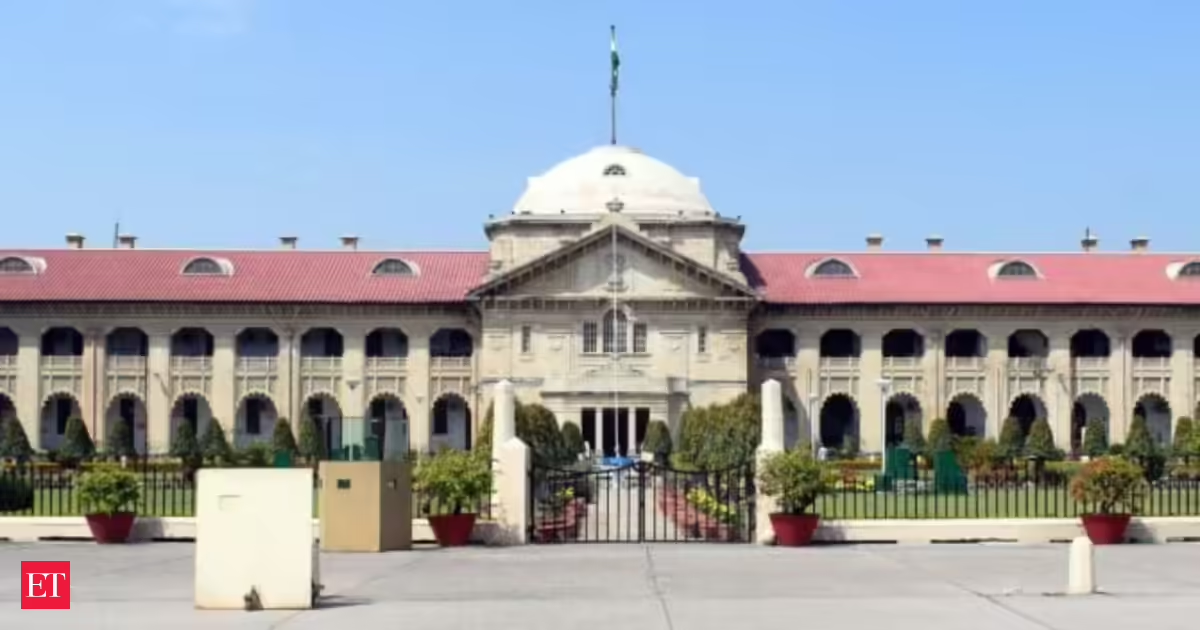
PRAYAGRAJ The Allahabad High Court has dismissed a series of writ petitions seeking to quash an FIR against nine people accused of gang-rape twice under the guise of “nikah halala”, including once when the woman was a minor, saying that when it comes to criminal law there is absolutely “no place for pleading personal laws”.India NewsA division bench of Justice JJ Munir and Justice Tarun Saxena was hearing the three petitions challenging a FIR, registered on December 9, 2025, in Amroha district of Uttar Pradesh, under various provisions of the Bharatiya Nyaya Sanhita (BNS), the Muslim Women (Protection of Rights on Marriage) Act, 2019, and the Pocso Act at Saidnagli police station in Amroha district, alleging incidents of sexual exploitation spanning nearly a decade.According to the FIR, the victim was married in April 2015 at the age of 15 and was subsequently divorced via triple talaq in January 2016. A few months later, she was married to another man under the pretext of halala and was raped. In April 2017, her first husband remarried her, only to divorce her again in January 2021. Later, in February 2025, she was gang-raped by two men who claimed the act was for the purpose of halala.Besides the man she was married to the first time, the other accused named in the FIR are a cleric as well as the husband’s brother and nephew who allegedly raped the woman on the pretext of halala.“Nikah halala” is an Islamic practice where a divorced woman must marry another man, consummate the marriage, and divorce him before she can legally remarry her former husband.Dismissing the petitions during a hearing onJuly 1, the bench observed: “When it comes to criminal law, unless the law itself makes exception, which it rarely does, there is absolutely no place for pleading personal laws governing marriage, etc., if, interlaced with a matrimonial relationship, a crime were committed.”During the hearing, the counsel for the petitioners submitted that “nikah halala” was a valid religious practice, and that under personal law, a marriage involving a minor is not void but merely voidable and, since the woman did not repudiate it within a year of attaining majority, the marriage was binding.The bench, however, noted: “The constitutionality of halala is not under challenge before us, but, if, under the garb of doing a halala, a minor girl is subjected to carnal relations, relying on her desire to marry a man who has already divorced her, it would certainly attract the provisions of the POCSO Act.”Referring to the Supreme Court’s judgment in Independent Thought v. Union of India, the bench said the apex court had given overriding effect to the Pocso Act, leaving no scope for lawful sexual intercourse with a girl below the age of 18 years. The court also noted that this protective mandate has now been explicitly incorporated under Exception 2 to Section 63 of the BNS.Rejecting the argument that some of the accused, including the cleric who solemnised the marriage and some elderly relatives, had only marginal roles, the court observed that all the accused were prima facie part of a common enterprise, with each playing a role that collectively constituted serious offences under the law.Holding that the allegations warranted a thorough police investigation, the high court dismissed all the connected writ petitions.
HC refuses to quash FIR for rape under guise of nikah halala
PRAYAGRAJ The Allahabad High Court has dismissed a series of writ petitions seeking to quash an FIR against nine people accused of gang-rape twice under the guise of “nikah halala”, including once when the woman was a minor, saying that when it comes to criminal law there is absolutely “no place for pleading personal laws” | India News
549 words~2 min read