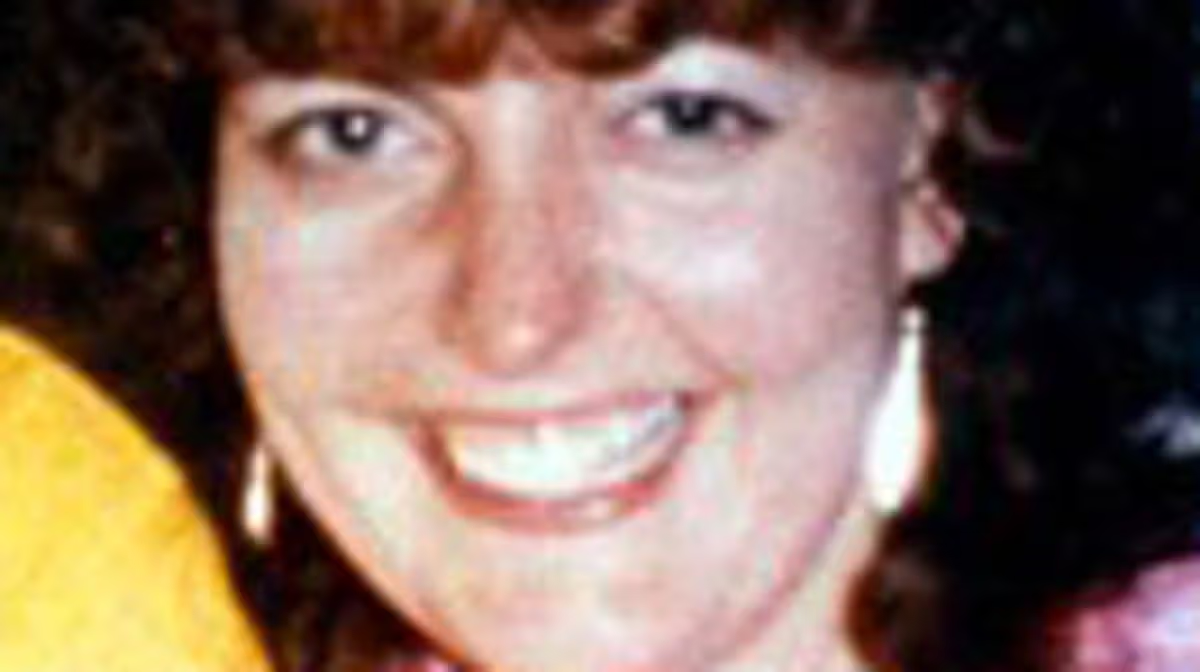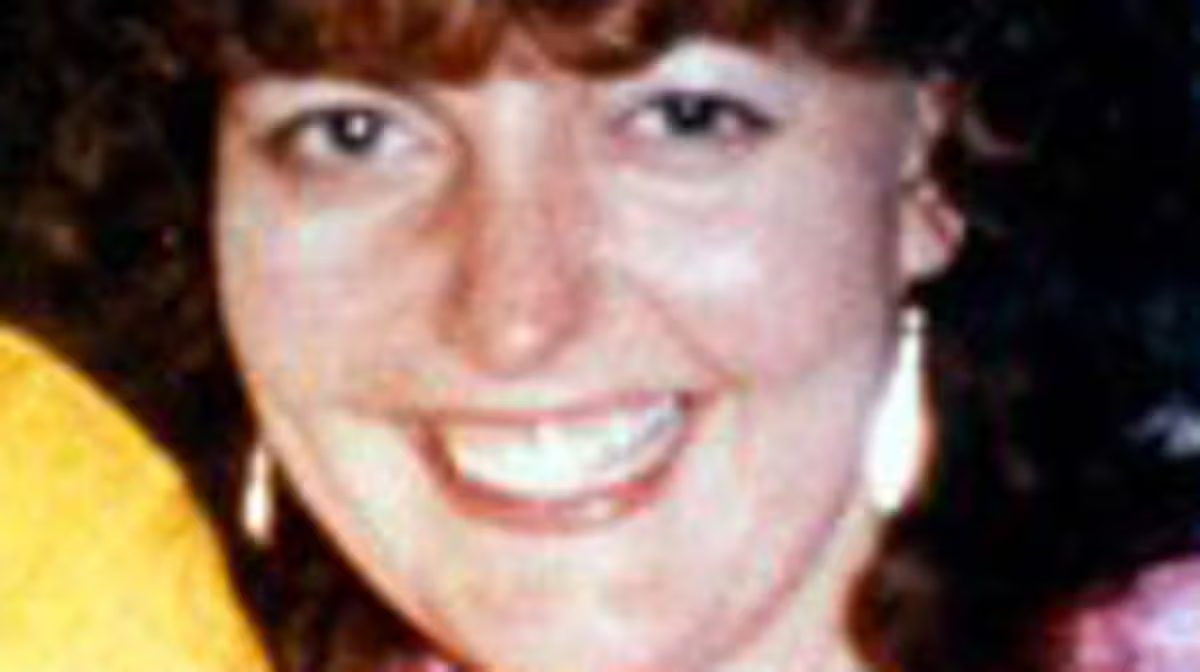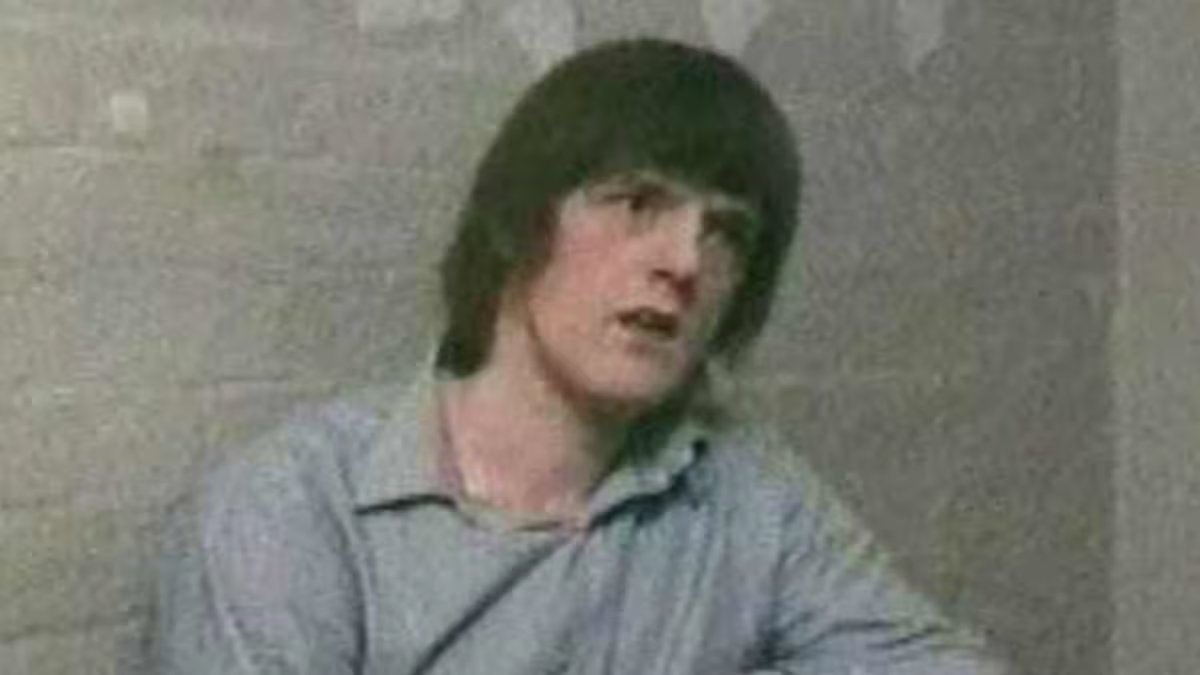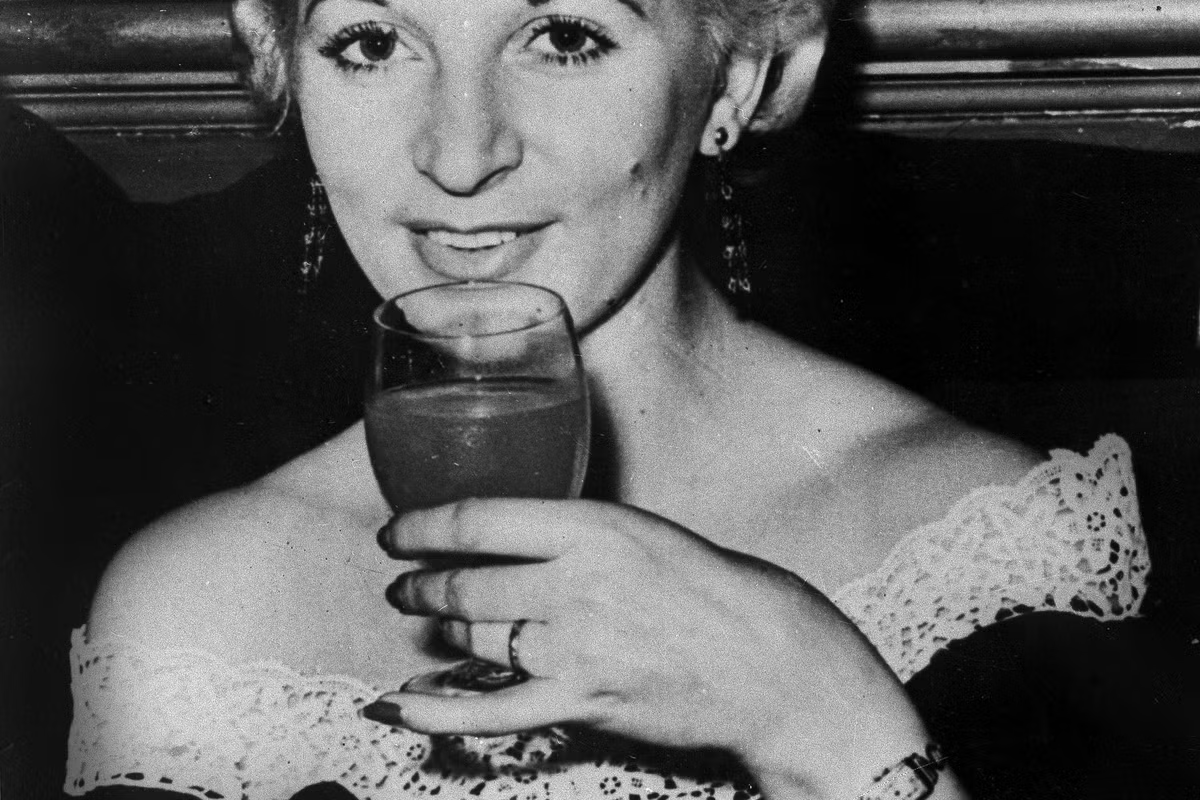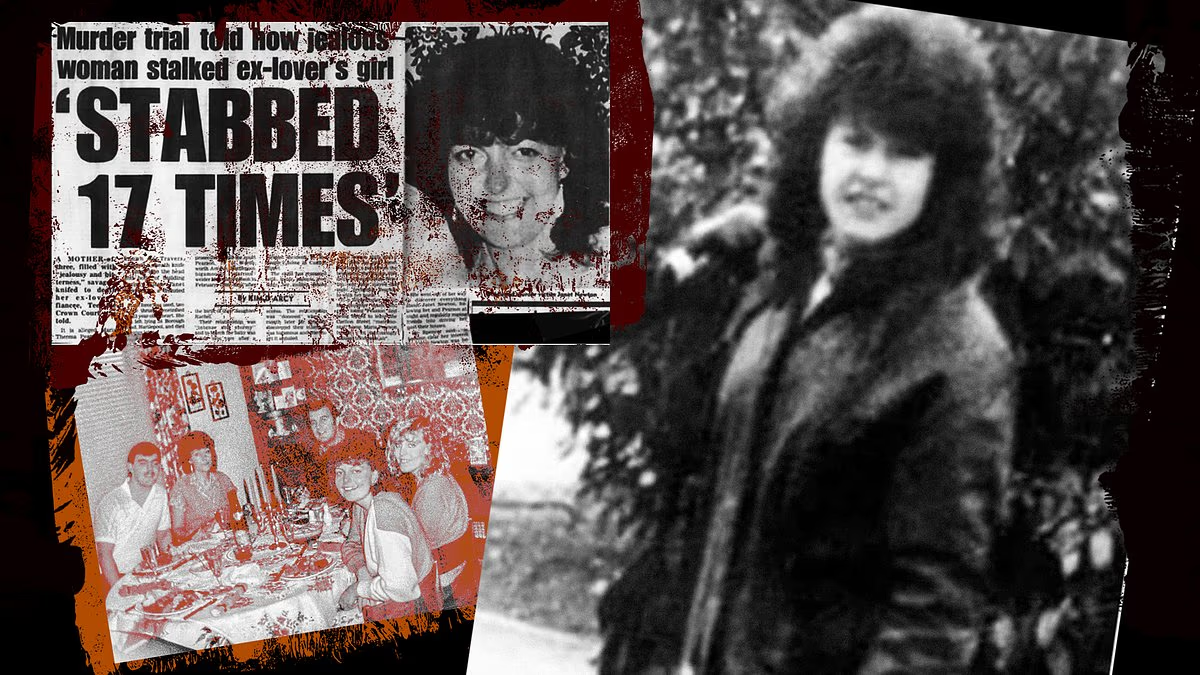
Freedom is finally within reach for Britain’s longest-serving female prisoner. After 39 years behind bars – and nine failed bids for parole – killer Maria Pearson, who’s served longer in prison than Moors murderer Myra Hindley, is preparing for release. What on Earth must she be feeling?The question is being asked by an unlikely person: the younger sister of the woman Pearson killed.She’s likely to be ‘bloomin’ terrified,’ says Lynn, whose sister Janet Newton was stabbed to death by Pearson in a ferocious and meticulously planned attack in 1986.‘Gentle’ Janet, whom Pearson regarded as a love rival, was stabbed 17 times, including through the heart. She was only 23.Pearson, now 70, was convinced that Janet had stolen her man, and bought the knife days beforehand, stalking her victim mercilessly before launching the fatal attack which left her dying in the street. So horrific were Janet’s injuries, police initially thought she’d been the victim of a hit-and-run.It’s extraordinary that Lynn – who was 18 at the time, and still sharing a bedroom with her sister – is attempting to put herself in Maria Pearson’s shoes at this momentous moment, but she is.‘We might think she’s sitting there over the moon that she’s getting out, because she’s been wanting this for so long. But when somebody finally says, “Yes, you can go”, it’s another matter.‘I bet she’s panicking. I don’t think she will be able to cope in the outside world.’But, more crucially, will the world be able to cope with Maria?Lynn, 59 – who asks us not to reveal her married surname or too many details about her life, for her own protection – has been sitting in her living room in the north east of England, trying to make sense of the letter she received this week laying out the Parole Board decision. Maria Pearson was sentenced to life imprisonment, aged 31, with a minimum tariff of 12 years for the murder of Janet Newton in a ferocious and meticulously planned attack in 1986She can’t for the life of her see what has changed since the last nine times Pearson’s suitability for release was assessed – and it was concluded she was still a danger to society and likely to reoffend.Twice she has been transferred to an open prison; twice she has been recalled, because of her concerning behaviour.The risk factors laid out even in the document green-lighting her release should, says Lynn, terrify us all. ‘They talk about her complex personality profile, her neurodiversity, her jealousy, frustration, anger, lack of remorse, lack of empathy, capacity to distort reality, persecutory ideas in respect of people’s ill will towards her, rigid-thinking and problems relating to other people.‘These are all the things they say about her – yet they conclude they can manage her in the community, when we all know how stretched mental health services in the community are. Isn’t that unbelievable? I dread to think . . . I just hope another family doesn’t have to go through what we have gone through.’The case of Maria Pearson – dubbed ‘Britain’s forgotten prisoner’ – is one of the most unusual in modern British justice because of the time she has served. This is a woman who, at 31, was sentenced to life imprisonment with a minimum tariff of 12 years.For all the heinousness of her crime, offenders have done worse, and spent less time in prison (‘only serial killers serve the sort of time she has,’ observes Lynn.) Technically, Pearson could have walked free in 1998. How does a 12-year sentence become 39 years?The answer lies with the detail of the law. Pearson could only be released once the Parole Board was satisfied she no longer needed to be detained for public protection. ‘For the past 20 years, she hasn’t been paying for the crime of murdering my sister in cold blood. She has been paying for her own behaviour,’ concludes Lynn.Yet the Newton family have also been paying. Each time Pearson has applied for parole, they have submitted a victim impact statement, setting out the devastation wreaked on not one or two, but now four generations.Lynn is now a grandparent of three. Her children never met their Auntie Janet, and when they were younger she tried to protect them from the awful details of her death.She tells me that her mother Carole – who died in 2013 and is now buried alongside her daughter – insisted on going to the cemetery every week. ‘I’d take her, so my eldest two were used to going to the grave. Pearson has served longer in prison than Moors murderer Myra Hindley's 36 years‘When they were younger they’d ask how Janet died and I’d say “she was poorly”. Then they asked why it said “tragically taken” on her grave. They were so shocked when they found out the truth. These things just don’t happen to families like ours.’Lynn also says that until it was certain, she kept the news of Pearson’s impending release from her father, who is now 90. ‘We’ve tried to protect him and haven’t told him about every parole application. He doesn’t need to know all that at his age. He just said, “Well, she’s served her time”, but added, “As long as she doesn’t come near me”.’It’s a condition of Pearson’s release that she will be banned from contacting her victim’s family or visiting the area. She will also be electronically tagged, ‘for a year,’ says Lynn. ‘We reckon we’ve got a year . . .’And what of Malcolm Pearson – Janet’s fiancé, but Maria’s ex. He was the third party in this love triangle and Maria tried to frame him for the murder. He was even arrested at one point.As far as Lynn knows, Malcolm is still alive. ‘We haven’t stayed in touch, and the last I heard he had become a kind of recluse. I would not like to be Malcolm now, given how obsessed Maria was with him. She was determined no one else would have him.’No wonder this crime sparked lurid headlines. It was, as Lynn admits, the sort of murder that only happens in films. The court case dealt not just with stalking but bigamy, domestic violence, obsession and cold, calculated fury. The woman at the heart of it (an evil psychopath, says Lynn) was the supposedly thrice married Maria Pearson, a mother of three who had taken the split with Malcolm Pearson, a welder, particularly badly. Malcolm was the father of Maria’s third child, a daughter.Their relationship had been volatile and violent – to the point their child was taken into care. It was also, crucially, bigamous. Malcolm was devastated to discover that when they married, Maria hadn’t divorced her second husband.She was already facing bigamy charges – and the collapse of her relationship – when Janet, a shy young woman who worked in a building society, appeared on the scene, and Malcolm fell for her.Lynn remembers them as being chalk and cheese. ‘He’d been used to being in this relationship where they were always fighting. Janet wasn’t like that. She was kind and gentle. He must have thought all his dreams had come true.’ Almost as soon as they started dating, Maria did her best to split them up, targeting Janet at the family home where she still lived with her parents and sister. ‘Gentle’ Janet, who Pearson regarded as a love rival, was stabbed 17 times, including through the heart. She was only 23Lynn was there, witnessing the escalation. She tells us that Pearson followed her sister and Malcolm on dates, sent letters to the house warning her off, and made threatening phone calls.‘Once she came to the house, saying she was doing it [trying to get Janet out of Malcolm’s life] for the sake of her children. She was saying to my mam, “You are a mother. You will understand”. She said she would kill for her children, but we never imagined in a million years how dangerous she was.’Did Janet know her life was in danger? Lynn says that after her death the police told her there had been a previous attack. Maria had set upon Janet in the lavatory of a pub one night when she was out with Malcolm. ‘She was banging her head off the dryer. I remember that night, her coming home and Mam asking if she’d had a good night. She said she had, and went off to bed. We only found out about what had happened from the police after she was murdered.’At the murder trial at Teesside Crown Court in July 1987, it was established the attack on Janet was meticulously planned – and prompted when Malcolm asked Janet to marry him, and they announced their engagement.Maria bought a knife, and recruited a student she met in a pub, arranging for him to be (unbeknown to him) her getaway driver. Her plan was to flee the country. This student would eventually be a key witness for the prosecution.The attack itself, in October 1986, was horrifying and audacious. Malcolm and Janet had arranged to meet, and when she didn’t arrive he headed to her home, just a few minutes walk away. He passed a commotion, with emergency services in attendance and saw a woman’s legs protruding from behind a vehicle. He ran to Janet’s house, assuming – as the police would do – that some poor person had been involved in a traffic accident. Only later would he discover that this was Janet.She’d been approached by Maria Pearson and stabbed 17 times. Maria had fled the scene and when apprehended, she pointed the finger at Malcolm. There was a bizarre moment when she called a local newspaper, professing innocence. Yet the forensic evidence was overwhelming and the judge called her ‘obsessive and jealous’.‘She’d planned it all. She was going to leave the country. She’d looked at what ferry she was going to take. This wasn’t a spontaneous crime,’ says Lynn.For years, Pearson maintained her innocence, and it’s thought it’s only been during the prolonged parole process that she’s accepted any culpability. More recently she claimed she’d been suffering from a pre-menstrual condition or postnatal depression. ‘She has never said sorry, though,’ says Lynn. ‘She has never expressed any remorse.’ Would we be having a different conversation today if she had? If Pearson had written to the family to express regret? ‘Maybe, if she’d said how horrified she was that she’d taken Janet’s life, maybe we could have started the process of forgiving. But we can’t. We can’t forgive someone who isn’t sorry.’Only scant detail is available about what sort of prisoner Pearson has been, but it’s clear she has been a difficult one who, as a previous parole ruling pointed out, was quick to resort to violence.After the latest – successful – parole hearing on Tuesday, the board described the decision to allow Pearson’s release as a ‘finely balanced’ one, concluding that she poses no more than a minimal risk of further serious offending.Pearson had made ‘mixed progress’ in prison, engaging with psychotherapy, while also presenting ‘ongoing challenges’ in her relationships with professionals.Some experts assessed her as posing a high risk of serious harm, others concluded her risk could be managed safely in the community. The summary added: ‘The panel accepted that Ms Pearson presents a risk of harm, particularly in situations where she feels distressed, challenged or under pressure. However, it concluded that the risk of serious, violent reoffending is low, noting the absence of comparable behaviour over many years in custody and the specific circumstances of the original offence.’None of which is reassuring to the family of her victim. ‘It doesn’t make sense,’ Lynn says of the volte-face. ‘My biggest concern is how dangerous she is. The prison service has made that clear, but the Parole Board say they can manage her in the community. I think this is a mistake. She’s going to be living next to other human beings, maybe not in our area, but next to someone.’Janet would be 63 now. Does Lynn think she and Malcolm would have lasted? Here is the irony: she does not. ‘I think they were too different. They’d only been together a short time, and she was on the rebound. I think the relationship would have worn itself out.’Which makes Janet’s murder even more senseless. ‘She was the sweetest person you could meet, and she came up against pure evil.’To find out how Rory Tingle revealed a bombshell update on the Putney Pusher case sign up to The Crime Desk newsletter HEREWhat kind of cases do you want to read more about? Let us know at: crimedesk@dailymail.co.uk
Britain's longest serving female prisoner is about to be freed
Freedom is finally within reach for Britain's longest-serving female prisoner. After 39 years killer Maria Pearson, who's served longer than Moors murderer Myra Hindley, is preparing for release
2,104 words~10 min read