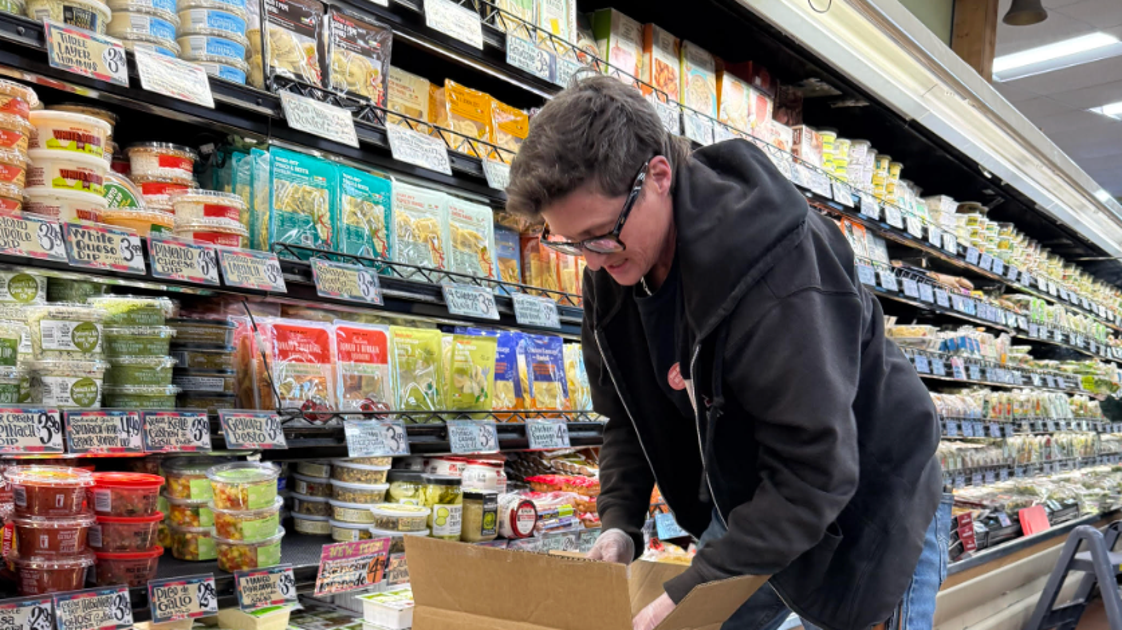
You wanted to be assigned to carts on a day like this. The sun was out after weeks of fog, and the temperature was flirting with 80. A chance to escape the frigid air of this suburban Trader Joe’s? Sign me up.In my first month on the job, I had mastered throwing the metal hook dangling at the end of the 12-foot strap just so to snag the handle of the sixth shopping cart from the end, yank just hard enough to get the row of nested carts into motion, and then the ballet of turning them in synchrony toward the cart corral, all without inconveniencing the drivers angling for the few, narrow parking spaces open at midday. I’m killing it, I thought.And then a voice. My mother’s voice. My mother’s voice in a car angling for a parking space at the grocery store. A voice intended for me, the kid in the booster seat in the back of the station wagon in the 1970s. A voice intended for me, the freshly hired, middle-aged Trader Joe’s employee, wrangling grocery carts in a strip mall parking lot on a Wednesday afternoon with the sun pounding down.“And THAT’s why you get a college degree!” When my mother first uttered that sardonicism, I was not much more than a toddler. But I’d heard it in her half-joking tone over the decades that followed, and it had wedged itself deep into my sense of self. I was not supposed to be wrangling carts in a parking lot. But more importantly, I was not supposed to be seen wrangling carts in a parking lot. And I sure as hell was not supposed to feel accomplished while I did it.The author working a shift at Trader Joe's.Photo by Michele WilsonOur family was always good at tongue-in-cheek, wink-wink humor. Behind the laughter, though, was something very real. Call it class anxiety? Both of my parents were raised with the absolute and unquestioned assumption they would attend college and “make something of themselves.” They met in college, and both went on to work in journalism — that is, until my mother was forced by the mores of the time to surrender her illustrious career to become a mother and homemaker. She bristled a lifetime about that.But they raised my siblings and me as they had been raised. The idea that we would attend college was not even debated. We would be educated, and then be accomplished in universally identifiable terms.When my parents died, and at the abrupt end of an unconventional career in journalism and activism, I found myself facing down my 50th birthday, and I was utterly unmoored. However, this moment also felt like an opportunity to start a second chapter. I’d always wanted to teach, so I reasoned maybe this was the moment to get that master’s degree. I enrolled in a degree program and started thinking about a day job that would help pay the bills but wouldn’t have me staring at screens all day.Trader Joe’s leapt to mind; I was going to run away with the circus.To be honest, I never really considered anything else. Working at Trader Joe’s had become a daydream for many of my middle-aged, mid-career peers. It seemed laid back, the employees seemed happy to be there (and possibly stoned), and the company had a passionate following. Besides, I was ready for less office politics and ego, fewer screens and screeds, and more leaving work at the office every day. Anyway, I believed it would be just a temporary thing while I blasted through my accelerated master’s program and got back to the business of respectability. My friends raised an eyebrow or two, but also could not contain their vicarious excitement at this prospect. It was something we could dream about, but to actually do it seemed... reckless? Unhinged? However, because I was abundantly clear that, of course, this was temporary, we all treated it like a gap year style adventure.That was seven years ago."This is a scene from my previous incarnation," the author writes.Photo by Mark MosherWhen I tell people that I work at Trader Joe’s, I always add, “and I LOVE it.”It is true that my years as a crew member have been life-changing in a thousand important ways, and that I truly enjoy the physicality of it. I discovered, to my utter surprise, that I actually like people, and I jump at the opportunity to help a perfect stranger find the crème fraiche, which they always agree is never where you’d expect it. The daily opportunity to bring a little happiness to perfect strangers was a bigger bonus than I’d ever imagined: I have laughed until I could not breathe with some customers; with others I have wept until I had to step outside and smoke a cigarette to get my shit together. But I don’t always love it. For one thing, my body reminds me that I am a menopausal woman with multiple worn-out joints who should probably not be lifting 50 pounds of carrots at 5 a.m.And of course, that motherly voice in my head reminds me regularly that this is not where I was supposed to end up.I was not allowed to watch “Laverne & Shirley” when I was a child. I asked my mother why, and her answer was hilarious and probably at least a little bit honest: “It’s crass, and I don’t want you to get the idea working in a factory is something glamorous or desirable.”Forty years later, and I still don’t think I seen an entire episode of “Laverne & Shirley,” but from what I have seen, it’s a celebration of the power of friendship, hard work, dignity and joy, despite mild deprivations. That’s hardly a corrupting message for a 9-year-old.But that belief that my parents held and instilled in us — that one needs a college degree in order to have an “upstanding” (read: white-collar) career in order to be worthy or admirable has a dark side; it still matters that you are kind, have empathy and contribute to society in concrete ways. A degree doesn’t guarantee that. And besides, these days, a degree is economically out of reach for many Americans and doesn’t ensure employment in one’s field of study in any case.Consider that two-thirds of respondents in a recent survey said they no longer see the cost of a four-year college degree worth the cost. Forty-two percent of recent college graduates are classified as “underemployed.” Yet, somehow the subtle (and occasionally overt) stigma of working a non-“professional” job persists, and I am not at all immune to it.I felt incredibly conspicuous in my first week of training. Would I fit in? Was I built for this? Most importantly, could I unlearn those early, misguided lessons about what kind of jobs I might be genuinely proud to have, and keep, and love?My initial thoughts of ‘How hard can it be?’ quickly became ‘Jesus Christ, I don’t think I can do this.’ I’d go home every night, smelling of truffles and kimchi, and do what I came to call emergency yoga. My muscles were screaming, and I had bruises all over my body from carrying heavy boxes. I was also not a little convinced that Trader Joe’s might be a cult. My co-workers were always smiling and at least outwardly friendly in a way I had never been nor attempted to be (journalists and activists are not, as you might guess, the cuddliest bunch). And I’d been raised in the Episcopalian way: love thy neighbor but don’t make a scene about it. Have a little dignity.Ultimately, I realized that my co-workers were, in the main, genuinely lovely people who were good at the emotional labor of making other people feel at ease. This confused me. Why, then, am I ― of all people ― here? I wondered. And how on earth am I even at least a little bit good at this job? But I am nothing if not a neurotic who loves a challenge. Maybe, just maybe, I could conquer this strange new world.I learned the lingo, how to rotate perishables with alacrity and how to diffuse situations with grouchy customers. I practiced being outwardly, intentionally and authentically friendly, and it was exhausting.I did my graduate school homework on my lunch break, out on the loading dock with the smokers and the pigeons. I rotated bell peppers and ran data regression analyses for my Research Methods class over and over in my head. I started to feel in the ZONE. This — this is no midlife crisis, I assured myself.Six months after I graduated, I had a part-time job teaching digital media literacy skills at the local university. I felt like I had arrived. But I also kept my job at Trader Joe’s while I figured out if teaching really was the lifelong dream I had thought it might be. Teaching was hard but exhilarating. Shamelessly, I plied my students with chocolates I bought using my employee discount. This is my jam, I thought. Even better, this would be something my parents would have bragged to their friends about. I was on my way. I had made the transition. I was captaining this ship of my life masterfully. WHAT MIDLIFE CRISIS?! And then COVID-19 arrived and all of my classes were canceled. The early COVID days as a Trader Joe’s employee were... something. It began with a run on staples such as canned goods. Then, as the supply chains gagged and coughed, it was toilet paper and hand sanitizer. In spring 2020, an editorial cartoonist depicted a Trader Joe’s employee standing before the Justice League, being inducted into the superhero pantheon. We hung that on the employee bathroom door. For a while, the sense that we were all in this together made the job that much more rewarding. But it didn’t last. It ended somewhere around the time the county instituted a mask mandate.By then, I only left my house to go to work and then back home again. After about six months of this — as the death counts rose and rose in that first awful winter — I started to feel more and more powerless. Customers had cabin fever too, and tempers were short, so they’d take their frustrations out on us. The author working a shift at Trader Joe's.Photo by Michele Wilson“I’m sorry, do you work here?”I’m stacking bags of cashews on the uppermost shelf while teetering on a stepladder. I pause. Nearly everything I am wearing is emblazoned with the Trader Joe’s logo, and I have a bright orange box cutter jammed into a holster at my belt. I’m looking for the source of her doubt. I want so badly to say something sarcastic, but bite my tongue.“Yes, how can I help you?” I say as I gingerly step down to solid ground.This woman is one of the known grouches among our regular clientele. She’s not mean exactly (we had plenty of those), but prickly. As soon as she starts speaking I realize my job, in this moment, is to be The Face of the Company. She is angry about plastic packaging on her produce. She is angry that the organic broccoli is out of stock and it’s only noon. She is angry at Big Agriculture. She is angry about things over which she and I have no control. She is frustrated with the state of industrial food systems, and my job here as an agent of that system is to absorb her anger — to nod and make faces that indicate that I share her frustrations, which I do.I explain that while I cannot solve her problems on the spot because I am merely a cog on the lowest tier of a massive machine, she should message our corporate office with her concerns. I tell her the company is actively eliminating two million pounds of plastic packaging this year. She mentions the Great Pacific Garbage Patch. We fall silent for a moment, gazing at the bananas. “I saw an amazing young woman from, I think, Sweden? on the news today...” she begins. “Greta Thunberg!” I almost shout. We exchange our admiration for the young climate activist who is becoming a household name. My customer takes a deep breath and smiles at me.“Thanks for listening to me rant. I’m sorry.”“It’s OK, I understand. It’s my job. Let me know if there’s anything else I can do for you,” I reply.We part ways — me back up on my stepladder and her off to the frozen section. I wonder if either of us might feel a little less powerless for a moment.After 2 1/2 years of COVID anxiety, things began to return to normal. I chose not to return to teaching right away, as the landscape of digital media convulsed with more misinformation and the task began to seem a fool’s errand.The usual joys and banal annoyances trickled back into my job at Trader Joe’s and life beyond it.“Are you open?” a customer would ask, as I stood at a register with no line, smiling and waving them over. “You look lonely!” I replied with my practiced jollity: “Where have you been? I’ve been waiting all day for you!” And on and on, each day settling into the normal rhythm, each day more or less the same. There were still the difficult customers, some of them regulars, who could break your flow, or worse, your spirit. A petite woman regularly told crew members that they were useless and stupid, until our captain told her she’d be banned from the store if she kept it up. (She’s now, years later, somehow even more petite, but friendly and sweet.)There were the melancholy regulars, like the widower who loved to come in just to make balloon animals for other customers’ children. And the young man fighting cancer, who always cornered me in the frozen section on Friday mornings to talk philosophy, until we stopped seeing him.There was the 101-year-old resident of the nearby senior living community who always wanted help out to her car with her groceries. She always parked at the farthest reaches of the lot to “get her steps in” and to conduct rousing conversations about her fascinating life. And there was a towering retired nurse who came in twice a week and who you knew from her booming voice before you saw her. She called me “Toots,” and it delighted me every time. It has been exhilarating to befriend such an amazing diversity of humanity at work. Most of my co-workers are Filipino, some Latin American or Middle Eastern. I’m one of the only employees who doesn’t speak multiple languages. They range from teenagers to senior citizens, each with their own stories and things to teach me. One young co-worker would plug his phone into the store speakers most mornings before the store was open as we stocked shelves, and that’s how I started a love-affair with North African hip-hop. Our art department, which is responsible for the handmade signs throughout the store, is full of accomplished illustrators. One of my fellow Gen X crewmembers calls me “Grandma,” and I cheerfully refer to him as “Grandpa.” (He turned me on to the senior discount on Tuesdays at the Ross Dress for Less next door. Bonus.)Recently my maternal grandfather came to mind as I struggled with whether to move on from Trader Joe’s for something more “respectable.” He had dropped out of Stanford to help build the Al-Can Highway, and then spent some years cattle-driving in the Southwest. He came home and married my very proper, college-educated grandmother. He settled down and got a “decent job” ... as a distributor for a chain of grocery stores. It hits me: I’m in the family business. And, if nothing else, this job has made me a happier, friendlier, more patient, more tolerant, and a far humbler version of myself. If I’m ever out rounding up carts these days, I laugh at the reliability of Mom’s voice in my head. When I hear it, I turn my face to the sky and drink in the rain, because there is joy in this absurdity, and dammit, I’m going to embrace it.I love my regular old retail job, the people I work with, the customers I serve, and, after years of learning the ropes, I’m good at it.The fact is, I did go to college, a few times. And I still ended up rounding up carts in a grocery store parking lot. I am ecstatically, finally, mostly, almost never ashamed of that fact. Brooke Shelby Biggs is a writer in San Francisco and a crew member at Trader Joe’s in Northern California. Her work has appeared in Mother Jones, Wired, The Nation, the San Francisco Chronicle and other outlets.Do you have a compelling personal story you’d like to see published on HuffPost? Find out what we’re looking for here and send us a pitch at pitch@huffpost.com.
I Was Nearly 50 When I Took A Job At Trader Joe's. I Was Shocked By What I Experienced There.
"My initial thoughts of 'How hard can it be?' quickly became 'Jesus Christ, I don’t think I can do this.'"
2,825 words~13 min read