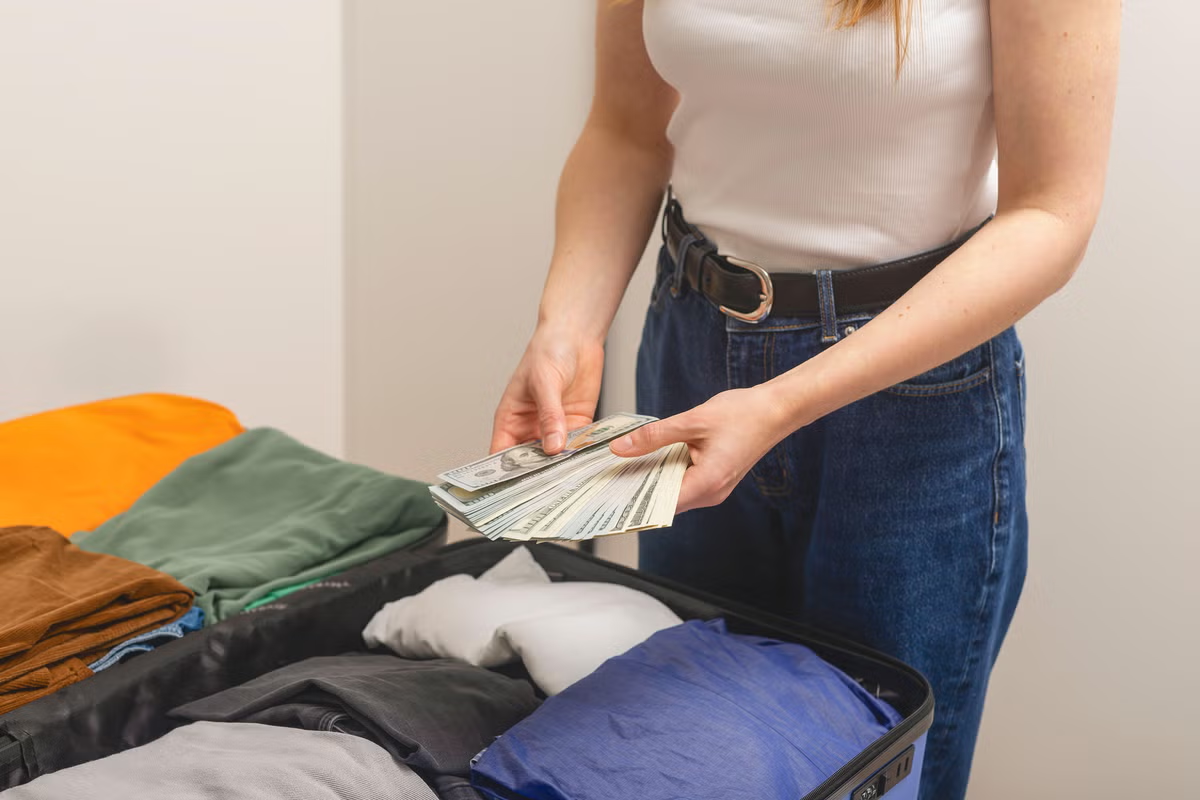
Restaurant recommendations, the best beaches and museum trips all feature highly on travellers’ to-do lists, but often money safety gets left behind.But this gap can be costly as travellers can unnecessarily lose money to card providers with steep foreign transaction fees, and just as often inadvertently make themselves easy targets for thieves.Andrew Hagger, personal finance expert at Money Comms, says the real danger is psychological: holidaymakers let their guard down precisely when they should be most alert.(Andrew Hagger/PA)“When you’re abroad, you’re more vulnerable as you’re not as alert as you would normally be as you’re busy enjoying yourself. But you mustn’t just chill; you need to have your wits about you,” he says.From choosing the right wallet to making smart decisions with banking, here are his top tips for keeping your money safe on holiday.1. Don’t neglect safety boxes(Alamy/PA)“Always make use of the hotel safe, even if it costs a few pounds a day, as it’s well worth it,” Hagger says. “And don’t go out with all your cards and cash; always leave some in the safe.”Furthermore, Hagger recommends noting down contact numbers for your bank providers, which can be found on the back of your credit or debit card, and keeping the list in a safe. “It sounds like a bit of faff, but if you lose your cards abroad, that will make life so much easier as you immediately have the phone number for your bank.”2. Calculate your daily cash spendWoman counting cash while packing holiday suitcase (Alamy/PA)Before leaving your accommodation, it can be tempting to carry a vast amount of cash to cover all eventualities. However, Hagger recommends calculating your estimated daily expenses, such as tips, food and expeditions, and only withdrawing that sum because if it does get stolen or you lose it, your entire holiday budget won’t be wiped out in one go. If you do need a top-up, you can use a debit or credit card, which are generally widely accepted abroad, or simply return to your hotel.3. Always pay in the local currency for card transactions(Alamy/PA)Get a free fractional share worth up to £100.Capital at risk.Terms and conditions apply.Go to websiteADVERTISEMENTGet a free fractional share worth up to £100.Capital at risk.Terms and conditions apply.Go to websiteADVERTISEMENTOften, foreign card terminals will offer payment in the local currency or sterling. Though sterling might seem like the more attractive option, as you know exactly how much you’re spending, it can incur fees. “If you don’t pay with the local currency, it allows the foreign bank to use a local exchange rate, which is pretty much a rip-off in most cases,” Hagger explains.But just because you’re paying in the local currency, it doesn’t mean that you’re immune from avoidable charges from your UK bank. “Most debit cards and credit cards will charge you a mark-up on non-sterling transactions. So when you’re abroad, most will charge you around 2.75% to 3% on top of your purchases,” Hagger says. “However, for some banks, such as the Halifax Clarity Card, Barclaycard Rewards, Monzo and Starling, you just pay the exchange rate and nothing else on top.”So, it’s worth shopping around before your trip abroad and selecting a card that doesn’t charge for non-sterling transactions.4. Consider credit cards for big purchases(Alamy/PA)If you have a credit card, it’s a good idea to use it for larger transactions abroad, such as car hire. As Hagger explains: “Credit cards are better for big purchases abroad, anything over £100, because of Section 75 of the Consumer Credit Act. That means your card provider will step in and help you if anything goes awry, and you get additional protections that aren’t offered with debit cards.”Under Section 75, the card provider is jointly liable with the retailer if there’s an issue with anything costing between £100 and £30,000. For example, if an airline goes out of business or a holiday rental turns out to be fraudulent, your credit card company is legally required to refund you.5. Carry cash and cards safely(Alamy/PA)“At home, I have a bulky wallet with all my cards and everything in it, but when I go abroad, I strip it down and take a smaller wallet carrying the bare minimum,” Hagger says. He recommends doing the same, as larger wallets are more likely to catch the eye of pickpockets and are also more likely to fall from your pocket.In addition, Hagger suggests keeping your wallet in a concealed, inside pocket in your clothing. “Whatever you do, don’t just stick it in your back pocket with your phone hanging out because in some places abroad they look out for tourists and they’ll soon whip your card or your wallet out,” he warns.For days by the pool or beach, Hagger suggests carrying your valuables on your person in a waterproof case to prevent loss or theft.6. Be vigilant with ATM fees(Alamy/PA)“All ATMs should state quite clearly if there’s going to be a charge before you make a withdrawal,” he says. “So, look at the ATM itself and make sure that it’s not going to charge you [excessive fees] before you take your money out.” It’s much better to stick to an ATM that’s affiliated with a bank, rather than the independent, standalone machines found in tourist hotspots, as the latter tend to charge higher withdrawal fees.Hagger adds: “You should also check what, if any, charges your UK bank has for ATM withdrawals. Some might charge you £5 per withdrawal, and if you make loads of little withdrawals, then that’s going to cost you a fortune.”
6 savvy hacks for keeping your money safe on holiday
We all want to relax on holiday, but it’s important to take steps to protect your money while abroad.
919 words~4 min read