Two critical vulnerabilities in the popular AI code editor Cursor could lead to remote code execution on the underlying operating system, Cato Networks reports.
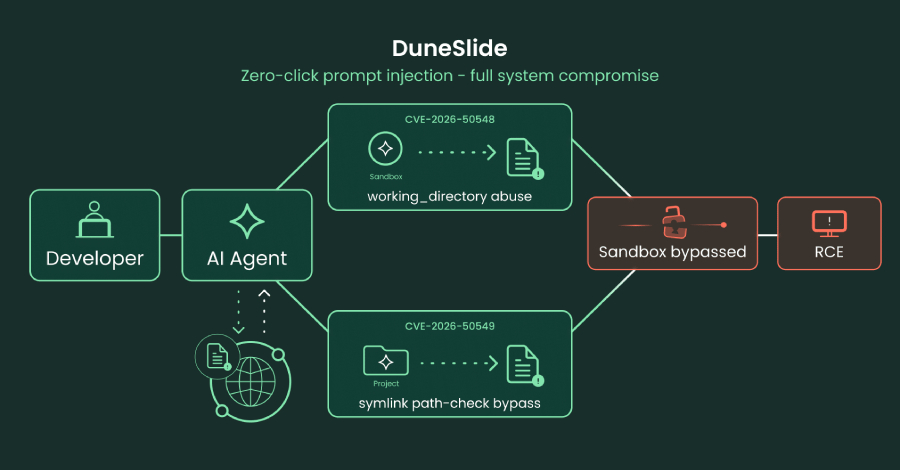
The security defects are tracked as CVE-2026-50548 and CVE-2026-50549 (CVSS score of 9.8) and are referred to as DuneSlide, given that they lead to remote code execution (RCE) outside of the IDE’s sandbox.
According to Cato, the flaws abuse Cursor’s automatic terminal command execution inside the sandbox, which does not prompt the user for approval, and can be triggered when a victim prompts the IDE to ingest an attacker-controlled payload.
The first issue is related to the sandbox’s security boundaries. While command execution should be restricted to the current working directory, a non-default value assigned to the working_directory parameter results in the path being added to the allow list.
Thus, an innocuous MCP server request could inject a prompt that would instruct the LLM to set the working directory to an attacker-supplied path outside the project scope.