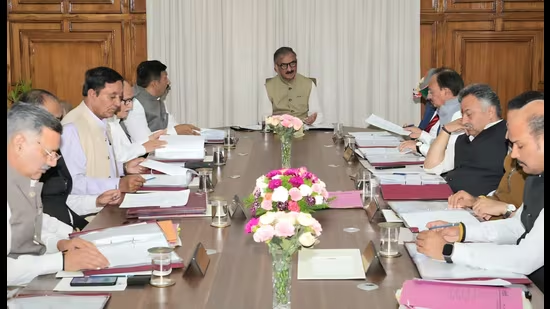
In a relief for residents of unauthorised colonies, the Punjab cabinet has approved an amendment to Rule 31 of the Punjab Apartment and Property Regulation (PAPR) Rules, paving the way for a simplified regularisation process for eligible colonies across the state.A decision to this effect was taken during a meeting of the council of ministers chaired by chief minister Bhagwant Mann on Wednesday evening. (Sourced)The decision was taken at a cabinet meeting chaired by chief minister Bhagwant Mann on Wednesday evening.Rule 31 of the Punjab Apartment and Property Regulation Rules provides a mechanism for the compounding of offences relating to unauthorised colonies. Under the rule, a promoter or developer who has developed an unauthorised colony may apply to the competent authority for compounding of the offence, either before or after prosecution has been initiated.The provision allows compounding only if the promoter fulfils the prescribed conditions, including obtaining the requisite licence under the Punjab Apartment and Property Regulation Act and Rules, paying the applicable compounding fee and other statutory charges, and complying with all directions issued by the competent authority. The application has to be submitted in the prescribed format.However, compounding of an offence under Rule 31 does not automatically regularise an unauthorised colony. The promoter must still satisfy all legal and planning requirements under the PAPR Act and Rules before a licence can be granted or the colony can be considered for regularisation. The rule was substantially amended by the Punjab government in 2022 to streamline the process for dealing with unauthorised colonies.The revised provisions will apply to eligible unauthorised colonies located within notified local planning areas as well as those situated on agricultural land earmarked under approved master plans. However, colonies falling under the regional plan of the Greater Mohali Area Development Authority (GMADA) will remain outside the ambit of the amended rules.It is, however, not clear how many colonies will benefit from the amendment.Finance minister Harpal Singh Cheema said applications under the amended provisions can be submitted until September 30.He said colonies whose applications were rejected under previous regularisation policies will also get another opportunity to apply under the new framework.Cheema further said complete applications will be issued provisional regularisation certificates within 30 days, while the competent authority has been directed to dispose of all applications received under the amended rules within six months.The government has also prescribed revised compounding charges for regularisation. Residential and industrial colonies will have to pay a compounding fee equivalent to 5% of the prevailing collector rate calculated on the gross area of the colony. In the case of commercial colonies, the compounding fee will be 10% of the prevailing commercial collector rate on the gross area.The state government said the amendment is aimed at bringing eligible unauthorised colonies into the legal framework while facilitating planned development and improving the provision of civic infrastructure and basic amenities.Fee for citizen services waived till September 30The cabinet has approved a three-month waiver of government fee and facilitation charges for several key citizen services from July 1 to September 30 to facilitate the ongoing Special Intensive Revision (SIR) of electoral rolls.According to an official statement, the decision has been taken to ensure that citizens can obtain documents required for the revision process without incurring any financial burden.The waiver will cover a range of essential services, including the issuance of caste certificates, residence certificates, birth certificates, duplicate Class 10 and Class 12 certificates, besides other notified services.The benefit will be available for services delivered through sewa kendras, doorstep delivery services and the online citizen services portal during the three-month period.The cabinet has authorised the administrative departments concerned to issue all necessary notifications, instructions and operational guidelines for implementing the decision.The department of good governance and information technology, along with the departments concerned, has also been authorised to undertake all consequential actions required for effective implementation of the proposal.The Punjab government will bear the expenditure arising from the waiver of government fees and facilitation charges during the three-month period.
Punjab cabinet approves amendment to regularise unauthorised colonies
The revised provisions will apply to eligible unauthorised colonies located within notified local planning areas as well as those situated on agricultural land earmarked under approved master plans
661 words~3 min read