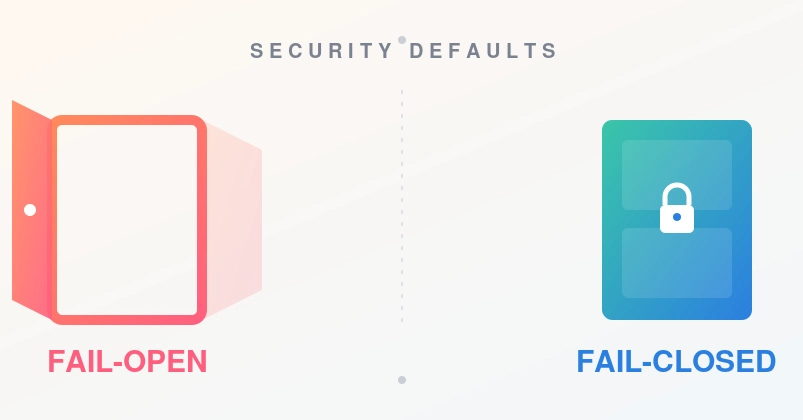
If you build software long enough, you eventually ship a bug that isn't a typo or a logic error — it's a default. Specifically, it's the answer to a question nobody asked out loud: "What happens when this check fails?"
That question has a name in security engineering: fail-open vs fail-closed.
The door analogy
Picture a badge-controlled office door. Normally you need a card to get in. Then the power dies and the lock controller crashes. In that instant the door has to "decide": swing open so people can move freely, or stay locked so no one gets through. Swinging open is fail-open. Staying locked is fail-closed.
Neither is universally correct. A fire exit is designed to fail-open — in an emergency, human life beats access control. A bank vault is the opposite: it fails closed, because a vault that pops open when the system glitches defeats its entire purpose.