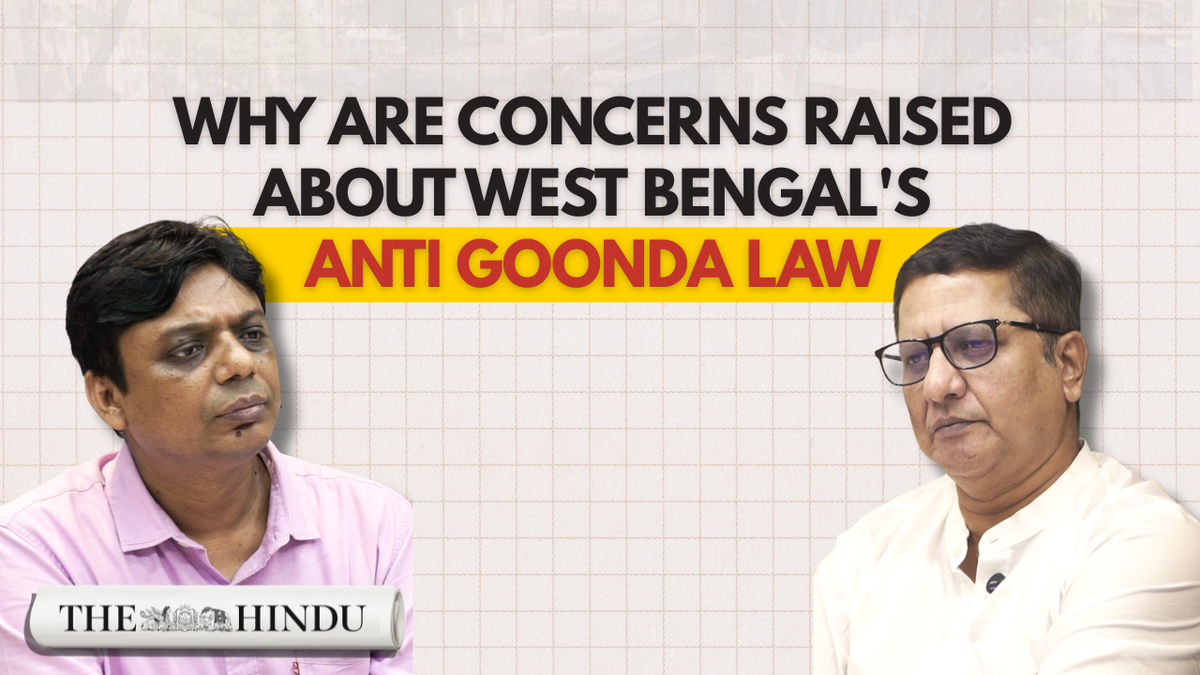
In West Bengal, the new BJP government has passed a law allowing the government to detain for a year anyone who is “generally reputed to be desperate and dangerous to the community” and to restrict the detainee’s access to a lawyer. The opposition has labelled the law as “scary” and said that it wouldn’t stand judicial scrutiny. But what were our Constitution-makers thinking when they enshrined preventive detention in the Constitution?Prevention is a convenient word that gives citizens the feeling that something has been or will be averted. But what systems exist to judge whether officials actually acted in the best interests of citizens in an enforcement and legal system as opaque as ours? The Terrorist and Disruptive Activities (Prevention) Act (TADA), 1987, another avatar of the UAPA, too gave the State unbridled powers. AG Perarivalan was arrested under this law as a conspirator in the Rajiv Gandhi murder case. He was only 19 years old then. He languished in jail for three decades. The only evidence against him was his own so-called confession, which was not recorded in its entirety and conveniently left out portions where he stated that he had no idea about the use of the two nine-volt batteries he had been asked to buy.This was confirmed to the courts in 2017, in an affidavit submitted by the investigating Central Bureau of Investigation (CBI) officer. In 2015, Perarivalan filed a remission petition with the Tamil Nadu governor. Governors came and went, but the file remained on the desk. The Supreme Court and the Government of India also played pass-the-parcel with his life for a while. The enormous ego of the State prevented it from taking responsibility for the loss of Perarivalan’s freedom, life and personal liberty. He was eventually released in 2022 by the Supreme Court, invoking its extraordinary powers under Article 142. Humility does not come easily to the State, which is why a loophole such as the one in our constitution is dangerous.The UAPA was first passed in 1967, but India’s constitutional history is dotted with innumerable acronyms enforcing preventive detention, such as the Armed Forces (Special Powers) Act (AFSPA), 1958, Maintenance of Internal Security Act (MISA), 1971, National Security Act (NSA), 1980, TADA, 1987 and Prevention of Terrorism Act (POTA), 2002, and others in specific regions and states, each one more crushing than the other.It is hard to argue that the makers of the Constitution did not know what they were doing when they introduced preventive detention into the Fundamental Rights clause. After all, many of them had been arrested under preventive detention, a provision that had been in operation in various parts of British India, beginning with the Bengal State Prisoners Regulation III of 1818. Why our freedom fighters and Constituent Assembly members thought it fit to keep this provision alive in independent India is baffling. Historians explain it as the psychological impact of Partition and the innumerable pulls and pushes that the government was dealing with in various parts of the country.Without diminishing the impact these epochal events would have had on the decision-makers of the day, I argue that this provision directly contradicts every principle that these very people espoused during the Constituent Assembly debates.Dr BR Ambedkar, head of the Drafting Committee, in his final speech in the Constituent Assembly on November 25, 1949, averred that the nature of the people in power would decide the quality of the constitution: “However good a Constitution may be, it is sure to turn out bad because those who are called to work it happen to be a bad lot. However bad a Constitution may be, it may turn out to be good if those who are called to work it happen to be a good lot.”It is astonishing then that Ambedkar was a votary of preventive detention. He must have known that the clause would be used to deny the oppressed their dignity. The marginalised and oppressed – the very people Ambedkar fought tooth and nail to protect – are disproportionately impacted by preventive detention laws. Ambedkar’s support for this clause is indefensible, although, to be fair, there was an across-the-board consensus on the matter in the Assembly. Equally, Ambedkar was worried about misuse and exercised caution about the question of due process. On September 15, 1949, he said in the Constituent Assembly:[T]hose who believe in the absolute personal liberty of the individual will recognise that this power of preventive detention has been helped by two limitations: one is that the Government shall have power to detain a person in custody under the provisions of clause (3) only for three months. If they want to detain him beyond three months, they must be in possession of a report made by an advisory board which will examine the papers submitted by the executive and will probably also give an opportunity to the accused to represent his case and come to the conclusion that the detention is justifiable. It is only under that that the executive will be able to detain him for more than three months. Secondly, detention may be extended beyond three months if Parliament makes a general law laying down in what class of cases the detention may exceed three months and state the period of such detention.Did he expect the Indian government to behave any better than the British? I don’t know, but he was uncertain about how Indian citizens would behave.Now I come to the question of three months’ detention without enquiry or trial. Some Members have said that it should not be more than 15 days and others have suggested some other period and so on … We do not know how the situation in this country will develop, what would be the circumstances which would face the country when the Constitution comes into operation, whether the people, and parties in this country would behave in a constitutional manner in the matter of getting hold of power, or whether they would resort to unconstitutional methods for carrying out their purposes. If all of us follow purely constitutional methods to achieve our objective I think the situation would have been different and probably the necessity of having preventive detention might not be there at all.Ambedkar defended the clause by saying that preventive detention was already present in both the Union and Concurrent lists (List I and III respectively) of the Seventh Schedule. This article, he claimed, limited its use; otherwise both Union and state governments could abuse it and “there would be no liberty left”.My submission is that if their attitude was as expressed today, that we ought to have no such provision, then what they ought to have done was to have objected to those entries in List I and List III. We are trying to rescue the thing. We have given power to the Legislatures of the State and Parliament to make laws regarding preventive detention. What I am trying to do is to curtail that power and put a limitation upon it. I am not doing worse. You have done worse.When asked about who had made those lists, Ambedkar said he had, and the house had passed them. He also added that, even then, “I had these limitations in mind.” He also backed TT Krishnamachari’s amendment, which he proposed at the fag end of the Constituent Assembly’s sittings, allowing Parliament to decide on the categories for preventive detention and increase the duration of detention without any oversight. This is Article 22, Clause (7).Ambedkar believed that a State born out of a liberal constitution was the best mechanism for change. He was probably wary of socio-cultural movements, and this suspicion was a result of his lived experience. Such movements were more often than not dictated, controlled and perpetuated by the caste-privileged, and kept the marginalised at the fringes or as receivers of largesse. If the people on the edges took to the streets of their own will, with demands of their own, they were squashed or ignored. To Ambedkar, the solution lay in what we guaranteed and made enforceable in the Constitution. He was a State constitutionalist. Ambedkar did not, and rightfully so, trust the upper castes and elites. In my opinion, this led him to place unbridled trust in the establishment in this particular case. An establishment which was also elite.On December 17, 1946, Ambedkar criticised Nehru’s Objectives Resolution on the grounds that it did not speak of remedies. He said, “All of us are aware of the fact that rights are nothing unless remedies are provided whereby people can seek to obtain redress when rights are invaded. I find a complete absence of remedies.” It is clear, then, that Ambedkar was aware of the dangers of an oppressive State. He also said in that same speech: “Obviously, what is law, what is morality, will be determined by the executive of the day, and when the executive may take one view, another executive may take another view and we do not know what exactly would be the position with regard to fundamental rights if this matter is left to the executive of the day.”Yet, in the case of preventive detention, he left too much in the hands of the executive, and in hindsight, it is clear that his proscriptions on the matter were not good enough. At the very end, he did warn us: “If hereafter things go wrong, we will have nobody to blame except ourselves.”He was right. In AK Gopalan v. State of Madras (1950), the Supreme Court, in a majority judgment, upheld the communist leader AKG’s detention under the Preventive Detention Act, 1950. This ruling set the tone for independent India. Between 2015 and 2019, 5,102 individuals were arrested and cases were registered against 3,902 persons under the UAPA. The conviction rate is a meagre 2.8%. No surer proof is needed for the argument that these cases were motivated by reasons other than the rule of law.A constitutional clause needs to be a safeguard against the worst excesses of the people in power. In a world where terrorism looms large, many feel the need for a legal armoury to prevent horrific crimes. Even in such situations, the State must only be able to bring in a very limited, narrowly tailored, tightly woven law, restricted to extraordinary situations and subject still to the supervision of the court. What we have today is a trivialisation of democracy.Excerpted with permission from We, the People of India: Decoding a Nation’s Symbols, TM Krishna, Westland.
Why does India’s Constitution include preventive detention? TM Krishna’s book examines the reasons
BR Ambedkar was a votary of preventive detention. However, he did warn that ‘if hereafter things go wrong, we will have nobody to blame except ourselves.’
1,757 words~8 min read