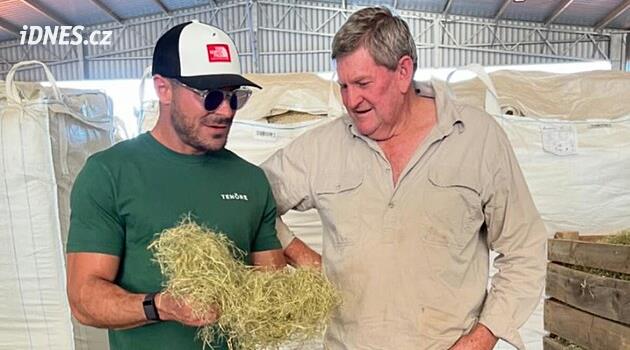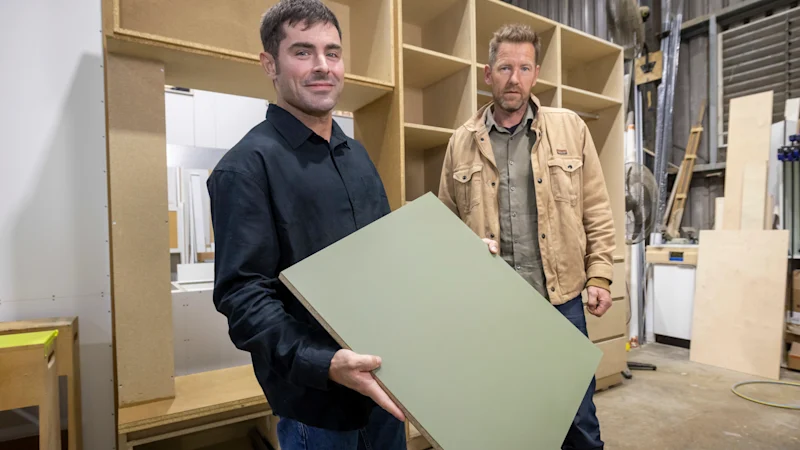
July 3, 2026 — 5:00amA cabinet factory in an industrial estate on Victoria’s Mornington Peninsula is possibly the last place you would expect to find Zac Efron.Pastries were laid out, beers were in tubs, and excited family members looked down from mezzanine offices at Burmak Cabinets’ unlikely visitor.The Hollywood superstar was there to see hemp.Efron’s home will feature hemp throughout, and many of the suppliers and producers are using the material for the first time.Wayne TaylorSpecifically, he was there to see the hemp he helped plant, harvest and watched compressed into board, be turned into what will be his future kitchen.Efron is building his forever home – somewhere he feels he could start a family – in NSW’s Tweed Valley, on land he bought in 2020 for $2 million. And while he’s not placing every brick, he is taking the building of his super-sustainable six-bedroom home, which will feature the unlikely building material throughout, very seriously. “To see every stage of development, and all the intricate details and pieces of the house, is such a fun way to come into a building process,” he said. “It’s very enlightening.”He was in the Hastings factory with his designer, pioneering environmentalist Joost Bakker. The pair became friends when the Ricky Stanicky star was filming his sustainability-focused docuseries Down to Earth, and visited Bakker’s Future Food System at Fed Square.“Hanging out with Joost after that, going to his house, spending time in places that he had built … I just had this feeling like, ‘man, if I ever make anything I want to do it with [Joost’s] sensibilities in mind’,” Efron said.So when it came time to build a home on his Tweed Valley land, it was a no-brainer to reach out to Bakker.Efron and Bakker on a piece of the hemp board cabinetry Burmak is building for the home.Wayne Taylor“And [he] did say, ‘I want you to really push your ideas as far as you can,’” Bakker said.Efron hadn’t seen exactly how far those ideas have been pushed yet – he landed in Melbourne from Miami the day before, and refuses to let Bakker send him photos, despite saying the last time he saw the site it was “just weeds and trees”.The house – dubbed “FutureCave” – is being built with blocks made of composited hemp and recycled oyster shells, contains walls made of compressed agricultural-waste straw, marmoleum surfaces and yet more versatile uses of hemp throughout.Efron’s wholehearted embrace of Bakker’s philosophy has been already been a game-changer for the industries supplying the designer.“I mean Zac’s support – to get Zac on the farm, to get Zac at the factory – it’s given them confidence,” Bakker said.ForestOne, the manufacturer supplying the boards for the joinery, has transformed its factory in Benalla to work with hemp, investing in research and developing new equipment to update their processes.Efron’s kitchen is Burmak’s second project for Bakker – they recently produced hemp cabinetry for Futures Studio at Woodleigh School, in nearby Langwarrin South.An example of hemp joinery at Woodleigh School on the Mornington Peninsula.Earl CarterThese projects have allowed the factory to explore new processes that will translate to future hemp construction.An earlier version of the material meant upgrading from saw blades that cost about $500 to ones that cost almost $3000. But this has meant other savings, with additional benefits.“Our staff like working with it,” Burmak Cabinets managing director Brad Kyle said, noting the sweet, biscuity smell in the air in the factory after a board was cut.Unlike traditional chipboard or MDF, hemp board doesn’t contain formaldehyde, which means it’s safer for workers both in the factory and on building sites. And it’s more sustainable throughout the process.“We lose about $30,000 a year in offcuts with traditional board,” Kyle said. “That’s a lot of money for a small business.“With hemp, we can send these back to the supplier, where it’s broken down and remilled into new board. There’s effectively no loss.”Professor Rachel Burton, who specialises in plant science at Adelaide University, said it felt like hemp was finally on an “upward trend” towards becoming mainstream. But it has a way to go.She said despite being legalised in 2017 for agricultural use, legislative hurdles remain. Unlike most crops, a licence is required to grow hemp, and each crop needs to be monitored. In some jurisdictions, it’s illegal to feed it to animals.Add to this few processing plants close to crops, limited seed stock and little diversity in the cultivars available for specific climates, and “it’s hard for farmers to say, ‘OK, is this going to be economic for me’,” Burton said.This is despite hemp being a regenerative crop for agricultural soil.Doug Rennie, whose potato and garlic farm in Hillston in western NSW provided the material for Efron’s home, started growing hemp for soil regeneration about five years ago.“It blows your bloody mind, the differences you see in the soil,” he said.When he realised it could also be a “cash crop” – something that made money, not just restored the soil – there was no obvious supply chain. He cold-called people in the hemp industry, eventually meeting Bakker.This led down a path of custom-building his own harvester and processing facilities on the farm, the latter of which took two years. But it’s only now looking like it might pay off.“It’s such a good crop for farmers to grow, but for us at the moment, there’s just no supply chain. There’s no market for the end material,” Rennie said.“It’s incredibly frustrating. It’s an amazing plant,” Burton said. “It takes somebody like a Zac Efron to do something like this and wake people up.”Efron had been on the farm to see the hemp going into his cabinets being harvested, which Bakker said was probably a first for any modern home builder.Wayne TaylorEfron recognises the power his celebrity brings to the project and industry.“I’ve always wanted to be a steward of the environment,” Efron said. “And it feels like we’re helping [these companies] naturally go where they wanted to go.”Ultimately, it’s also about helping Efron to end up in a place where he wants to be, after a lifetime of never finding a place he could settle, he says.“I feel like there’s motivation for me in accomplishing a build like this,” he said. “And wanting to live in a space like this in the future, and have a family one day.“A future home in every sense.”More:ConstructionProperty developmentNSW residential propertyRural propertyLuxury propertyCelebrity lifeProperty listingsFrom our partners
How Zac Efron is turning an Aussie bush block into his forever home
A cabinet factory in an industrial estate may be the last place you’d expect to find the superstar, who is deeply involved in the build.
1,073 words~5 min read