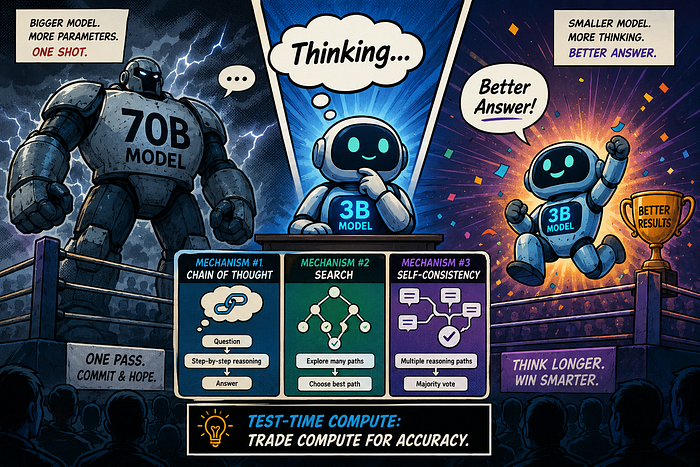
Ashutosh Saxena, founder and CEO of TorqueAGI, developing physical AI to make robots more intelligent.gettyEvery major AI investment decision eventually comes down to the same question: How do you know if a model is actually capable? For most executives, the answer has been a single number.Parameter count became the industry’s scoreboard. Bigger models generally produced better results, leading many leaders to equate size with intelligence. That shortcut was useful for a time. Today, it is increasingly misleading.What we call a “model” is not a single object. It is a stack of design decisions, each shaping what the system can do and how well it does it. As AI development shifts from brute-scale toward deliberate reasoning, understanding those layers is no longer optional for executives making consequential technology bets.Here is the framework.1. Architecture: The Computational FoundationArchitecture determines how information flows through a system.Transformers, diffusion models, state space models and mixture-of-experts are not interchangeable. Two systems with identical parameter counts can behave dramatically differently depending on how they are built. Architecture is the engine design. Everything else runs on top of it.2. Representation: How The World Is EncodedA system cannot reason about what it cannot represent.Language models work with token embeddings. Vision systems use latent representations. Robotics systems depend on geometric and spatial encodings. Some of the most significant AI breakthroughs had nothing to do with scale; they came from better ways of organizing information. A well-structured representation can outperform a much larger model built on a poor one.Representation determines what the system sees. That makes it foundational.3. Objectives: What The Model Is Trained To OptimizeEvery model is shaped by what it is rewarded for.Language models optimize next-token prediction. Recommendation systems optimize engagement. Reinforcement learning systems optimize cumulative reward. The objective is not a detail; it is the compass. It determines which behaviors get reinforced and which get suppressed. A system becomes precisely as good as its training objective demands.Consider physical AI. A warehouse robot trained only to maximize packages picked per hour may become fast but brittle. The moment a box is misaligned or a human steps into its path, performance degrades. Safety, robustness and edge-case handling never emerged because they were never part of the objective.4. Search And Reasoning: How Solutions Are ExploredThis is where the most important innovation is happening right now.Early AI systems produced answers directly. Modern systems explore before they respond via chain-of-thought reasoning, reflection loops, planning and test-time compute. These are not minor refinements. They represent a fundamental shift in how AI systems think.The distinction matters: parameters increase capacity. Search increases reasoning depth. OpenAI’s o1 model illustrated this clearly on hard mathematical reasoning benchmarks. Its gains came not simply from scaling a conventional language model, but from a reasoning-focused approach that allows the model to spend more time working through problems before answering.In enterprise terms, this is the difference between a system that retrieves an answer and one that reasons through practical implications. As an example, when a key supplier goes offline unexpectedly, a reasoning-based system works through the problem: which alternatives have capacity available, how do their lead times interact with current inventory buffers, which downstream production lines are most exposed and what is the optimal re-routing sequence given current customer SLA commitments. The reasoning depth is where operational value lives.A larger model may know more. A better reasoning process may reach better conclusions. These are not the same thing, and conflating them leads to poor technology decisions.5. Memory: Extending Intelligence Beyond The PromptMemory is consistently underrated.Context windows, retrieval systems and long-term memory architectures allow AI to access information beyond what fits in a single input. Two models with identical architectures and parameter counts can behave entirely differently depending on what they can recall. In enterprise deployments, access to the right organizational knowledge often delivers more value than a larger model ever could.In sales workflows, a smaller model with access to your deal history, pricing structures, customer interactions and negotiation precedents can outperform a frontier model without that context. The frontier model knows more about the world. The smaller model knows your business. For most sales decisions, that matters more.The same principle applies to physical AI. A warehouse robot without memory of SKU velocity, demand patterns or layout changes treats every task as new. One with access to that operational knowledge can prioritize inventory, anticipate bottlenecks and adapt as conditions change. Those advantages do not come from a larger model. They come from memory and retrieval.6. World Models: Internal Understanding Of RealityThe most capable AI systems do not merely recognize patterns. They anticipate outcomes.For language models, this means understanding causality, human behavior and relationships between concepts. For systems operating in the physical world, it means understanding geometry, contact dynamics, object permanence and physics. World models are what separate systems that react from systems that reason about what happens next.As AI moves beyond screens and into real environments, this distinction becomes increasingly important. The ability to predict outcomes before acting is becoming a prerequisite for reliable autonomy.Why The Next Decade Will Not Look Like The LastScale drove the first wave. It will not drive the next one.Parameter count remains an important metric. It is no longer the defining one. Architecture, representation, objectives, reasoning, memory and world models increasingly determine what a system can actually do.As AI systems become more capable, the more useful question is not how large a model is, but what makes it intelligent.Forbes Technology Council is an invitation-only community for world-class CIOs, CTOs and technology executives. Do I qualify?
Stop Measuring AI By Parameter Count. Here’s What Actually Matters
Two systems with identical parameter counts can behave dramatically differently depending on how they are built.
916 words~4 min read