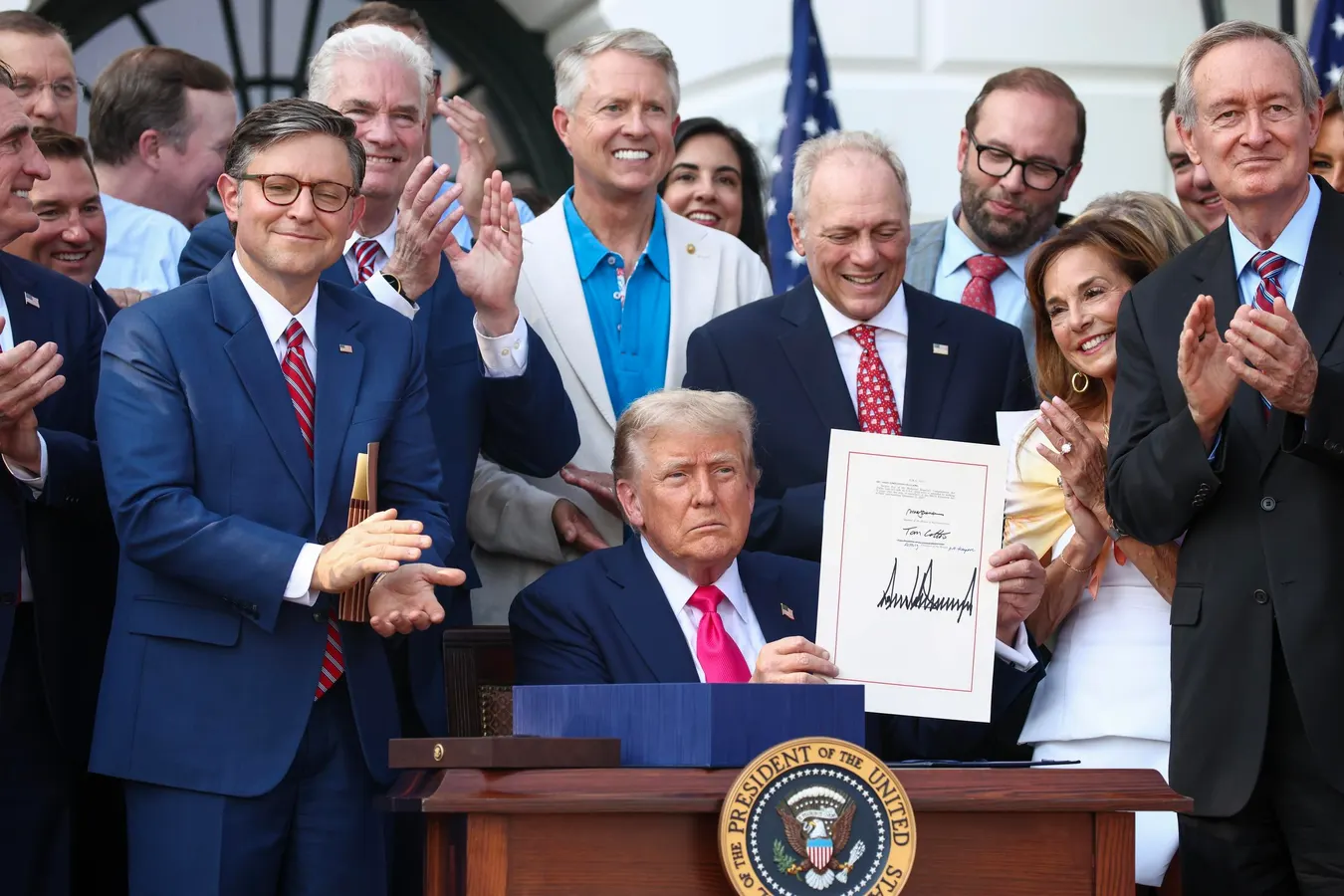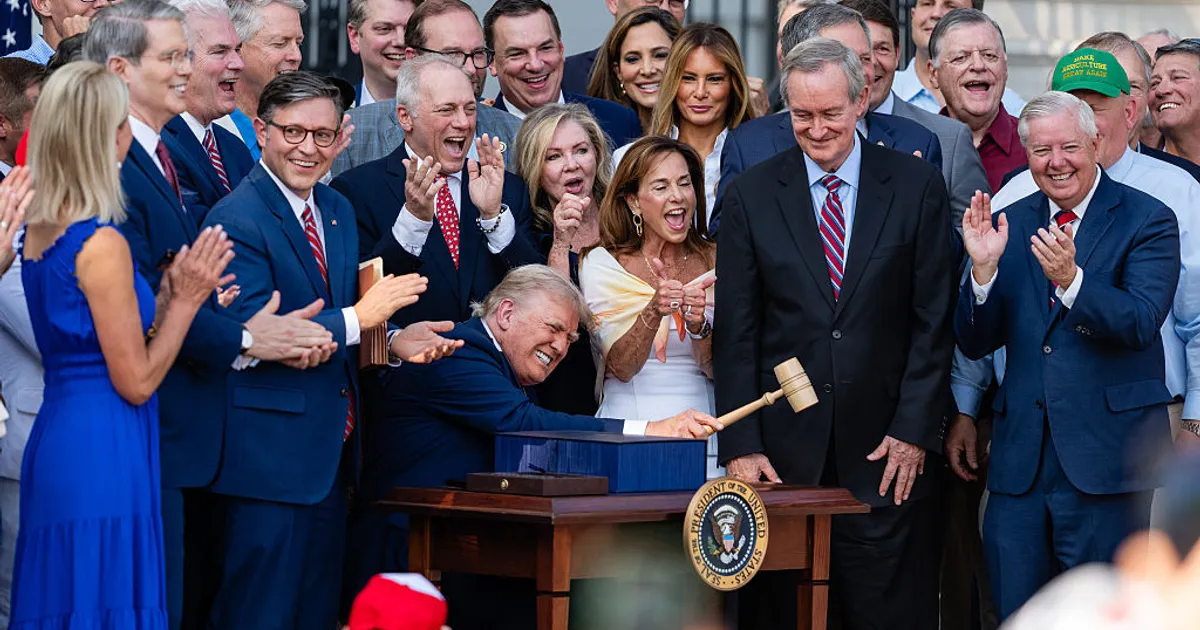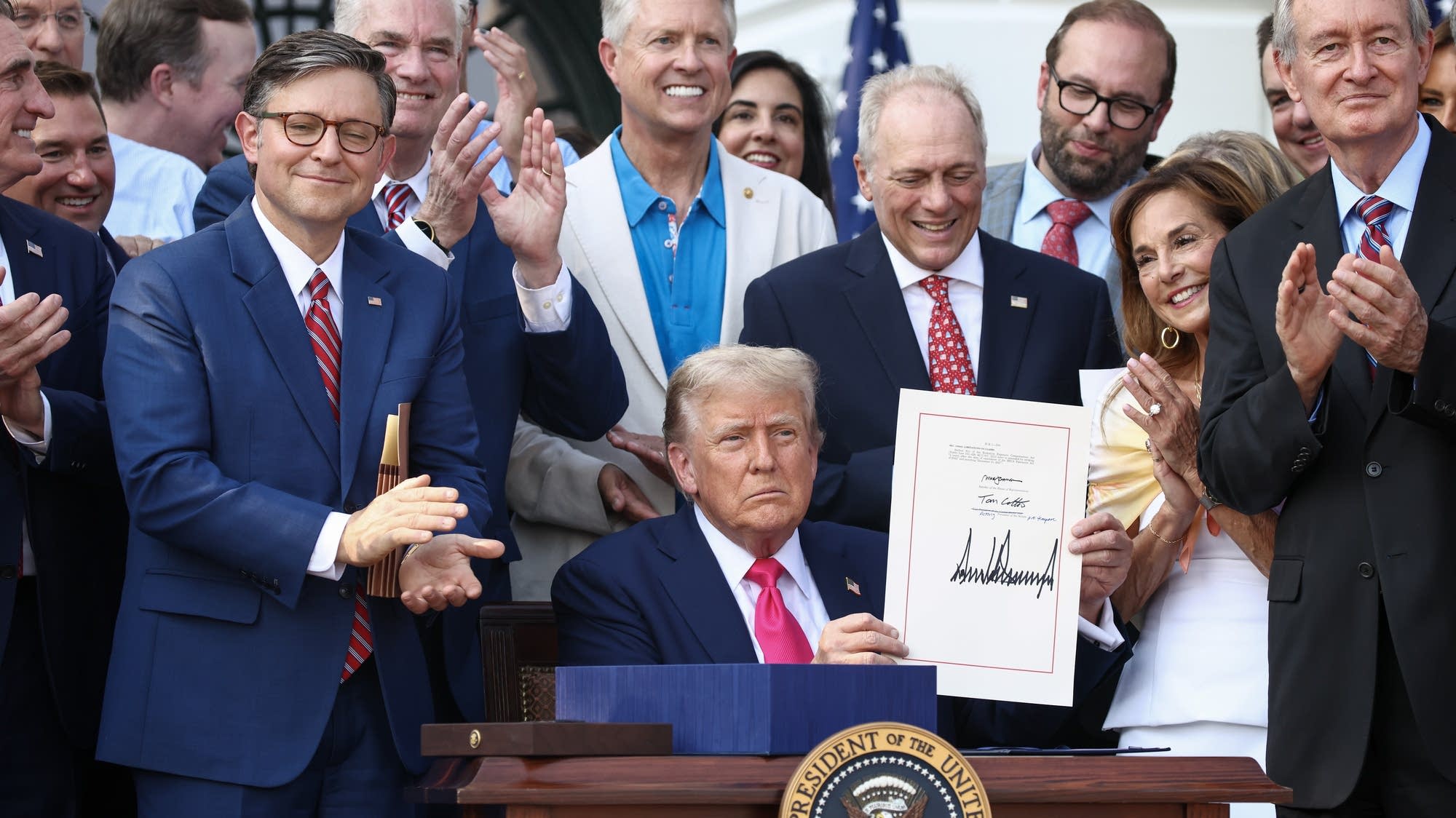
This week, marks one year since Congress passed the Republican tax and spending bill — the “One Big Beautiful Bill Act.”“Marketplace Moring Report” is spending some time looking at how some of the provisions from the law have played out — including who has benefited most. For more on that, host Kimberly Adams spoke with Andrew Lautz, director of tax policy at the Bipartisan Policy Center. The following is an edited transcript of their conversation.Kimberly Adams: Remind us of some of the headline tax effects of this legislation.Andrew Lautz: The 2025 tax law extended a number of expiring tax cuts from Republicans' last major tax law, the 2017 Tax Cuts and Jobs Act. They also included a number of new tax cuts, many of which were priorities of President Trump. And these are some of the tax cuts you've heard most about in the year since this passed into law: the tips deduction, the overtime deduction, the auto loan interest deduction.Adams: You and your colleagues at the Bipartisan Policy Center also have a list of “wins” from this legislation that maybe didn't get as much attention as some of those headline ones you just mentioned. What are some of the provisions that maybe flew under the radar?Lautz: Sure, a few worth mentioning here. The child tax credit was increased under the One Big Beautiful Bill. The maximum credit was $2,000 per child; it's now $2,200 per child, so the vast majority of parents and families who are claiming the child tax credit got a little bit of a boost.Somewhere between 85% and 90% of all taxpayers take the standard deduction; that standard deduction last year increased $750 for single taxpayers, $1,500 for married couples filing jointly. Now, because it's a deduction, that doesn't translate to an exactly $750 or $1,500 tax cut, but it does mean several hundred dollars in tax cuts for the vast majority of people filing their taxes. There's also a couple of smaller provisions that might take a few years to bear fruit, but that we think are worth highlighting. Congress expanded the low-income housing tax credit; this is a tax credit targeted at housing developers that helps bring more affordable housing supply online.Adams: You mentioned the increased child tax credit, that extra $200 per kid. But not every parent was able to get that this tax season. Why is that?Lautz: First of all, if you don't have income tax liability, if you make such little in income that you're not paying federal income taxes, you're actually capped at how much child tax credit you can get. That's capped at $1,700 per child, and so you don't get the full child tax credit. And then, if you make above a certain amount — and that's $200,000 for single taxpayers, $400,000 for married couples — you start to phase out of that maximum $2,200 per child until it hits zero. And so if you make too much money, you're also not getting the full child tax credit.Adams: Taxpayers were also able to write off more of their state and local taxes this year. This was a huge sticking point during the negotiation for the bill. How did that actually play out this tax season?Lautz: Taxpayers in high-tax, high-cost states did receive larger refunds on average, and we think a lot of that is driven by the state and local tax deductions. So, think taxpayers in New York, New Jersey, Connecticut, California — states that historically have had high taxes. A lot of high-income taxpayers in those states are benefiting from that boost in the SALT cap. We expect the folks in the mid-six figures — you know, your $250,000, $300,000, $400,000 a year — are the primary beneficiaries of this increase in the cap. And, again, primarily in high-tax states, high-property-tax states, where you have enough taxes to take advantage of that higher cap.Adams: One of the other things that was a big talking point during the negotiation for the bill, and when it passed, was that supporters said it would lower taxes for small businesses. Has that actually happened?Lautz: We have some early evidence, both in corporate income tax receipts and in individual income tax receipts, that small businesses are taking advantage of some of these provisions early on. And I mention individual income tax receipts, because what some Americans don't know is actually the vast majority of businesses in the country file their taxes as individual owners of the business. These are called pass-through businesses — they include S corporations, partnerships, LLCs, a lot of business types that people are familiar with. And again, we have early evidence that some of these provisions — full deductions, full and immediate deductions for research and development, full and immediate deductions for machinery and equipment. You know, if they have a $100 expense, they can take in $100 deduction in that first year, rather than having to spread that out over time. That has a real tax benefit for businesses large and small.Adams: A tax cut for a business or an individual is also a revenue reduction for the federal government. What kind of impact have we seen on federal revenues as a result of all these changes?Lautz: Great question. So, revenue in fiscal year 2026, the current fiscal year that we're in, is actually up about 5% compared to the same period in fiscal year 2025. Now, part of that is due to tariff revenue coming in. Tariff revenue is massively higher this fiscal year than it was last fiscal year. But individual income and payroll taxes are also up. Individual income taxes are up about 5% compared to the year prior. That's mostly due to higher wages and salaries, higher non-withheld tax payments, things like capital gains and business income. Now, where we've seen a big decline is actually in corporate income taxes. Those are down about $88 billion or 30%.Adams: And, just so we can get the comparison right, on the individual side?Lautz: Individual income taxes are up about $87 billion; corporate income taxes are down about $88 billion.Adams: Especially when you're looking at the difference between sort of individual tax payments going up and corporate tax payments going down, is it more or less what you expected when we originally got the bill?Lautz: [Corporate tax payments are seeing] a big drop. And, again, some of this, some of this is due to the accelerated deductions for research and development, machinery and equipment, coming back online. Now, overall, it's important to remember that the overall fiscal impact of the One Big Beautiful is expected to increase federal deficits and debt by trillions of dollars over the next 10 years. The official score from last July was $3.4 trillion on net over 10 years. That's reflective of not only the tax cuts in the bill, but also some of the spending cuts that were included. In the early months of fiscal year 2026, we're seeing higher overall revenues due to a number of factors.
Trump's tax and spending law, one year on
The “One Big Beautiful Bill Act” has been law for about a year. Here’s how the provisions have played out.
1,168 words~5 min read