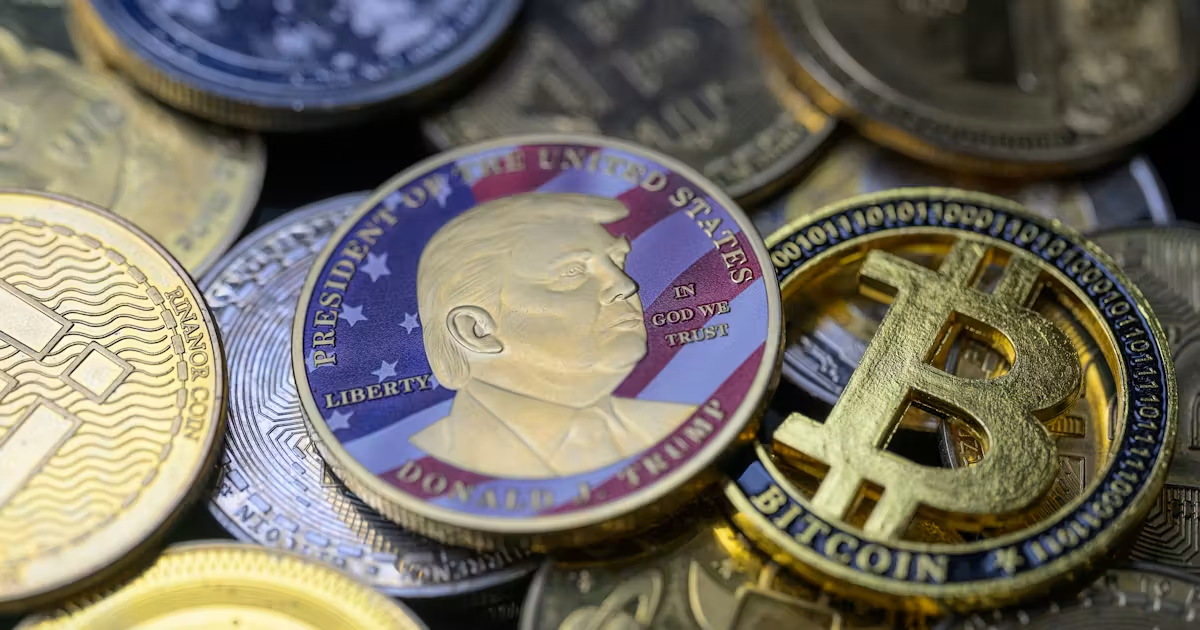
Being president of the United States is by far the most lucrative business venture of Donald Trump’s checkered business career. The June 30 release of his financial disclosure report makes this official. Trump has turned the American presidency into an extractive industry. In 2025, Trump mined more than $2.2 billion in income from being president, most of it from crypto, from which he extracted $1.4 billion. That’s all the more remarkable when you remember that crypto entered a slump last year and that investors in Trump’s crypto ventures who were not members of the Trump family lost $2.3 billion, according to a June 9 investigation by Tom Bergin of Reuters. It’s almost as if Trump’s ability to draw income from business ventures did not depend on those ventures being successful!A cynic might observe that Trump’s special treatment is no different from that of American chief executives in the private sector who are similarly insulated from failure. But Trump’s payday puts theirs in the shade. The only CEO whose compensation exceeded Trump’s last year was Elon Musk, who (for now) is a category of one. Musk’s $158 billion pay package from Tesla last year was more than 15 times larger than the combined pay packages of the other 391 chief executives surveyed in late June by The Wall Street Journal. If we set Musk aside, the highest-paid chief executive in the Journal’s ranking was Shankh Mitra, chief executive of Welltower, “a real estate investment trust focused on senior housing and healthcare.” Let’s leave for another day the ethics of harvesting a vast personal fortune from the physical and mental decline of one’s fellow human beings. My point here is that Mitra’s obscene pay package last year of $821 million was less than half of Trump’s $2.2 billion. Plus, I bet Mitra had to put in at least some actual work.I observed a year ago that Trump is America’s first rentier president. A rentier is someone who makes his money through the possession of assets rather than the exertion of labor. Rentiers are capitalism’s nepo babies. Prior to Trump, the main rentier occupations were real estate and finance. Trump himself was a classic rentier capitalist, a rich kid who joined the family real estate business, exaggerated his success to a credulous tabloid press, and inherited $413 million from his more successful father. Trump moved the family business from dowdy apartment buildings in Brooklyn and Queens to luxury apartments and hotels in Manhattan and beyond, but many of these went bankrupt. In 2018, The Economist concluded Trump would have made more money had he been a more conventional rentier and invested daddy’s money in index funds. The rentier presidency is a much more lucrative proposition than rentier capitalism, and one with which index funds can’t possibly compete. Crucially, there is no index fund that lets you acquire a stake without investing money or labor. During the 2024 presidential campaign the Trump family acquired a 60 percent stake in World Liberty Financial and was granted 75 percent on net revenues from token sales. (The Trump family stake in the company, the less valuable part of this deal, has since fallen to 38 percent.) Trump did not pay for these privileges, yet last year he earned more than $594 million from them. Neither is there any evidence, according to Reuters’ Bergin, that Trump ever paid for his stakes in the crypto firms ALT5 Sigma, American Bitcoin, or Celebration Coins. This last alone netted Trump more than $636 million last year. The business press often notes these days that Trump has become less a real estate investor than a crypto investor. But to call Trump a crypto investor is a misnomer because investors, um, invest. Trump doesn’t invest. He receives. Nor should we call Trump a media investor, because Trump didn’t pay one cent to acquire his majority stake in Trump Media & Technology Group. This company owns Truth Social, on which Trump posts his late-night rants, and “has engaged,” Michael Hiltzik observed last March in The Los Angeles Times, “in a number of baroque financial transactions.” It works out well for Trump that he didn’t put money into Trump Media & Technology Group because it lost $715 million last year on revenue of $3.7 million. Yet Trump’s stake in this money-losing venture somehow remains, according to his latest filing, worth more than $50 million. Nice work if you can get it.The business model for a rentier presidency might puzzle the untutored, given the extensive losses involved. Why would anyone invest with the president of the United States? Some of them are just suckers, still bedazzled by the phony business-genius image he created during 14 TV seasons of “The Apprentice” and “Celebrity Apprentice.” But others derive value in other ways. The United Arab Emirates bought a 49 percent stake in World Liberty Financial for about $500 million, then dropped another $2 billion on a World Liberty Financial stablecoin, and in return got an export ban lifted on AI computer chips. Binance founder Changpeng Zhao found various ways to boose World Liberty Financial, including giving the firm some software free of charge, and snagged a presidential pardon. Other examples of Trump auctioning off government policy are too numerous to mention, but Senator Chris Murphy, Democrat of Connecticut, provided a pretty good overview in a recent floor speech (video and transcript). Often what’s paid to Trump is protection money against some non-specific future harm. That explains ABC’s $16 million settlement of a baseless defamation suit Trump brought against George Stephanopoulos, and CBS’s $16 million settlement of a baseless election-interference suit Trump brought over the editing of a “60 Minutes” interview with Kamala Harris. These were shakedowns for Trump’s presidential library. The ABC and CBS windfalls landed there, according to the financial disclosure, along with a $24.5 million settlement with Meta over Trump’s post-January 6 suspension from Facebook and Instagram, and a $22 million settlement with Google over Trump’s post-January 6 suspension from You Tube. People often speculate that Trump ran for president in 2024 in order to stay out of jail. That’s certainly possible. But I’m more inclined to think he did it to stay out of bankruptcy court. It’s hard to remember, but as recently as March 2024 bankruptcy looked like a real possibility for the ex-president, at least to me. At that time Trump was worth a mere $2.6 billion, according to Forbes, and his net-worth trajectory over the previous decade was downward. What a difference a presidential election makes. By March 2026 Forbes put Trump’s net worth at $6.5 billion. In 2024, according to last year’s financial disclosure, Trump earned more than $622 million. In 2025, according to this year’s financial disclosure, Trump earned more than $2.2 billion. How does a full-time politician increase his wealth by $4 billion over two years and his income by $1.6 billion over one? To ask the question is to answer it. And on top of everything else, he gets free housing.
Kleptocracy Is Trump’s Most Lucrative Business Venture
His investments make money even when his ventures fail!
1,163 words~5 min read