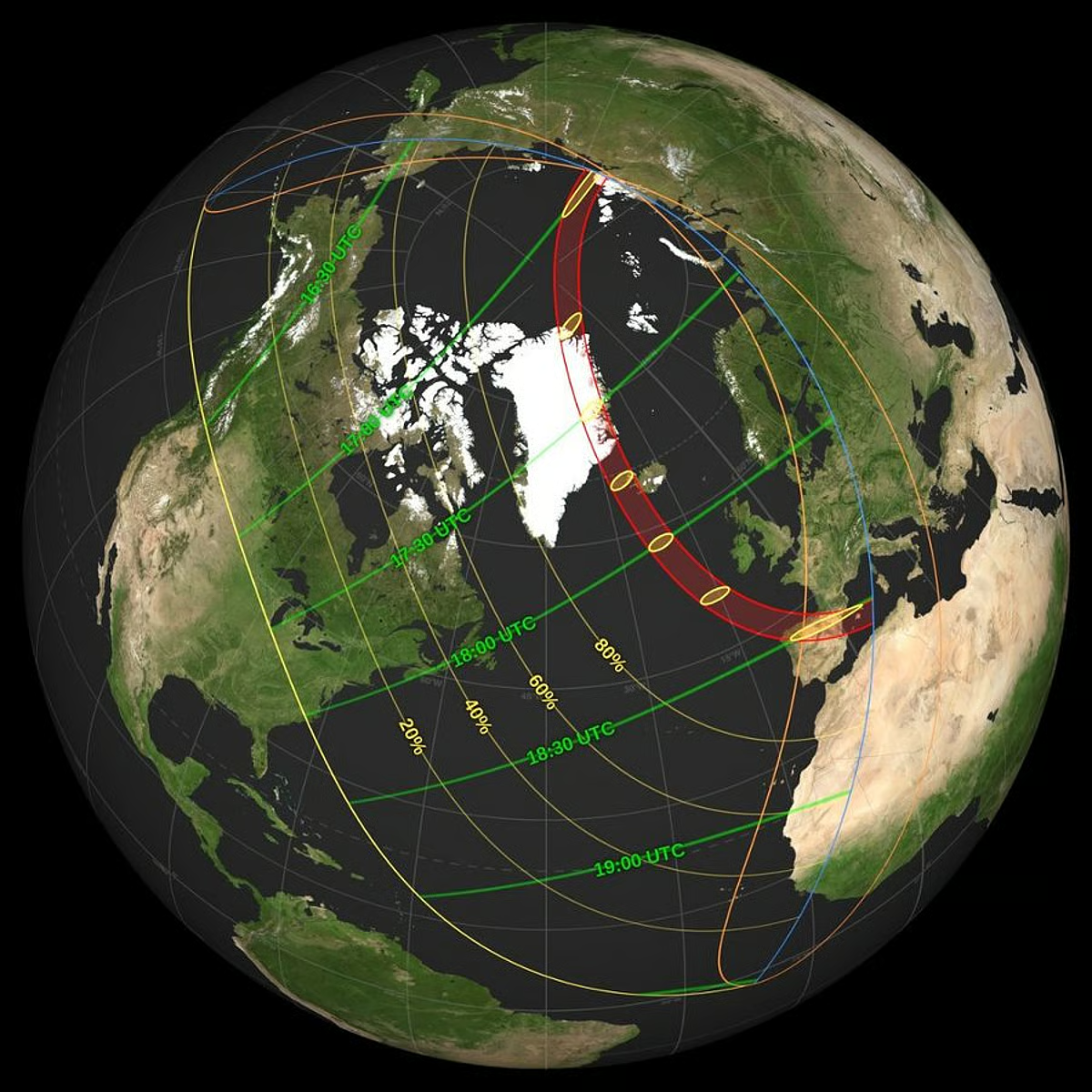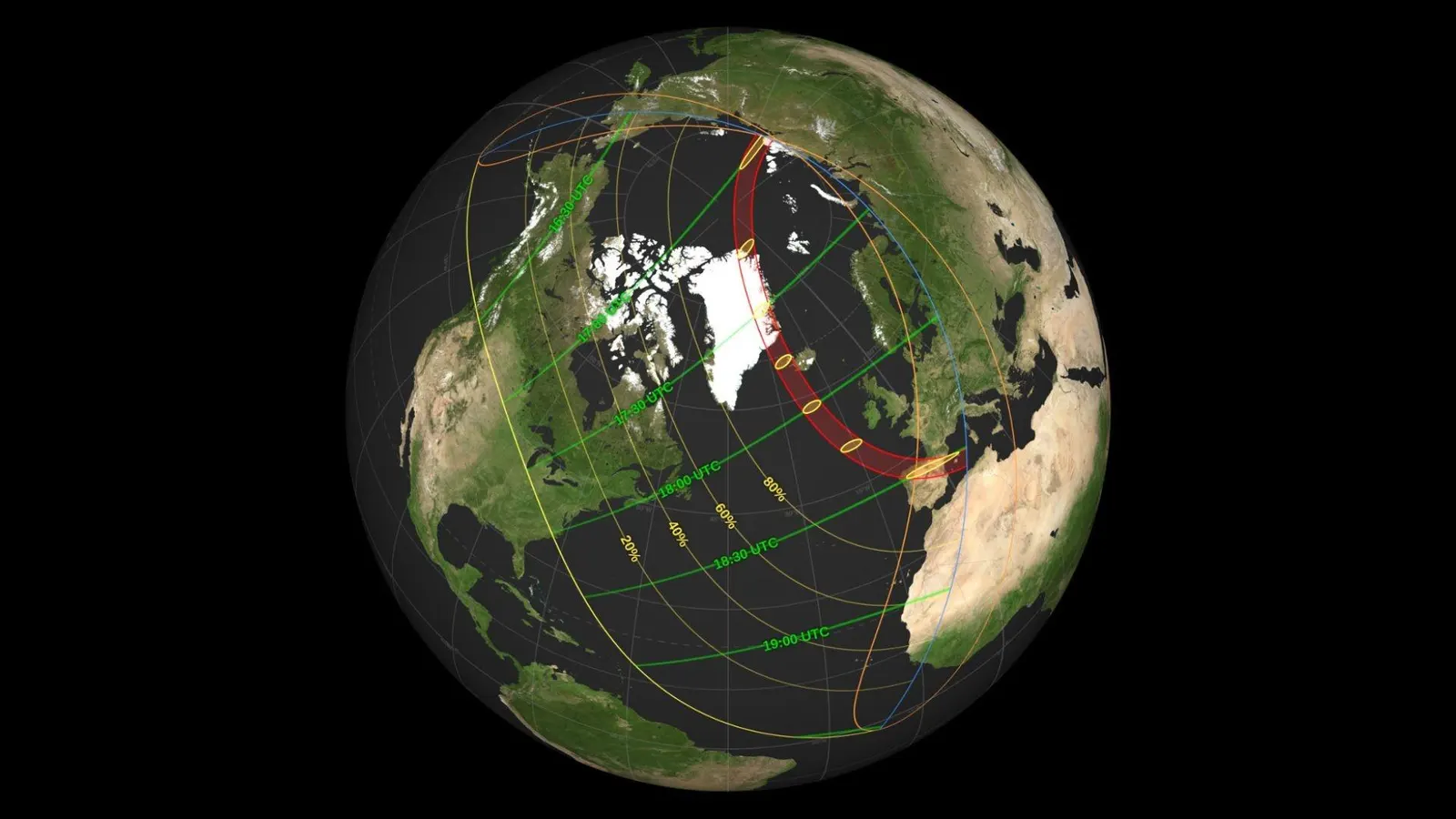
A map showing where path of totality for the 2026 total solar eclipse.NASA's Scientific Visualization StudioNASA has published a new map to help eclipse-chasers plan for the next total solar eclipse, but in Canada and some parts of the the U.S., there will be no totality — just a small partial solar eclipse. The total solar eclipse, which will be seen only in parts of Europe, it will come on the same day as the annual Perseid meteor shower reaches its peak under dark, moonless skies, creating a unique day for skywatchers. NASA’s map joins another from the European Space Agency as Europe prepares for its first total solar eclipse on the mainland since 1999.Here’s everything you need to know about using NASA’s map to see the August 12, 2026 solar eclipse from the U.S. and Canada. Where And When the 2026 Eclipse Will Be VisibleOn Aug. 12, 2026, the moon’s dark central shadow will project a path of totality across eastern Greenland, western Iceland, the Atlantic Ocean and northern Spain. However, NASA’s map also shows a partial solar eclipse visible from a much wider zone across the Northern Hemisphere, including Alaska, the northeastern U.S. and every Canadian province.MORE FOR YOUNo part of North America will see totality, as it did during the “Great North American Eclipse” on April 8, 2024. Instead, the moon will only appear to take a bite from the sun — a modest view for most, but significant in Alaska, Atlantic Canada and parts of New England, as well as in remote Nunavut. Understanding NASA’s Eclipse MapNASA’s map — designed by NASA’s eclipse cartographer, Ernie Wright, and published on the webpage for NASA’s Scientific Visualization Studio — shows two different parts of the moon’s shadow. The narrow central shadow is the umbra, where the sun is completely blocked and a total solar eclipse is visible. The much broader outer shadow is the penumbra, where the sun is only partly blocked, and a partial solar eclipse is visible. Here’s what the colors mean:Red lines mark the path of the umbra — the path of totality.Yellow ovals inside that path show where the umbra falls on Earth at 15-minute intervals.Yellow curves across the wider map show the partial eclipse region, with percentages indicating how much of the sun’s area will be covered by the moon.Green lines show the progress of the eclipse over time, marking when maximum eclipse reaches each part of the map.Eclipse maps often look strange because they flatten a curved Earth onto a page. This one is especially unusual because the moon’s shadow begins at a very eaely sunrise in a remote part of northern Siberia, Russia, then sweeps south across the Arctic and North Atlantic towards a Mediterranean sunset. This map shows where a total (red) and the partial (orange) eclipse will be visible across Earth’s northern hemisphere.European Space Agency (ESA)Viewing Times And Locations In North AmericaIn the U.S., the eclipse will be visible from Alaska in the morning and across parts of the northern and northeastern states around midday and early afternoon. In Canada, every province will see at least a small partial eclipse, with the best views in the east.For most observers, this will not be an eclipse worth traveling long distances for. In the U.S., Alaska and Maine get the best views. In Canada, the deepest eclipse in populated areas will be in Newfoundland and Labrador, while Iqaluit in Nunavut will see one of the most impressive partial eclipses in North America.Here are selected locations in the U.S. and Canada, with the time of maximum eclipse and the percentage of the sun covered by the moon, according to NASA:Fairbanks, Alaska: 8:27 a.m. AKDT — 37% partial solar eclipseAnchorage, Alaska: 8:21 a.m. AKDT — 28%Presque Isle, Maine: 1:50 p.m. EDT — 28%Bangor, Maine: 1:53 p.m. EDT — 23%Portland, Maine: 1:53 p.m. EDT — 19%Boston, Massachusetts: 1:55 p.m. EDT — 16%New York City, New York: 1:54 p.m. EDT — 9%Philadelphia, Pennsylvania: 1:53 p.m. EDT — 7%Iqaluit, Nunavut: 1:24 p.m. EDT — 61%St. John’s, Newfoundland and Labrador: 3:34 p.m. NDT — 53%Halifax, Nova Scotia: 3:00 p.m. ADT — 31%Montreal, Quebec: 1:45 p.m. EDT — 18%North America will see a partial solar eclipse on Aug. 12, 2026. (Photo by Henning Kaiser/picture alliance via Getty Images)dpa/picture alliance via Getty ImagesWhat To Expect During The Partial EclipseFrom the U.S. and southern Canada, the eclipse will look like a small chunk missing from the sun. In Alaska, Maine and Atlantic Canada, the effect will be easier to notice through eclipse glasses, especially around maximum eclipse.It will not get dark in North America. Even when 50% of the sun is covered, daylight remains strong because the remaining visible solar surface is still intensely bright.During a partial solar eclipse, it is never safe to look directly at the sun without proper eye protection. Regular sunglasses are not safe — always use solar viewing glasses or handheld viewers that comply with the ISO 12312-2 international safety standard. Cameras, binoculars and telescopes need secure front-mounted solar filters. Wishing you clear skies and wide eyes.
NASA Drops Map Of Next Total Solar Eclipse — And It Visits The U.S.
NASA’s new 2026 eclipse map shows totality across Greenland, Iceland and Spain — and a partial solar eclipse for parts of Europe, the U.S. and Canada.
842 words~4 min read