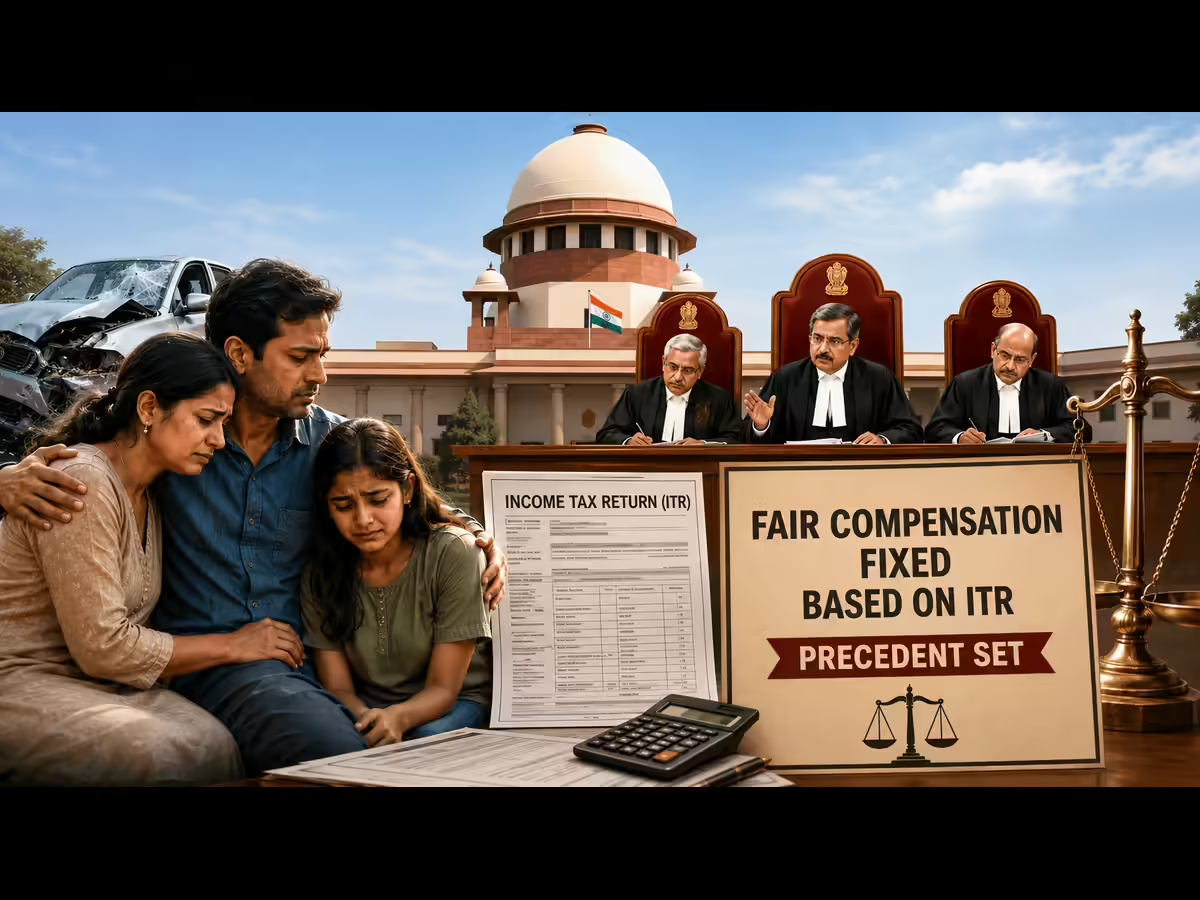
Eight years ago, 39-year-old Manoranjan Pandey, the sole breadwinner of his family, lost his life in a tragic accident while travelling from Behrampur to Bhubaneswar. His vehicle was struck by a truck being driven in a rash and negligent manner, because of which, the man suffered injuries and passed away during treatment. His family has been fighting a legal fight for fair compensation since. Now, the Supreme Court has not only fixed the relief amount for the family but also set precedent on deciding annual income of motor accident victims using their income tax return (ITR). It has issued guidelines for courts to fix the income of deceased victims in motor accident or injured claimants using their ITR. It held that ITRs being a statutory document are an important reference point when it comes to assessing one’s income, for the purposes of compensation under the Motor Vehicle Act. But pointed out that there “can be no hard and fast formula for computing the annual income of a deceased person/claimant”.ALSO READ | Man booked 11 shops for Rs 25 lakh in Mumbai in 1995 but didn't get possession even after 30 years; he fights back and wins full refund with 12% interestMan dies in accident, family seeks Rs 2.25 crore compensation: SC fixes relief based on ITR Manoranjan Pandey, who lost his life in the tragic accident in 2018, was the sole breadwinner of his family, according to the 2019 appeal filed in the Behrampur Motor Accident Claims Tribunal, and was running his own construction business and earning Rs 15 lakh per annum. Based on this, the claimant-appellants had sought a compensation to the tune of Rs 2.25 crore. The tribunal in February 2023, held the insurance company liable to pay a compensation of Rs 2.27 crore along with 6% interest per annum from the date of filing of the claim petition. The income of the deceased was ascertained as Rs 15 lakh per annum based on his ITR for the Assessment Year 2018-19. However, the insurance company approached the Odisha High Court, seeking a reduction in the compensation amount. The HC allowed the appeal and cut the compensation awarded by Rs 39,24,914 to Rs 1,87,75,150 along with 6% interest per annum. The court reduced the deceased’s annual income as Rs 13,33,226, by taking the average of the previous two ITRs, instead of only the previous ITR.ALSO READ | Rs 299 auto-debit you never signed up for? How that free 7-day trial can lead to UPI mandate for recurring debit - how to track these and revoke if needed Dissatisfied with the outcome, the family knocked on the door of the Supreme Court. The top court fixed the victim’s annual income as Rs 14,00,000, up from Rs 13.33 lakh fixed by the HC. “There was no reference made to other factors relating to the nature of business,” the SC said, and announced that the family will be entitled to a relief of Rs 1,97,81,505. The amount is to be remitted directly in the bank account of the claimant-appellants, within a period of 4 weeks.Income tax return use for motor accident damages: How ITR will decide compensation The issue which before the apex court was whether for assessing the annual income of a deceased person or claimant under the Motor Vehicles Act 1988, the ITRs for the previous year is appropriate or average of the past two/three years is to be taken into consideration? “Some Courts take the average of the last 3 years, whereas some take the last return filed to assess the income of the deceased,” SC stated. While the ITR is the prima facie evidence of the deceased’s income, it does not always reflect the true income of the deceased. Factors like business income pattern, growth pattern and nature of business also warrant consideration.ALSO READ | Homebuyer paid for a flat in a Delhi housing society in 2003, got delayed possession, sought compensation for delay; SC defends his right A bench of justices Sanjay Karol and N Kotiswar Singh held that there can’t be a fixed formula to calculate annual income under the Motor Vehicles Act. It, however, drew a clear distinction between salaried employees and self-employed persons for the purpose of assessing compensation based on their ITRs.Salaried vs self-employed motor accident victims: How will ITRs be used to determine compensation? For salaried individuals, the ITR of the previous year will be sufficient for showcasing the annual income. In case the employee was recently promoted but the corresponding ITR has not yet been filed, courts could also decide based on promotion letters, salary records, other financial documents. Moreover, in cases where the ITR has been filed after the death, it would be appropriate to call for the ITRs for the past three years along with balance sheets of the concerned person/entity. When it comes to self-employed or individuals carrying out their own business, in our view, the average of the income specified in the ITRs of up to the previous three years is to be taken as a reference point for assessment of annual income from their business. If only one or two ITRs were filed, surrounding circumstances like nature of business, growth pattern, negative income etc. will also be taken into consideration.
Man dies in motor accident, family seeks Rs 2.25 crore in damages: Here's why SC fixes ‘fair’ compensation based on his ITR, sets a precedent - The Economic Times
Manoranjan Pandey, who lost his life in the tragic accident in 2018, was the sole breadwinner of his family, according to the 2019 appeal filed in the Behrampur Motor Accident Claims Tribunal, and was running his own construction business and earning Rs 15 lakh per annum. Based on this, the claimant-appellants had sought a compensation to the tune of Rs 2.25 crore.
874 words~4 min read