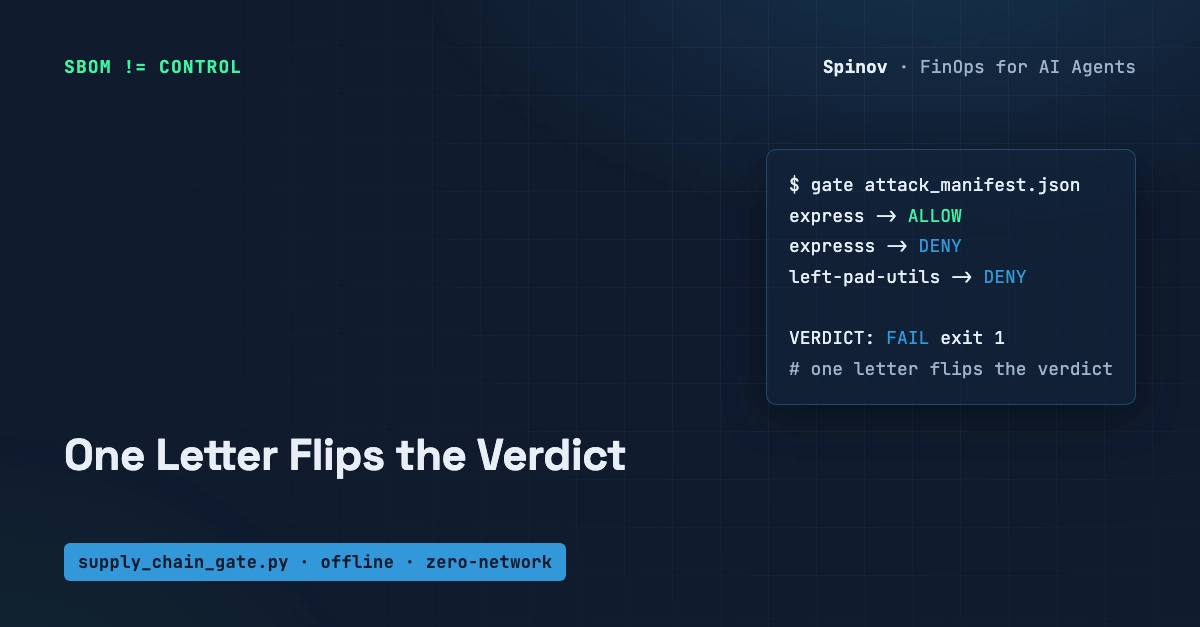
A pre-install supply-chain gate returns ALLOW or DENY for each package your AI agent proposes, before npm install runs, keyed on provenance: is the name in a vouched snapshot or a popular baseline, and is the .npmrc registry trusted. An SBOM taken after resolve cannot answer that question. In this post's attack manifest, supply_chain_gate.py returns 2 DENY and exits 1.
AI disclosure: I wrote supply_chain_gate.py with an AI assistant and ran it myself, offline, before publishing. Every number in the output blocks below is pasted from a real local run on Python 3.13.5, standard library only, no network. I checked the exit codes (0 / 1 / 2), hashed the STDOUT twice to confirm it is byte-for-byte deterministic, and edited every line. The external figures I cite (the USENIX 2025 package-hallucination study) are the researchers' numbers, not mine, and I link the source and say how they measured. I keep their numbers and my run's numbers in separate paragraphs on purpose.
In short:
An SBOM and a CVE scan run after npm install. They record what resolved and whether it has a known CVE. Neither can say whether your agent should have proposed that name in the first place.
A coding agent recommends a dependency with the same flat confidence whether the name is real, hallucinated, or one letter off a real one. That confidence is exactly what a post-resolve scan cannot see through: a name registered yesterday has no CVE yet, so a known-CVE scan lists it as clean.