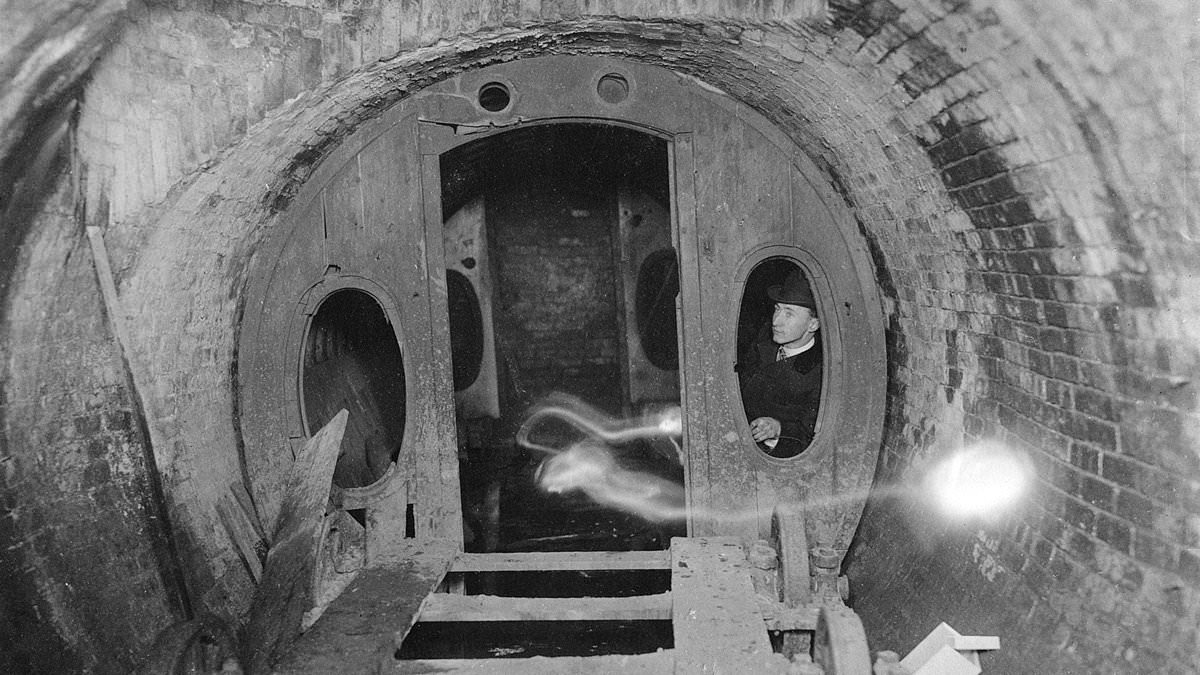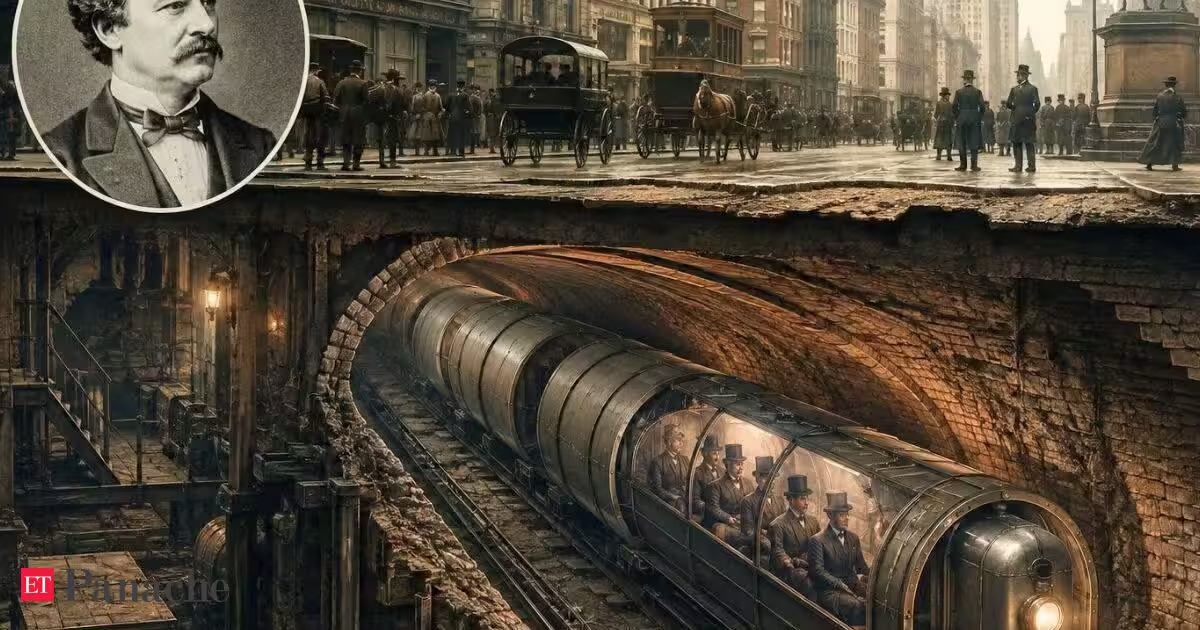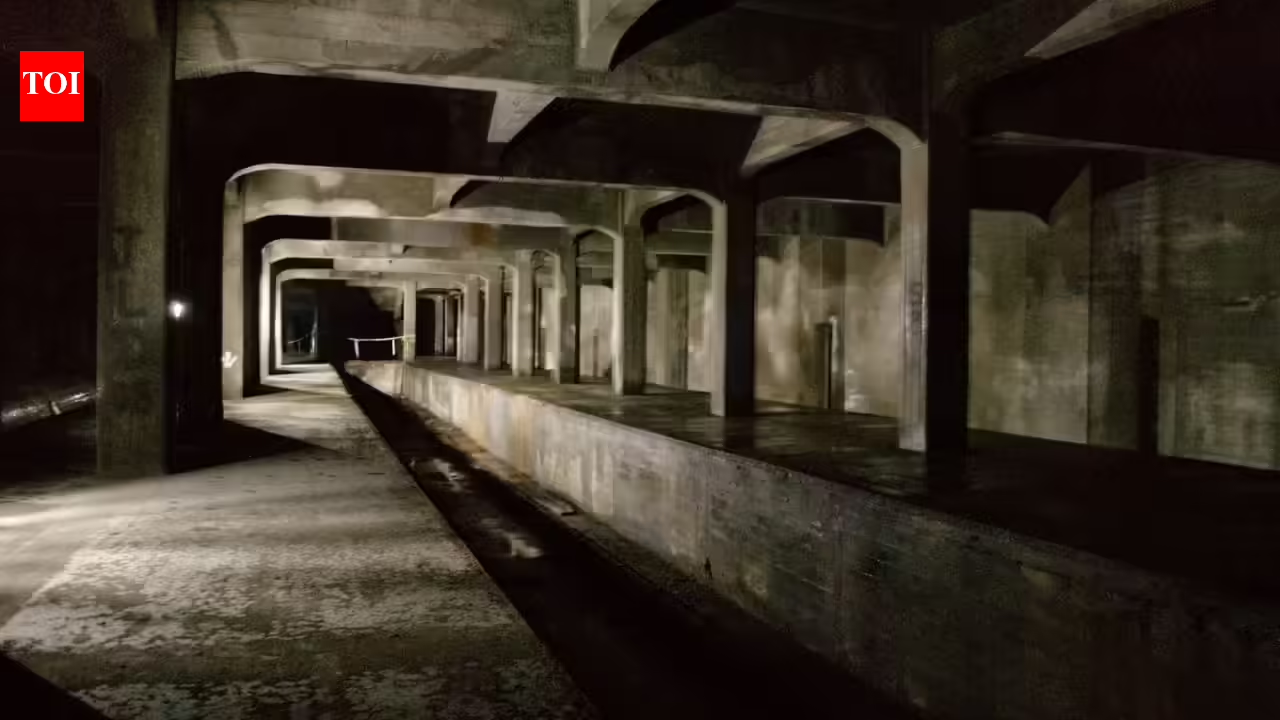
In Cincinnati, parts of the road network sit slightly too wide for what passes through them today, as if something else was meant to be there. Central Parkway cuts through the city in a smooth, sunken line that feels older than the traffic moving across it. Beneath sections of it lies concrete work that never quite fulfilled its purpose, stretches of tunnel that begin with intention and then simply stop. It is not a hidden secret so much as a leftover decision, one that was made in an era when cities expected to grow in straight lines and solve congestion with bold underground fixes. What remains now is a mix of drainage, railway ambition, and interrupted planning, all folded into a corridor that never became what its builders imagined.How the Miami and Erie Canal corridor became Cincinnati’s early subway routeLong before any talk of trains, the space now known as Central Parkway carried water rather than wheels. The Miami and Erie Canal once ran through the city, a working channel for freight and trade in a different century. By the early 1900s, it had lost its usefulness, slow-moving and increasingly unpleasant, more of a problem than an asset.Rather than leave it to decay, the city chose to repurpose the route. Filling it in created a long, continuous strip of land cutting through the urban centre, unusually suited for transport planning. It was one of those rare urban quirks where geography seemed to offer a ready-made solution.By the mid-1910s, attention had shifted to underground rail. Congestion at street level was becoming harder to ignore, and planners saw the former canal as a straight path through the city that could carry something faster and cleaner than trams or horse traffic had ever managed.The early scheme was ambitious, a loop stretching well beyond downtown and reaching out towards neighbourhoods like Clifton, Norwood and Walnut Hills. It was never a modest proposal. Stations were marked out, routes drawn, and sections of work began to take shape beneath the surface. The idea was that trains would slip beneath the city’s busier streets, surfacing only at key points before dipping underground again.For a while, it felt like the shape of a future system was actually forming.Tunnels, platforms, and an incomplete network taking shapeWork did progress, though not in a single continuous push. Sections of tunnel were dug, reinforced and left in varying states of completion. Some stretches were more developed than others, with platforms partially formed and passageways that hint at where tracks might have gone.Above ground, certain station sites were marked out along what became Central Parkway. A few structures appeared in anticipation of services that never arrived. Further out, in places like Norwood, construction also began to echo the central effort, though it never fully aligned into one operating network.What survives is uneven. Parts look like infrastructure still waiting for activation, while others resemble ordinary underground utility spaces that happen to be oversized.How financial pressure and politics brought construction to a haltBy the 1920s, momentum had started to thin. Costs were rising, not only from materials but from the broader financial strain that followed the First World War. City priorities were also changing, and the political backing that had supported the project began to weaken.A new administration in City Hall viewed the subway with less enthusiasm. What had once been a flagship plan of an earlier leadership began to feel like an expensive inheritance. Work slowed, then paused in places, then stopped altogether. By 1928, construction had effectively ended, leaving the system suspended mid-formation.Economic pressures of the following decade made any revival unlikely. The Great Depression removed whatever possibility remained of returning to large-scale urban rail building in the city.What remains of a subway dream that never reached completionWhen the work stopped, it did not disappear. The tunnels remained sealed or repurposed, the canal bed became a roadway, and the half-finished sections settled into the background of city life. Over time, most residents passed over or beside it without thinking much about what lay underneath.Later attempts to revisit the idea of a subway surfaced from time to time, usually when traffic congestion became difficult to ignore. The proposed routes often echoed the original plan, running parallel to major highways that now carry far more vehicles than anyone in the 1920s could have anticipated.Still, nothing matched the scale of what had once been started. The infrastructure remained as it was left: incomplete, but physically present.An unbuilt system still reflected in Cincinnati’s Daily commuteToday, commuting through Cincinnati can feel shaped by decisions made long before modern traffic existed. Roads fill quickly, especially along the main interstate corridors, and journeys that should be short often stretch longer than expected.Beneath parts of the city, the abandoned system sits quietly, not entirely forgotten but rarely seen in full context. It is less a landmark than a structural pause in development, a reminder that large civic projects do not always resolve in the way they are drawn.The old subway plan is still discussed from time to time, usually in the context of what might have been different if it had continued. But physically, it remains what it became nearly a century ago: a partially built system resting under a city that moved on above it.
In the 1920s, this American city built a subway beneath its streets but it never carried a single passenger
In Cincinnati, parts of the road network sit slightly too wide for what passes through them today, as if something else was meant to be there. Central Parkway cuts through the city in a smooth, sunken line that feels older than the traffic moving across it.
875 words~4 min read