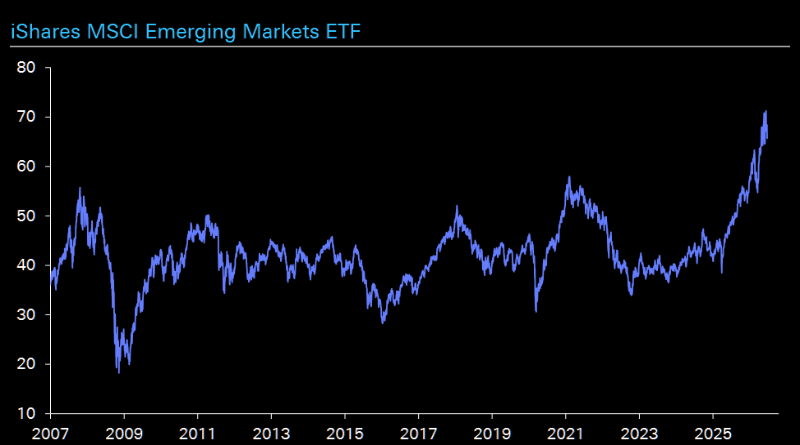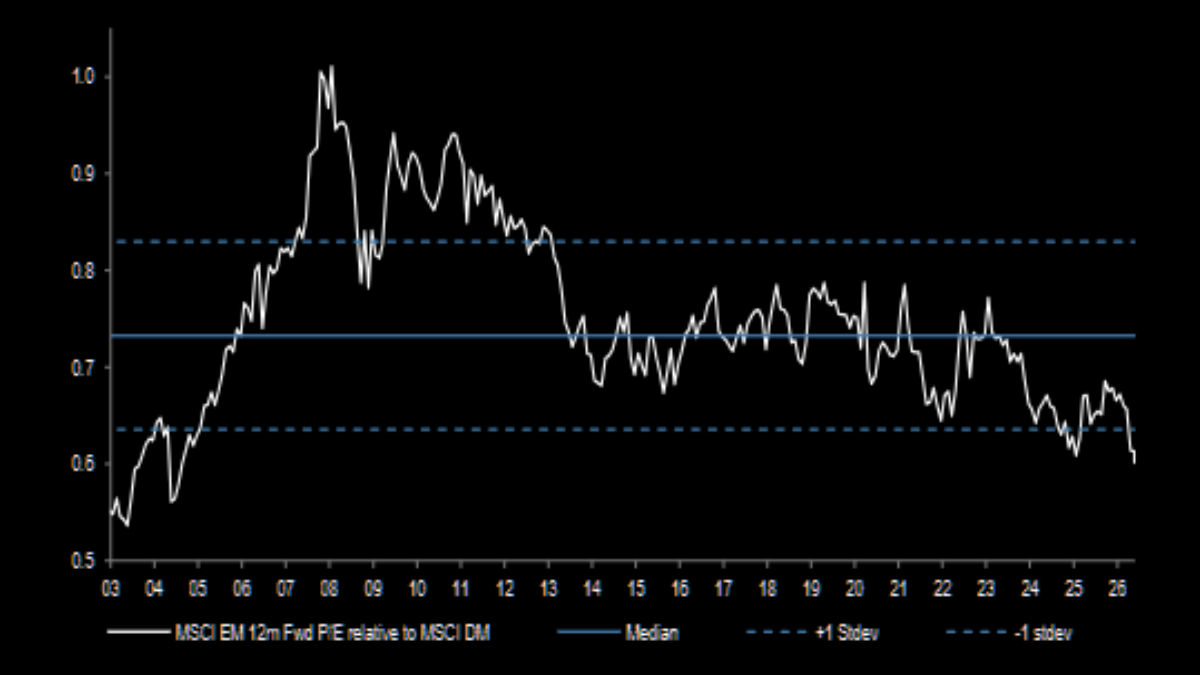
AI-led growth – North Asia sits at the centre of the global AI hardware supply chain, from semiconductor manufacturing and testing to networking and infrastructure.Favourable macro conditions – A weaker US dollar and lower interest rates have helped improve financial conditions across many emerging economies.Attractive valuations – Emerging markets continue to trade at lower valuation multiples than many developed market peers, despite improving earnings in several regions.Earnings momentum and governance reforms – Corporate earnings, shareholder returns and governance standards are improving across a number of key emerging markets.Diversification beyond developed markets – China, India, Latin America and other emerging economies offer exposure to different growth drivers, sectors and economic cycles.For Sonal Tanna, portfolio manager for JEME (JPMorgan Emerging Markets Research Enhanced Index Equity Active ETF) at J.P. Morgan Asset Management, the renewed attention reflects several developments occurring simultaneously.“EM have been boosted by a number of factors such as dollar weakness, which in turn supports EM economic conditions; Asia’s role in the AI hardware supply chain; some improvements in governance in markets such as Korea and China, and potential reforms on the horizon for Hungary; and valuations which can look reasonable compared to Global markets, in particular the US,” Tanna says.Sonal Tanna, portfolio manager for JEME (JPMorgan Emerging Markets Research Enhanced Index Equity Active ETF) at J.P. Morgan Asset Management. The backdrop has changed after an extended period in which investors increasingly concentrated their exposure in developed markets.“Investors are already very well positioned in US equities, both directly and given the US’s substantial weight in global equity funds. Conversely emerging markets have been broadly out of favour for some years,” Tanna says.“We believe that several dynamics are encouraging investors increasingly to diversify away from more expensive and more widely held DM. Positive performance is both an outcome of that diversification and a trigger for investors to revisit underweight positions in EM.”The AI infrastructure storyArtificial intelligence may be grabbing headlines through software applications and large language models, but much of the infrastructure underpinning the technology sits within Asia’s manufacturing ecosystem.Semiconductor fabrication, testing, packaging, networking and supporting technologies are heavily concentrated across North Asia, giving many emerging markets a direct connection to one of the defining investment themes of the decade.“North Asia remains central to the AI supply chain – across compute, testing and packaging, substrates, and networking – with three quarters of global semiconductor manufacturing located in Asia,” Tanna says.“The memory upcycle remains intact, and hyperscaler capital expenditure forecasts continue to be revised upward, reinforcing the durability of demand.”That growth story has helped drive strong performance across parts of the market, although some observers caution that headline index returns do not always tell the full story.Nick Reddaway, co-founder and chief investment officer at Drummond Capital Partners, says recent gains have been heavily influenced by a relatively small group of companies.“More recently, the rotation has been driven predominantly by a very narrow basket of AI-exposed semiconductor companies,” he says.“This sector is traditionally quite cyclical, and today not only are the stocks going up multiples in short periods of time, they are backed by an extraordinary increase in demand and pricing delivering extremely strong earnings that are forecast by some to become more structural than cyclical.”Reddaway says investors should distinguish between enthusiasm and speculation.Nick Reddaway, co-founder and chief investment officer at Drummond Capital Partners. “There is no dot-com misguided boom here, the fundamentals are very strong, with SK Hynix nearly tripling revenues from a year earlier in its recent results, but the very strong performance of the broad emerging markets indexes hide the reality that essentially 3 stocks with exceptional gains are driving it.”Tanna says investor attention is also extending beyond the most obvious AI beneficiaries.“Where valuations across parts of the supply chain have moved to elevated levels, we continue to find opportunities in complementary areas – networking, substrates, and power infrastructure – where demand-supply imbalances remain favourable,” she says.Macro conditions and valuation supportTechnology is only one of several factors supporting renewed interest in emerging markets.Currency movements have also played an important role, particularly as expectations for the US dollar have shifted.“A weaker dollar has been a key support for emerging markets, easing financial conditions and enabling central banks to lower rates,” Tanna says.She says substantial fiscal support across major economies continues to underpin demand, while many emerging economies outside China remain exposed to sectors benefiting from inflationary conditions, including industrials, defence and commodities.Valuations remain another point of differentiation.“EM as a group have a meaningfully lower PE than DM,” Tanna says.However, the picture varies considerably across regions. ASEAN markets remain relatively inexpensive on both an absolute and historical basis, while technology-heavy North Asian markets have appreciated alongside global technology peers.The question for investors is not simply whether valuations are low, but whether current earnings and returns on equity can be sustained.Tanna says there is also growing attention on governance reforms that may support shareholder outcomes across several markets.“Governance is improving in South Korea, due to the Value Up programme,” Tanna says.She also points to increasing focus on shareholder returns in China and improvements in governance standards across parts of Central and Eastern Europe, including Poland and the Czech Republic.Together, these changes are prompting investors to take another look at emerging markets.More than a China storyAlthough China remains a significant component of emerging markets indices, investors increasingly view the asset class as a collection of distinct economies with different growth drivers, policy settings and sector exposures.“China, India and other EM offer diversification benefits in terms of their economies and also the composition of their respective stock markets,” Tanna says.China continues to navigate a challenging economic environment, although there are tentative signs of improvement. India, meanwhile, remains supported by structural reforms, while Latin America offers exposure to different economic drivers, including commodities, energy and domestic demand.“In India, structural reforms over the past decade underpin long-term growth, and a mid-cycle slowdown is being met with monetary and regulatory easing,” Tanna says.The diversity of these markets is one reason emerging markets continue to play a distinct role within global portfolios.Reddaway says concentration within major equity indices has increased the value of diversification across different regions and economic drivers.“More broadly, there are also many structural growth trends that are underrepresented within developed markets,” he says.“In an environment where equity market indices have become increasingly concentrated in a narrow group of companies – including within emerging markets themselves – there is an increasing need to diversify global equity allocations across regions and economic drivers.”Navigating a fragmented marketFor all their potential attractions, emerging markets remain a complex asset class.The MSCI Emerging Markets Index spans more than a dozen markets across Latin America, Europe, the Middle East, Africa and Asia Pacific, and contains more than 1100 companies across sectors including financials, information technology, communication services, consumer discretionary, industrials and energy.“The emerging markets asset class is large, diverse and complex,” Tanna says.“There are substantial variances in business models, management quality / corporate governance, and government and regulatory dynamics.”Access can also present practical challenges.Some markets, including India and onshore China, can be difficult for individual investors to access directly because of local regulations, foreign exchange controls and account-opening requirements.The result is an investment landscape that demands a detailed understanding of local conditions, regulatory frameworks and corporate behaviour.The renewed interest in emerging markets reflects a combination of technology, macroeconomic and market-specific factors. Yet the asset class remains diverse and complex, meaning questions around concentration, governance and access are likely to remain central as investors reassess its role within global portfolios.To find out more, please visit J.P. Morgan Asset Management.
Six reasons emerging markets are back in focus
Emerging markets have re-entered the investment conversation after spending much of the past decade in the shadow of developed markets, particularly the US.
1,254 words~6 min read