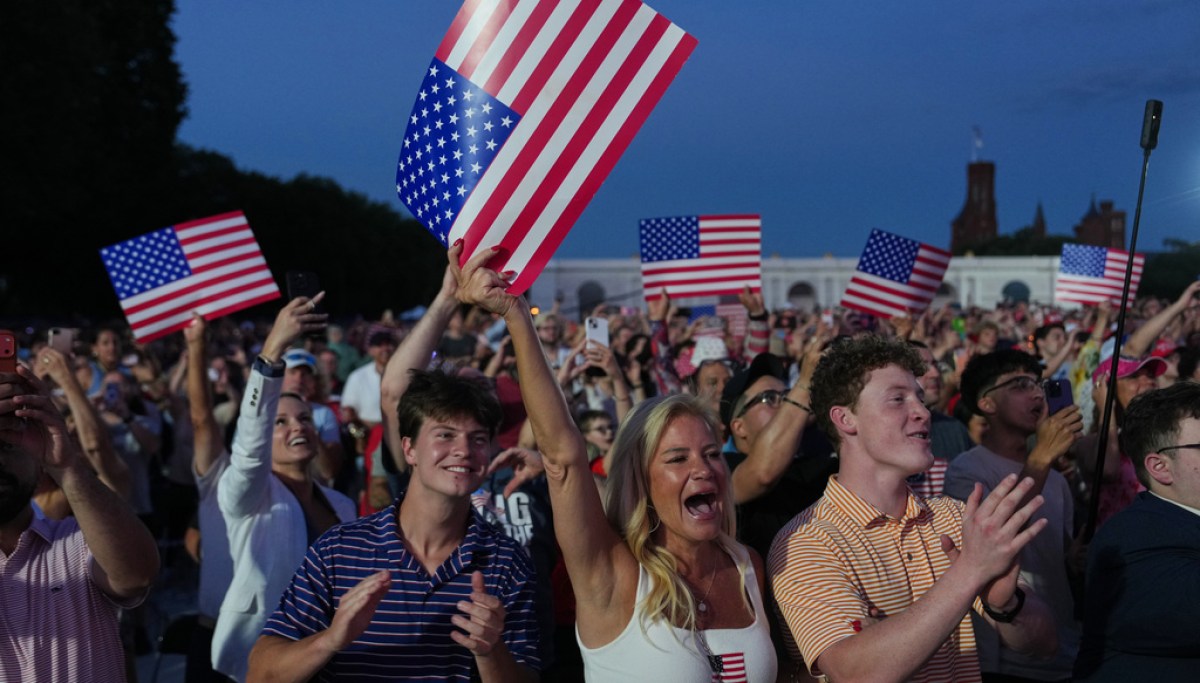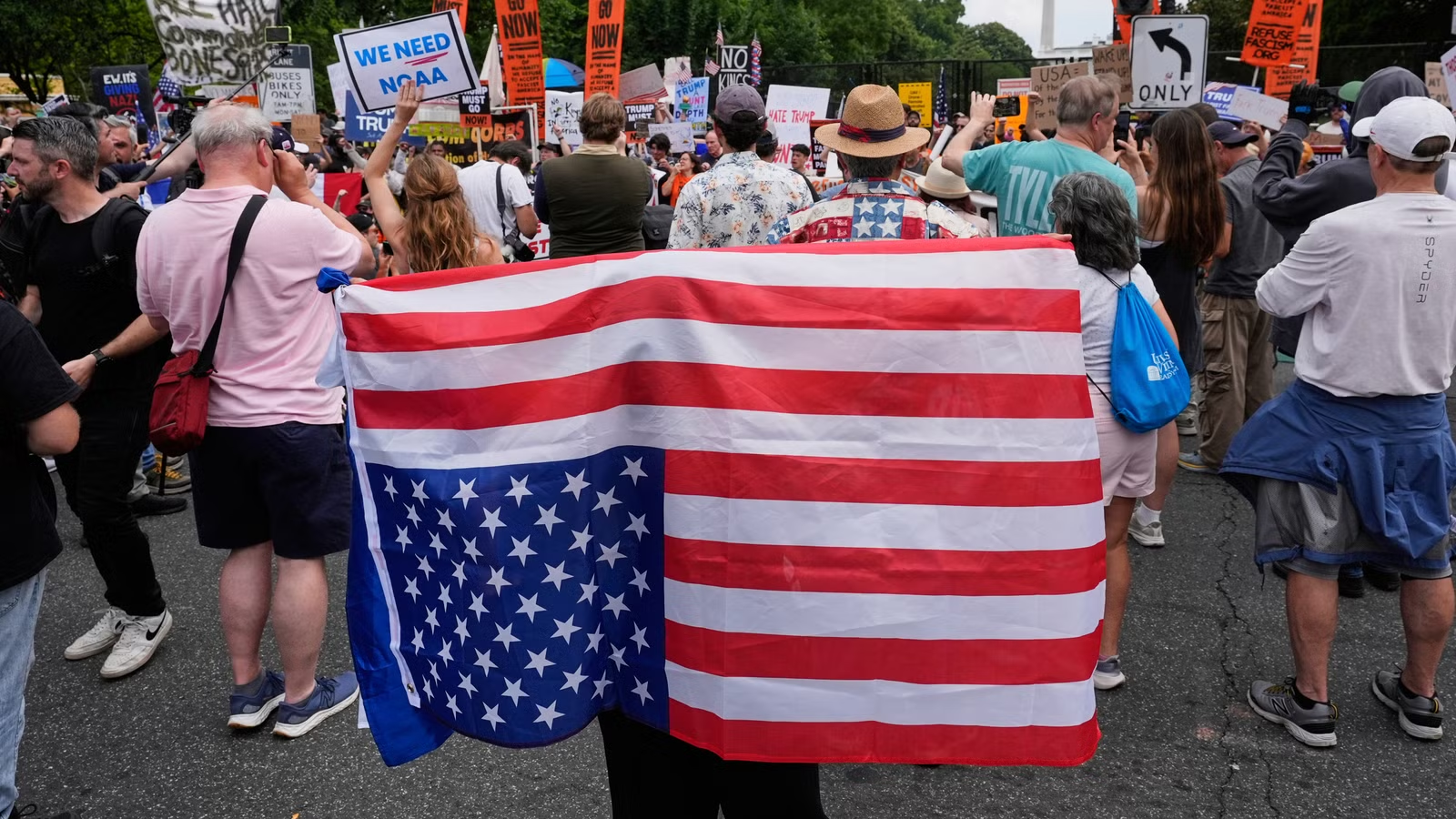
A new survey found that older, white Republicans are most likely to say that they fly the American flag outside their home, while Black Americans are least likely to. These findings were released in the days leading up to America’s 250th anniversary, when Americans’ pride seems to be at a historic low. Fifty percent of the 2,596 adults surveyed by The Associated Press-NORC Center for Public Affairs Research said they never display the American flag at their homes, even during holidays like the Fourth of July. Around 2 in 10 said they display the flag for most of the year. Last year, a YouGov survey found that around 51% of Americans said they had an American flag at home, and around 23% said they had it on display year-round. Only 10% of Black adults who answered the AP-NORC survey said that they have an American flag outside their home daily or for most of the year, and 18% said they put it out during the holidays. MoMo Productions via Getty Images"There is a widening gap between the ideals the flag is meant to represent and what our nation has actually delivered," Patrice Willoughby of the NAACP said. “Black Americans are deeply patriotic, but the choice to not fly the American flag is a reflection of the harsh duality of this country,” Patrice Willoughby, NAACP chief of policy and legislation, told HuffPost. “There is a widening gap between the ideals the flag is meant to represent and what our nation has actually delivered. Instead of dismantling the progress our communities fought and died for, the U.S. should honor the strength of our diversity and create a future that works for us all.”In comparison, 19% of Hispanic adults reported having their flags out year-round, and 29% said they’ll do it for specific holidays; 27% of white adults said their flags are out daily, and 29% said they are out for holidays, The Associated Press reported.The American flag has stood as a symbol of freedom and unity; however, only 22% of Black adults see the flag as a unifying symbol, compared to 42% of Hispanic adults and 55% of white adults. Young Democrats and independents are more likely to view the flag as a symbol of division. “There’s always been a kind of vexed relationship to the symbols of American patriotism in Black communities, primarily because of the history of racism in the country,” Eddie Glaude, a political commentator and the chair of Princeton’s Department of African American Studies, said. Glaude pointed to his own experiences, referring to how his father had fought in Vietnam but came home and had difficulty voting. There is also a mentality where conservative views are wrapped up in the image of the American flag. The AP-NORC survey found that 73% of Republican respondents viewed the flag as a unifying symbol. “When you see an identification of a certain iteration or expression of conservative politics, and it’s wrapped in the flag, the flag will bear the burden of that intensification,” Glaude said. That dynamic, he said, has been especially pronounced this year. “Trump has done so much work to blur the celebration of the country with the celebration of himself,” he said.Gallup released similar poll results on Monday, finding that 48% of white Americans fly their American flag outside their home compared to 33% of people of color. Gallup noted that respondents also said pride had a significant effect on whether they would display the flag at their homes. Pride is at its lowest point since Gallup started tracking it in 2001. “Pride has been falling for two decades, but the pace has quickened in recent years, with the latest reading down eight points from last year alone, one of the largest single-year drops in the trend,” Gallup reported. Notably, a 2022 YouGov survey found that the majority of Black Americans view the American flag favorably, even if they don’t display it outside their homes. The debate over what the American flag means for Black Americans is not new. “It’s an expression really of the ongoing tension and divisions within the country, and it just intensifies as our politics intensifies,” Glaude said. “There’s a through line, a kind of consistency that there’s always this vexed relationship to the symbolism of American patriotism among Black folk.” Andrew Lichtenstein via Getty ImagesArtist David Hammon's African American Flag is exhibited at the Smithsonian National Museum of African American History and Culture in 2025. President Trump had said he would be reviewing Smithsonian exhibits for bias against American values. After Jan. 6, 2021, when rioters stormed the Capitol under the flag, this was widely cited as a turning point for many Americans who had previously viewed the flag as a unifying symbol. When Colin Kaepernick began kneeling during the national anthem in 2016 to protest police brutality, the gesture — and backlash against it — further polarized the flag as a symbol of unity.This sentiment goes back to 1852, when Frederick Douglass publicly questioned what July 4 meant for Black Americans. “The Fourth July is yours, not mine,” Douglass said on July 5, 1852. “You may rejoice, I must mourn.” Despite those divisions, millions of Americans still display the flag.Federal law governs how Americans display the flag. There is a U.S. Flag Code that residents must follow when displaying it. If the flag is on a house-mounted flagpole, the pole must be angled horizontally or upward diagonally from the home. If there are multiple flags on the pole, the American flag must be on top. If the flag is not properly lit at night, it’s recommended to either install lights or bring the flag inside. It is not formally illegal for a private citizen to hang the American flag upside down, as it’s been ruled by the U.S. Supreme Court to be a form of political protest and therefore protected under the First Amendment. (Upside-down American flags were a temporary symbol of right-wing protests in 2024 after President Trump was found guilty of falsifying business records during the 2016 presidential election.)
New Poll Reveals Which Americans Are Least Likely To Fly The Flag — And The Reason Is Eye-Opening
It also sheds light on which political parties and ages are most likely to wave the red, white and blue.
1,009 words~5 min read