view more
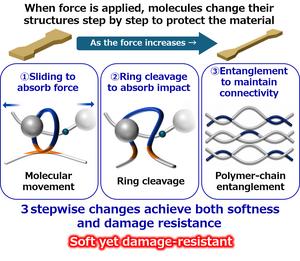
Osaka, Japan – Your shock-absorbing sneaker soles are likely made of polyurethane, a highly elastic and tough polymer. The ability of these elastomers to absorb impact without breaking is extremely important for practical applications, and while multiple strategies exist for enhancing elastomer toughness, each has its limitations. However, achieving synergistic toughening by integrating all three mechanisms within a single material remains challenging.
Now, researchers at the University of Osaka have overcome these limitations by developing a multipath synergistic strategy to toughen elastomers. This exciting discovery will be reported in Nature Communications.
Elastomers are polymers that are exceptionally elastic, i.e., they can deform strongly under external stress and revert to their original shape when the stress is removed. However, traditional elastomers are not very tough, as microscopic cracks can cause the material to tear.
Consequently, strategies are employed to enhance the toughness of elastomers by dissipating energy. That is, during deformation, the polymer absorbs mechanical energy and dissipates it by converting it into other forms of energy.