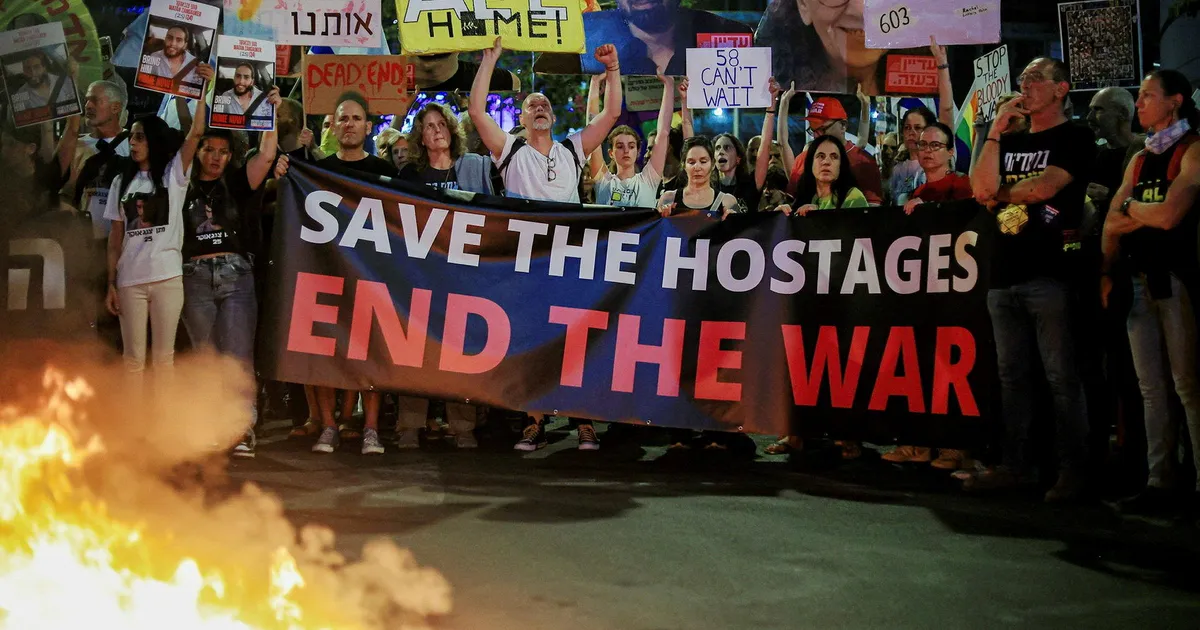
The former military official in charge of matters relating to Israeli hostages held during the Gaza war said the conflict “could have ended at least a year earlier” and that Israel might have been able to bring back more captives alive. Nitzan Alon, former head of the Israeli military’s Hostages and Missing Persons Command, said during a conference at Reichman University in Tel Aviv on Wednesday that Israel had “paid a heavy price in soldiers killed, perhaps even some hostages killed, and immense costs in blood and money that were not necessary”.He was speaking after far-right Finance Minister Bezalel Smotrich took credit on Monday for the return of hostages to Israel. Mr Smotrich, along with many other ministers, repeatedly voted down ceasefire deals under which Israeli hostages would have been swapped for Palestinian detainees held in Israel, arguing that such deals endangered security.Mr Alon's claim is the latest turn in a polarising debate over whether Prime Minister Benjamin Netanyahu's government did enough to secure the release of hostages. His ruling coalition faced a major protest movement that gained popularity throughout the war, calling for the government to prioritise the release of captives through a deal. For much of the war, ministers insisted that achieving “total victory” through military strength was crucial to defeating Hamas and, therefore, to bringing the 251 hostages home. But many key figures spoke out against this strategy. Gadi Eisenkot, former military chief of staff and war cabinet minister, said as early as January last year that hostages “can only be returned alive through a deal” – a position echoed across parts of the Israeli political establishment.“When talking about the return of all the hostages, it should be remembered that around 40 hostages who were abducted alive were killed in captivity and I do not forget that,” Mr Alon said.“In certain cases, with different conduct and decisions, or different negotiations, we might have been able to bring them back alive. The cabinet and the political leadership refused earlier comprehensive deals in the name of that ‘total victory,’ which is in fact a falsehood.”Palestinians gather at the site of an Israeli strike at the Al Mawasi camp in Khan Younis, southern Gaza Strip. AFPInfoIn response to Mr Alon’s comments, Mr Netanyahu’s Likud party accused the official of asking the government “to surrender to Hamas’s conditions” and said that, had the Prime Minister listened to him, Israel would not have won several key victories. Mr Alon’s comments came the morning after Mr Netanyahu drew anger from hostage activists for a comment he made on a television talk show. When asked how the war had changed him, Mr Netanyahu said: “First, I lost some weight,” drawing laughs from the audience. Boaz Zalmanowicz, the son of hostage Arie Zalmanowicz, who died in captivity aged 85, reacted to Mr Netanyahu's comment on X: “Humour? Here's my dad, who was kidnapped and murdered in physical and mental agony by Hamas because he didn't get medication, didn't eat and lost weight until death while being abandoned by Bibi. Humour.”Hamas seized 251 hostages and killed nearly 1,200 people in raids on southern Israel on October 7, 2023. Only 166 captives were recovered alive, most in exchange for Palestinians detained by Israel, over the course of three ceasefire deals, including 20 who were handed over at the start of the current ceasefire in October last year. The remains of 29 hostages still in Gaza were also returned under the final ceasefire deal.The Hamas attack resulted in a devastating Israeli military offensive on Gaza that killed more than 73,000 Palestinians, destroyed large areas of the coastal strip and displaced most of its two million-plus residents.
Gaza war could have ended a year earlier, says ex-head of Israeli hostage file | The National
Nitzan Alon claims more captives could have returned alive had Netanyahu's government acted differently
608 words~3 min read