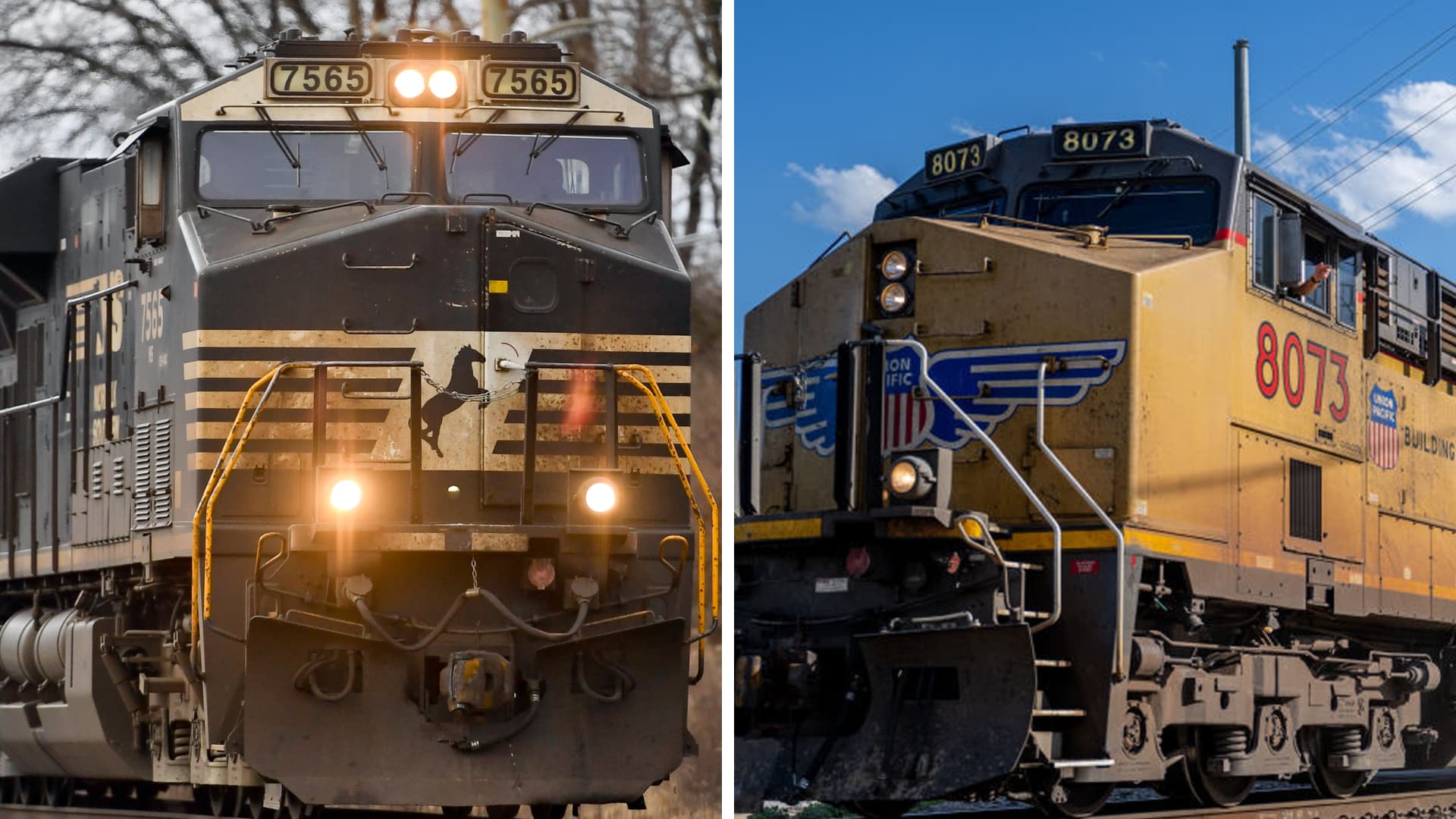
Most Americans do not think much about freight rail until shelves are empty, prices rise, or supply chains break. Yet railroads move the food we eat, the cars we drive, and the materials used to build homes and factories. When freight moves slowly or costs more, families pay more.That is why the proposed merger between railroad companies Union Pacific and Norfolk Southern matters.Union Pacific mainly operates in the western United States, while Norfolk Southern serves much of the East. A coast-to-coast shipment often must transfer between railroads near the middle of the country. Each handoff adds transaction costs of delays, paperwork, and uncertainty.
The merger would combine those networks into the first single-line transcontinental freight railroad, spanning roughly 50,000 route miles across 43 states and connecting more than 100 ports. Instead of changing carriers, many shipments could remain on one network from origin to destination.The Surface Transportation Board accepted the amended merger application in May, beginning a demanding federal review. That scrutiny is appropriate. Regulators should examine service, safety, and competition. But they should not assume that a larger company automatically means a worse outcome. The right question is whether consumers are likely to benefit.That is the consumer-welfare standard. Competition is bigger than any one deal. Regulators should consider prices, output, innovation, and choice rather than simply count the number of companies before and after a merger.Economic research also cautions against treating every acquisition as harmful. A National Bureau of Economic Research study of power plant acquisitions found productivity gains of 2% to 5% after ownership changes. That finding does not prove this merger should be approved, but it shows why efficiencies must be weighed against possible harms.The strongest case for the UP-NS merger begins with fewer handoffs. The companies estimate that single-line service could improve transit times by 24 to 48 hours on some routes and save shippers about $3.5 billion annually. Those are company projections and should be tested. But the economics are straightforward: fewer transfers can mean less waiting, lower inventory costs, and more reliable delivery.The merger could also make rail more competitive with trucking. Critics focus on the reduced number of major railroads, but many shippers choose between rail and trucks. Trucks carry about two-thirds of domestic freight volume and remain essential for short routes and final delivery. Rail, however, can be much cheaper for long-distance, heavy freight. One industry comparison estimated costs near $70 per net ton by direct rail versus $215 by truck.A more reliable coast-to-coast railroad could therefore strengthen competition across the broader freight market. It could also ease highway congestion while allowing trucks to focus on the routes they serve best. Rail, trucking, and ports are complements as much as competitors.Private investment is another potential benefit. Freight railroads generally maintain their own infrastructure. The Association of American Railroads reports that the industry invests more than $23 billion annually and has reinvested roughly $840 billion since 1980. Meanwhile, state and local governments spent about $206 billion on highways and roads in 2021.Trucking is indispensable, but it operates on infrastructure heavily supported by taxpayers. If private capital can modernize rail and attract freight without another federal spending program, regulators should count that as an economic benefit.The merger still raises legitimate questions. Some shippers fear higher rates or reduced bargaining power. Labor groups may worry about jobs and safety. Rival railroads may object to competitive effects. Regulators should examine those concerns and impose narrowly tailored conditions when supported by evidence.But they should protect competition, not competitors from competition.OPINION: UNION PACIFIC-NORFOLK SOUTHERN RAIL MERGER PUTS AMERICA FIRSTAmerica needs lower transportation costs, stronger supply chains, and more private investment. If this merger can move goods faster, expand viable shipping options, and improve rail’s ability to compete with trucking, it could benefit businesses and families far beyond the railroad industry.The evidence should decide. If the promised gains are credible and competitive harms can be prevented, the Union Pacific-Norfolk Southern merger would not threaten prosperity. It would be an opportunity to help America move again.Vance Ginn is a nationally recognized economist and one of America’s leading advocates of free-market policies that promote economic growth, expand opportunity, and ensure fiscal responsibility.