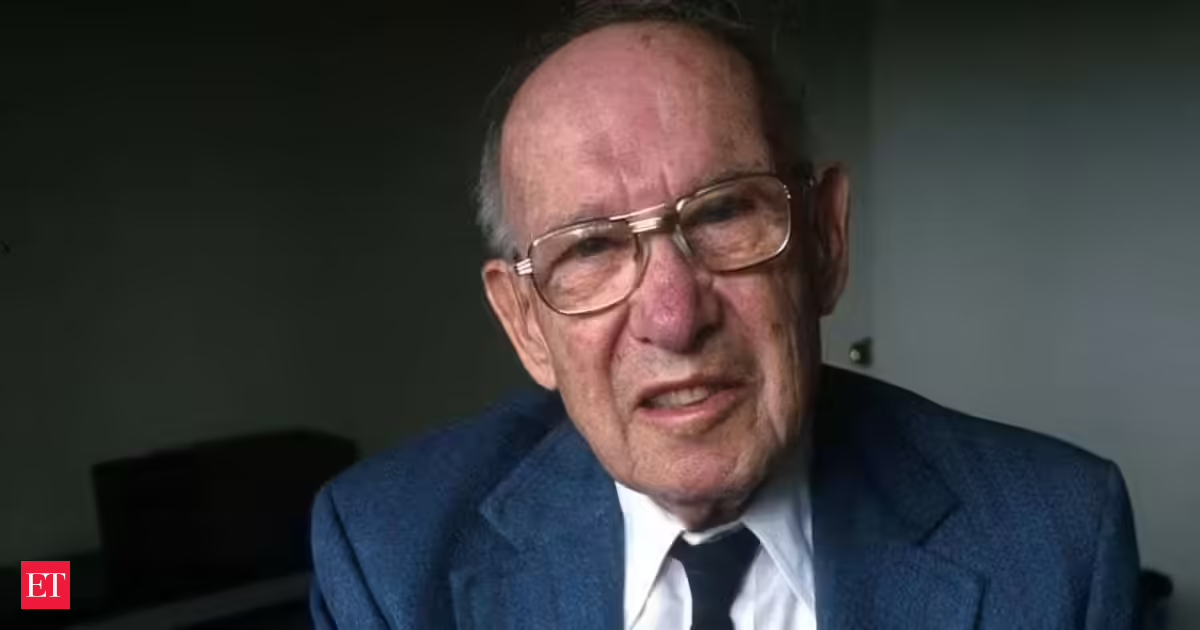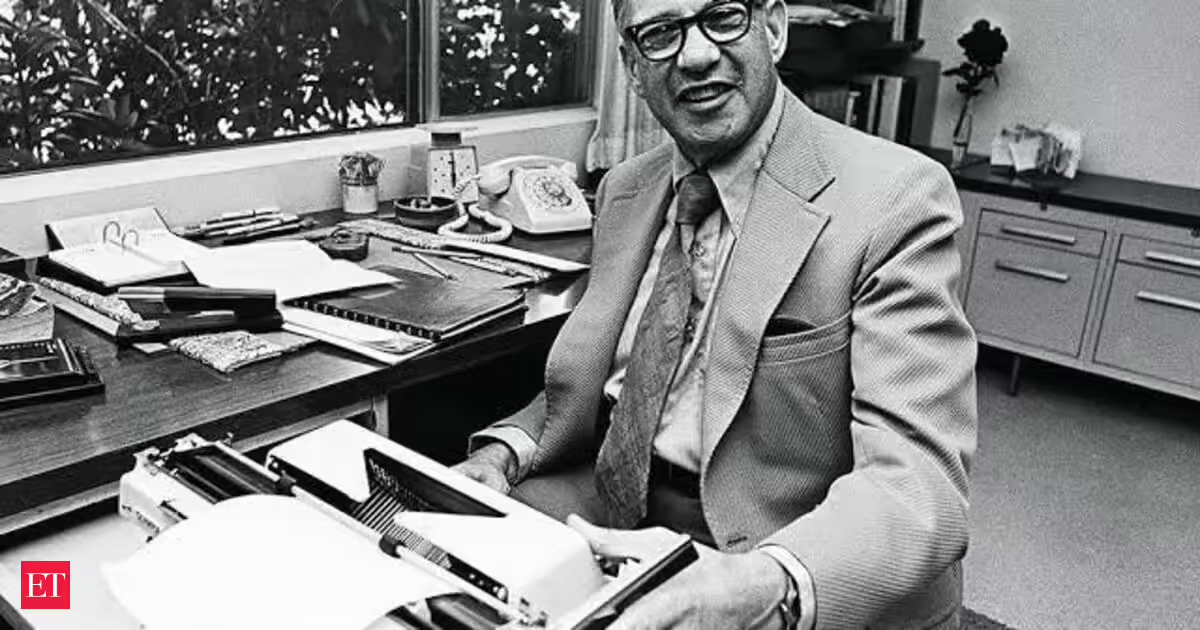
Quote of the Day by Peter Drucker, the Father of Modern Management: The Quote of the Day Today arrives at a time when change defines almost every part of modern life. Technology evolves in months instead of years. Careers transform overnight. Businesses face constant disruption. In such moments, this timeless insight from Peter Drucker offers more than inspiration. It provides a practical way to think.The Quote of the Day reminds us that uncertainty is rarely the greatest threat. The real risk comes from applying old solutions to new realities. History repeatedly proves that those who adapt often outperform those with greater experience but rigid thinking. As the old proverb says, “A tree that bends in the wind survives the storm.” That wisdom echoes Drucker's message perfectly.“The greatest danger in times of turbulence is not the turbulence—it is to act with yesterday's logic.” — Peter DruckerMeaning of the Quote of the DayThe Quote highlights a truth that many people overlook. Turbulence itself is not the enemy. Every generation experiences economic shifts, technological breakthroughs, social changes, and unexpected challenges. What separates success from failure is the willingness to rethink old assumptions.Peter Drucker believed that yesterday's strategies cannot automatically solve today's problems. Markets change. Customer expectations evolve. Skills become outdated. Leaders who refuse to learn often fall behind, while those who stay curious discover new opportunities hidden inside uncertainty.This wisdom applies equally to everyday life. A student preparing for tomorrow's careers cannot rely only on yesterday's knowledge. A professional must continue learning instead of depending on past achievements. Relationships also require flexibility because people grow and circumstances change. The Quote of the Day reminds us that adaptability is not weakness. It is one of the strongest forms of intelligence.Life lessonsThe Quote of the Day offers lessons that extend far beyond business strategy. It teaches that continuous learning is no longer optional. The world rewards people who improve their skills, question familiar routines, and stay open to different perspectives.Another important lesson is that experience should guide decisions, not control them. Experience becomes valuable only when combined with fresh thinking. Otherwise, it can become a barrier to innovation. As another timeless proverb says, “New wine must be poured into new wineskins.” Every new challenge deserves thoughtful solutions instead of automatic reactions.Ultimately, the quote reminds us that the future belongs to those who prepare for it, not those who simply defend the past.About Peter Drucker: Often called the "Father of Modern Management," Peter Drucker (1909–2005) completely transformed how the world views corporations, leadership, and the role of the worker. Before Drucker, business was viewed mostly as a mechanical process of factory lines, strict efficiency, and top-down command. He shifted the paradigm, treating management as a humanistic discipline—a "liberal art" that blends psychology, sociology, ethics, and history.He was a prolific Austrian-American author, educator, and consultant who wrote over 35 books, predicting major global shifts decades before they happened.Drucker’s theories are timeless because they focus on human behavior, purpose, and clarity. His most famous contributions include:Management by Objectives (MBO): Drucker introduced a framework where managers and employees jointly set clear, structured goals. Instead of telling people how to do their jobs, leaders define what needs to be achieved, giving employees the autonomy to find the best way there. The SMART Goal Framework: Derived from his MBO philosophy, he laid the groundwork for goals that are Specific, Measurable, Achievable, Realistic, and Time-bound. The "Knowledge Worker": In 1959, long before the internet and the tech boom, Drucker coined this term to describe professionals who think for a living (engineers, software developers, analysts) rather than perform manual labor. He noted that for knowledge workers, mindsets and continuous lifelong learning are the ultimate capital. Decentralization & Flatter Hierarchies: He argued heavily against rigid command-and-control corporate structures. He believed decision-making power should be pushed down to the people closest to the action and the customer, resulting in faster problem-solving and higher morale. The True Purpose of a Business: Drucker famously stated that the ultimate goal of a company is not just to make a profit. Profit is simply a requirement for survival. Instead, he argued, "The purpose of a business is to create a customer."
Quote of the Day by Peter Drucker: "The greatest danger in times of turbulence is not the turbulence—it is to..." — Why does adapting your thinking matter more than ever for success? Learn the most powerful lessons on leadership, innovation, adaptability, and creating your own future from the Father of Modern Management
Quote of the Day by Peter Drucker continues to resonate because it confronts one of the biggest challenges of modern life: keeping pace with constant change. His powerful words reveal that lasting success depends less on circumstances and more on adapting your thinking, embracing innovation, and taking responsibility for creating your own future.
692 words~3 min read