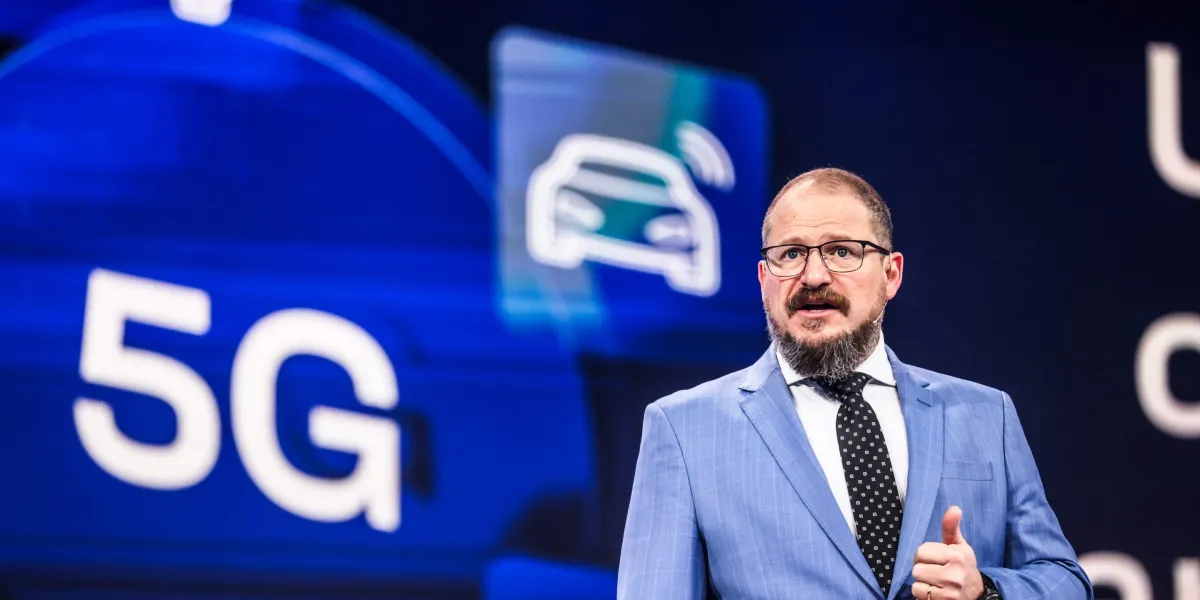
Mariam Sorond is NextNav Board Chair and CEO, focused on solving a national security challenge.gettyFor the better part of a decade, the wireless industry has wrestled with a question it can never quite answer: Is there anything 5G can’t do? Answering that question became something of an industry obsession. Billions were spent building networks hyped to enable remote surgery, autonomous vehicles and a world where every household appliance would talk to every other household appliance. Conferences overflowed with futuristic demos. Investors placed enormous bets. As the chief wireless architect at the time, I focused on designing a cloud-native, open RAN-based 5G architecture to deliver a range of 5G capabilities, including ultra-reliable low-latency communications (uRLLC). It was meant to enable reliable communication with minimal latency and could allow the network to push compute to the edge to support a range of Industry 4.0 applications, such as robotics, factory automation, autonomous vehicles and mission-critical applications. And when 5G failed to materialize these use cases at scale, a narrative took hold: 5G overpromised and underdelivered. That narrative is understandable from a larger perspective, but it misses a very important reality. While some skeptics viewed the industry as overpromising, 5G was quietly becoming the backbone of something incredibly consequential: public safety. The 5G Revolution Happened In Public SafetyDuring the September 11 attacks, first responders from different agencies couldn't communicate with each other because their radio systems ran on incompatible frequencies and proprietary networks. On-site responding firefighters couldn't talk with police officers, and local agencies couldn't coordinate with federal ones. The 9/11 Commission later identified the communication failures as a contributing factor in the loss of first responder lives that day. One critical action taken in response to the communication failures on 9/11 was the establishment of FirstNet, a nationwide public safety broadband network operating on the dedicated 700 MHz spectrum. FirstNet fundamentally changed how first responders operate by providing them with priority access to a dedicated broadband network with frequencies that reliably carry signals through buildings and across wide areas.The result was that firefighters, police officers and paramedics could all operate with a level of reliability and coordination they had never had before. None of this generated the kind of headlines that a remote surgery possibly would have, but the reality has undoubtedly saved the lives of countless people. Today’s 5G, and the tantalizing prospect of a much more advanced 6G, could have an equally urgent and unglamorous outcome: enhancing national security, including by delivering resilient positioning, navigation and timing information. America's Hidden Dependence On GPSTo fully realize the national security implications, you have to understand that modern infrastructure runs on positioning, navigation and timing information, collectively known as PNT. Financial markets depend on precise timing to synchronize transactions. Power grids rely on it to maintain stability. Telecommunications networks, aviation systems, shipping logistics and emergency services all treat PNT as a given. And nearly all of it flows from a single source: GPS. GPS is one of the great technological achievements of the 20th century. It is also, at this point, a single point of failure for 21st-century infrastructure. The signals travel over 12,500 miles from space, which makes them vulnerable to jamming, spoofing and even solar storms. Across Europe and the Middle East, those vulnerabilities are already being exploited. In the Baltic States, 85% of civilian flights in Estonia have been affected by GPS disruption stemming from the war in Ukraine. Those same issues have ships and planes on high alert in the Middle East, and the ongoing conflict across the region is causing havoc for civilian applications like ride-hailing and food delivery. The U.S. isn’t immune. A 2022 GPS interference incident impacted Denver International Airport for over 30 hours, impacting a 50-mile radius. Eight months later, another incident shut down a runway at Dallas-Fort Worth International Airport and affected a 40-mile swath of airspace for days. Between the two airports, over 342 flights were impacted. Just this April, UHU Technologies released a report detailing “hundreds of vehicles with suspected personal GPS jammers” and other significant incidents around the Ports of Los Angeles and Long Beach over a four-year period. Any of these could have disrupted port operations at one of the country's busiest complexes.And the threats are not only due to intentional hostile actions: A severe geomagnetic storm in May 2024 disrupted the high-precision GPS systems that modern agriculture depends on, forcing farmers to halt planting during peak season. These are warnings, and they are growing louder. A single day of GPS disruption could cost the U.S. economy an estimated $1.6 billion. Longer outages would cascade through finance, energy, transportation and telecommunications in ways that are difficult to fully model and easy to underestimate. America has understood this vulnerability for two decades, as have our adversaries. China and Russia have both built terrestrial complements to their satellite navigation systems, creating layered resilience that the United States still lacks. The Wireless Industry's Next MissionThis is where the wireless industry has an extraordinary opportunity. The same infrastructure built for 5G, the nationwide cellular coverage, the tower networks, the massive device ecosystems and standardized 3GPP architecture can support resilient, ground-based PNT that will provide national security for our country. Mobile network operators already operate the largest distributed infrastructure networks in the U.S., reaching 97% of the U.S. population with 5G coverage. They are uniquely positioned to deliver PNT as a service, providing backup timing and positioning that keeps critical systems running when satellite signals falter. Think of it this way. GPS created an entire economy: Ride-hailing, precision agriculture, logistics optimization and countless other industries exist because GPS made accurate positioning and timing ubiquitous and free. There is no reason a terrestrial PNT layer couldn't do the same. Today’s 5G, and tomorrow’s 6G, could ensure that the invisible systems powering modern life never go dark, while also providing a platform for entirely new ones to emerge.Forbes Technology Council is an invitation-only community for world-class CIOs, CTOs and technology executives. Do I qualify?
The 5G Killer Apps Weren’t As Glamorous As We Expected
Today’s 5G, and tomorrow’s 6G, could ensure that the invisible systems powering modern life never go dark, while also providing a platform for entirely new ones to emerge.
996 words~5 min read