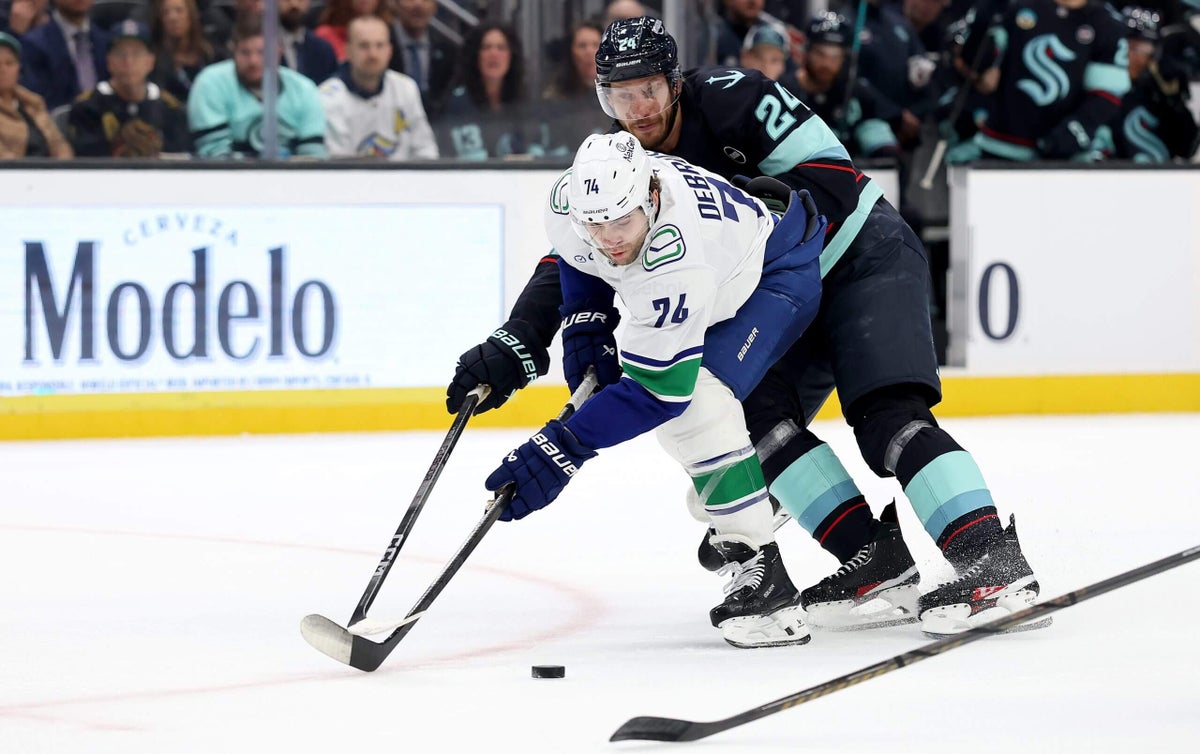
NHL free agency has nearly arrived.This is the first July 1 of the cap growth era, and it promises to be a fascinating one. Based on how the market has shaped up, the overwhelming amount of cap space remaining in the league and the lack of talent available on the open market, we could be in for a telling and memorable day.For the Vancouver Canucks, however, this isn’t expected to be a day of significant swings or aggressive moves.“If the question is, with what we’re trying to do and where we want to go, are we going to be trying to get there through free agency?” Canucks general manager Ryan Johnson asked rhetorically in a conversation with The Athletic earlier this month. “Then I’d say the answer is probably not.”With our expectations in check, it’s clear that the club will surely do something. Perhaps the Canucks will add a veteran defender to push their young blueliners for minutes, or target a reclamation project veteran at a conservative price point. At the very least, you’d expect them to go about filling out the Abbotsford lineup.However, what might matter more for Vancouver is what happens to the market in general, and whether those forces might enhance the exchange value and demand for some of the Canucks’ expensive veteran players with term in their late-20s.Here’s everything you need to know about the Canucks as a new league year dawns, and the frenzy begins.Cap space and budget questionsThe Canucks enter July 1 with a relatively full roster.As Vancouver considers its options on the open market, in fact, the Canucks will also need to be mindful of the fact they have 11 forwards on one-way contracts, plus an entry-level players in Liam Öhgren, who’s clearly a full-time NHL player, and a variety of other credible roster hopefuls like Braeden Cootes, Ilya Safonov and Jonathan Lekkerimäki.They also have three defenders on one-way contracts, plus a handful of entry-level players in Tom Willander, Elias Pettersson and Zeev Buium who are clearly full-time NHL players. Plus a credible roster hopeful in Kirill Kudryavtsev.And Vancouver also has two goaltenders on one-way contracts, with a third talented, young goaltender who requires waivers in Nikita Tolopilo.More than the cap space question, because Vancouver is awash in it, if the Canucks can’t further subtract from their roster, they’ll optimally be looking at adding a maximum of two, maybe three, NHL players on one-way contracts this summer.The bigger restriction for the Canucks, however, is more likely to be budgetary. Despite ownership promising the fans in this market that incoming management would have whatever resources they required while rebuilding this roster, it’s telling that the Canucks have added no one with significant experience to the front office, hired a first-year NHL bench boss and have yet to add experienced assistant coaches to his staff, and only acquired Brendan Gallagher after first sending out Nils Höglander in a sequence of deals that ended up saving Vancouver cash.There is no way to “weaponize cap space” in an era of cap growth, largely because of leaguewide scarcity dynamics. When everyone has cap space, nobody is going to pay for it.The scarce resource in the current NHL climate is talent, and perhaps equally as important, cash.If a team in a hot Canadian market were looking to inject future value into its organization and wanted to leverage free agency to do so, there are all sorts of ways to go about doing that. Signing useful veterans to signing bonus-laden short-term deals with very limited forms of trade protection, for example, could pay real dividends if the Canucks wanted to ensure that they accumulate the sort of draft capital that could expedite their efforts to construct an entirely new core of elite talent.Based on what the organization has signalled through the first two months of the Sedins’ presidency, however, the Canucks don’t seem to have the interest or the resources to try to update, for example, Montreal’s big market rebuilding playbook for the cap growth era.Extension considerationsThe Canucks have several younger players who will become extension eligible on July 1, most notably Buium and Öhgren.Budgetary considerations may, once again, dictate the path forward for the Canucks. Given the prices that we’re seeing thrown out there across the NHL at the moment — for the likes of Pavel Dorofeyev and A.J. Greer — and the logic of how endemic cap growth is likely to shift market prices for quality players in the years ahead, locking in good, young players to team-friendly extensions as early as possible — even before they’ve demonstrated their value — is likely to be required for teams to get ahead.Consider two prominent examples in the Carolina Hurricanes and Anaheim Ducks. Last July, the Hurricanes went about prioritizing eight-year extensions for then-22-year-old Logan Stankoven and 21-year-old Jackson Blake. Stankoven had played 102 NHL games to that point, and his career high in points was 38. Blake had played 81 NHL games and scored 17 goals.This year, Blake broke out offensively in the regular season and was Carolina’s most consistently dynamic offensive creator in the playoffs. Stankoven, meanwhile, broke out in the playoffs and was the Hurricanes’ first-line centre on a playoff run that resulted in them winning the Stanley Cup.Their respective second contracts don’t even kick in until next season, but have set the Hurricanes up to contend durably and sustainably — in a manner consistent with what Johnson keeps citing as the primary goal for the franchise — for the balance of this decade.In contrast, the Ducks didn’t prioritize signing then-20-year-old 45-point centre Leo Carlsson or then-21-year-old 20-goal-scorer Cutter Gauthier to proactive long-term extensions last summer. This season, without having their best young players locked up long-term, the Ducks took a massive leap forward as a team. And their improvement was significantly powered by Carlsson emerging as a near point-per-game superstar and Gauthier’s 40-goal campaign.Anaheim is still in good shape given its depth of talent, but the Ducks will be shelling out a massive and avoidable premium for Carlsson and Gauthier relative to the price they could’ve captured and fixed last summer.Now, it goes without saying that Buium and Öhgren aren’t exactly Gauthier or Carlsson, but the analogy still holds. Right now, Vancouver has an opportunity to fix its costs for its most promising young players, and to do so in the current contractual environment — which allows for eight-year contracts, and more team-friendly flexibility in structuring contracts — before the new CBA kicks in on Sept. 15.Missing out on this opportunity would be more than inopportune. It would be outright wasteful, especially given the state of the franchise and its position in the NHL’s hierarchy.In Öhgren’s case, if we employ Dom Luszczyszyn’s Net Rating model to project his future outcomes, we can see that the model considers him to be a base rate bet to develop into at least a third-line forward in his mid-20s:Now I would strongly suggest, however, that the model has no way of accounting for just how disorganized the Canucks team game was, and how significantly that impacted the underlying profile of every player that Adam Foote coached. Still, Öhgren barely has to outperform even this too-bearish projection to provide the Canucks with surplus value, something like a six-year extension that buys two unrestricted free agent years and compensates him in the $4-$4.5 million range.And if Öhgren can build off what he accomplished this season and develop into a middle-six forward or even a second-line winger, then the Canucks could have a massive value on their hands.It’s worth the very tolerable risk, especially if the club front-loads the deal and avoids signing bonuses late into the contract (making it straightforward to buy out before Öhgren turns 26).As for Buium, the risk is somewhat greater given his likely cost and player archetype — smaller puck-moving defenders are generally volatile — but the upside is enormous if he can deliver on his immense potential.The Net Rating projections for Buium, and again the model has no way to account for what a train wreck Vancouver’s team-level game was last season, view Buium as a base rate bet to develop into a top pairing defender by the time he hits his early 20s.Locking Buium up with a Jake Sanderson-type eight-year, $8 million annual average value contract — front-loaded, and with no signing bonuses late in the deal to manage the risk if he doesn’t hit his ceiling — is an absolute no-brainer for the Canucks.Organizational areas of needThe Canucks have a lot of NHL players already locked in, and of course, there are no dire needs for a team absent any variety of win-now pressure. That said, there are a few organizational holes the Canucks should actively be looking to address in free agency:
Canucks 2026 free agency primer: Cap space, budget questions, needs, targets
Here's everything you need to know about the Canucks as a new league year dawns, and the frenzy begins.
1,936 words~9 min read