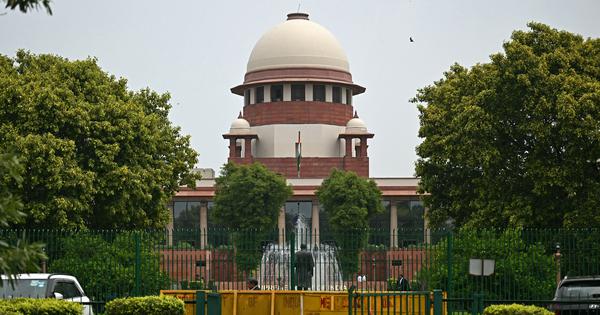
New Delhi: In a significant verdict aimed at bringing uniformity to motor accident compensation, the Supreme Court on Wednesday laid down guidelines on how courts should determine the annual income of deceased victims or injured claimants on the basis of Income Tax Returns.The top court held for salaried individuals, only the Income Tax Return (ITR) of the previous year will be sufficient for showcasing the annual income and for self-employed persons, it held that the average income disclosed in ITRs for up to the previous three years should ordinarily serve as the reference point.Read more: SC directs status quo on Karnataka HC order on ethanol allocation; Centre says 20% blending still an experimentA bench of justices Sanjay Karol and N Kotiswar Singh held that there cannot be a rigid formula for computing annual income under the Motor Vehicles Act, but drew a clear distinction between salaried employees and self-employed persons for the purpose of assessing compensation based on their ITRs."In the considered view of this court, there can be no hard and fast formula for computing the annual income of a deceased person/claimant. ITRs being a statutory document are an important reference point when it comes to assessing one's income, for the purposes of compensation under the Motor Vehicle Act," Justice Karol, who authored the judgement, said.The verdict agreed to the submissions made by senior lawyer JR Midha that there must be a bifurcation made between salaried individuals and self-employed individuals when it comes to assessment of annual income.Recognising conflicting approaches adopted by different courts across the country, the bench observed that while some courts relied only on the latest ITR, others averaged income reflected in returns for the preceding years, leading to inconsistent awards."In our view, for salaried individuals, only the ITR of the previous year will be sufficient for showcasing the annual income from salary. The reason for considering only the preceding year is that the financial impact of promotions is significant and may be reflected in the ITR for only that year," it said.However, where a promotion or salary revision had taken place shortly before the accident and was not fully reflected in the latest return, courts could also consider promotion letters and other corroborative financial records, it said.For self-employed persons and business owners, the bench held that the average income disclosed in ITRs for up to the previous three years should ordinarily serve as the reference point, keeping in view the fluctuating nature of business income."In our view, the average of the income specified in the ITRs of up to the previous three years is to be taken as a reference point for assessment of annual income from their business. There may also be a scenario where only one or two ITRs have been filed."Given such scenarios and the fluctuation of income in these professions, surrounding circumstances are also to be taken into consideration," it said.The verdict then referred to scenarios which may lead to fluctuations in income of the deceased or injured self-employed victims and said these would include the nature of the business, growth pattern and impact of death on the business and potential growth of business.It also referred to negative income and any other relevant factor relating to the business that may affect the income of the accident victims."The date when the ITRs are filed would also become a relevant consideration, as there may be scenarios where inflated income is showcased after death/injury. In these circumstances, the surrounding factors of the business would become more relevant. However, if sufficiently supported by financial statements, such ITRs may also be taken into consideration," it said.The judgment came while deciding an appeal filed by the family of a construction businessman, Rashmirekha Tripathy against Sriram General Insurance Company Ltd.The top court also enhanced the compensation payable to the claimants.Applying the principles to the present case, the bench found that the deceased, a 39-year-old construction businessman, had disclosed annual incomes of about Rs 11.6 lakh and Rs 15.06 lakh in the two preceding assessment years.Read more: Indian-American groups, lawmakers welcome US Supreme Court birthright citizenship rulingWhile the Orissa High Court had averaged the two returns and fixed his annual income at Rs. 13.33 lakh, the top court held that the nature of the deceased's construction business also deserved consideration and fixed his annual income at Rs 14 lakh.Consequently, the court enhanced the compensation payable to the deceased's family from Rs 1.87 crore awarded by the high court to Rs 1.97 crore, while maintaining interest at six per cent per annum.
SC lays down guidelines on computation of income of motor accident victims
The Supreme Court has established new guidelines for determining motor accident compensation based on Income Tax Returns. For salaried individuals, only the previous year's ITR will be considered, while self-employed persons will have their average income from the last three years used. This aims to bring uniformity to compensation awards across the country, addressing inconsistencies in previous court rulings.
752 words~3 min read