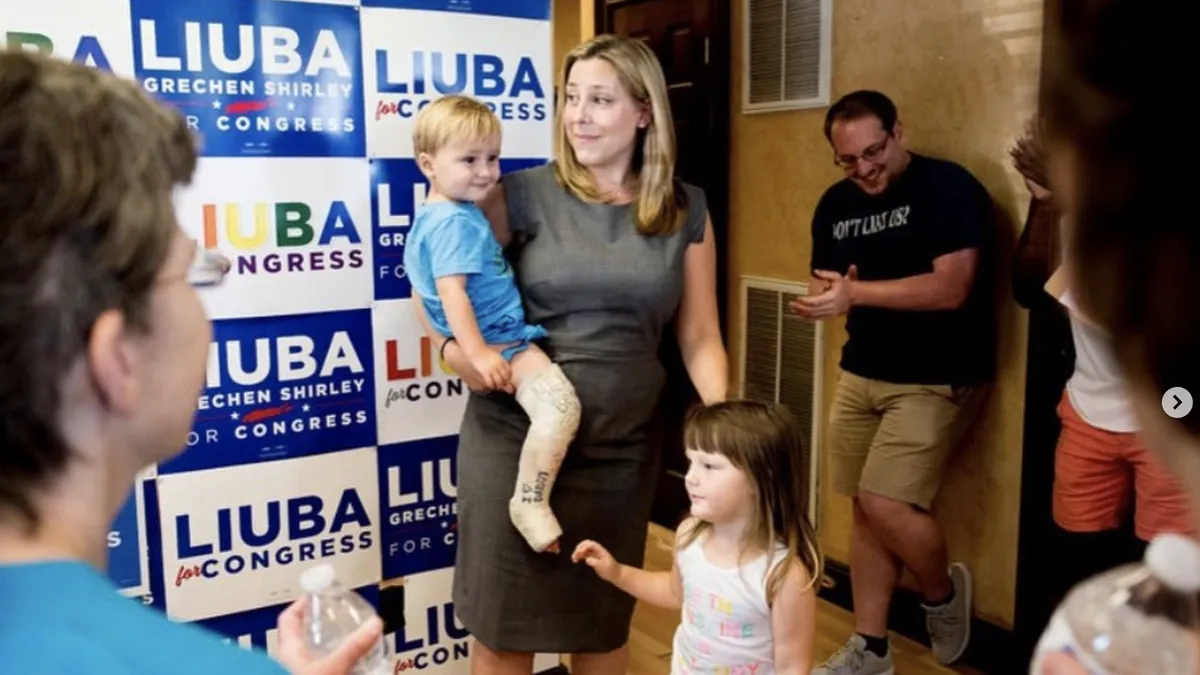
Liuba Grechen Shirley was nursing two children when she decided to run for Congress in 2018.During the day, she gave speeches and knocked on doors with a baby wrapped to her chest and a toddler at her side. In the afternoons, she relied on her mother's help for child care. Her mother would come over to watch the kids while she went back out to hit the campaign trail."Honestly, six months into the campaign, it was very clear to me why there weren't more moms of young children in office," Grechen Shirley said. "It really wasn't sustainable."Grechen Shirley lost the race to incumbent Peter King, who continued to represent New York's 2nd District in the U.S. House of Representatives until 2021. But during her campaign, she won a precedent-setting Federal Election Commission vote to allow candidates for federal office to use campaign funds for child care. And with that, she sparked a movement and the next chapter of her career by launching the Vote Mama Foundation, a research organization that tracks the political participation of mothers."I definitely plan to run for office again. I don't know when," Grechen Shirley recently told USA TODAY. "Honestly, right now, I feel like I can make so much more of a difference building Vote Mama than I can with one vote in Congress, because I am working on changing the political system across the country."In addition to the federal commission's vote, 19 states have enacted laws allowing candidates running at the state and local level to use contributions for child care, according to the National Conference of State Legislatures. Another 21 states and Washington, D.C. have approved the use of campaign funds for child care via ethics rulings and other opinions. Some states have started to broaden these rules to allow candidates to use campaign funds for other dependent care, too, like elder care.Georgia Democratic Rep. Nikema Williams ran a successful campaign in the summer of 2020, while working full time. Meanwhile, her then 4-year-old son's daycare shut down because of COVID-19 and he started virtual kindergarten. It felt impossible to do it all, she said. When she met Grechen Shirley and learned she could use campaign funds for child care, she hired her son's daycare teacher as a nanny − but not without pushback, some even from members of her own campaign."I don't regret it," Williams said, adding that she encourages moms and dads both to use campaign funds for child care. "Because I think we have to shift the narrative that only women have to take care of children."The fight to get more moms in officeFour male candidates had previously requested one-off permission to use campaign funds for child care when their spouses accompanied them to events, Grechen Shirley said. But she was the first to ask the Federal Elections Commission to establish child care as an official use for campaign funds moving forward.When Grechen Shirley put the request in, she said her campaign manager was her sole supporter and that some of her colleagues told her she would "be attacked for being a woman and a mom."But other key supporters slowly trickled in − including former Secretary of State Hillary Clinton, whose team wrote a three-page letter in support. The commission unanimously approved her request in May of 2018, and Grechen Shirley quickly hired a nanny to her campaign staff."It really, genuinely changed the way that people have run for office," Grechen Shirley said. "It can completely transform the political landscape."Since then, parents running for federal office have spent over $1 million in campaign funds on child care, and parents running for state and local offices have spent more than $700,000, according to Vote Mama. This includes more than 200 moms, dads, Democrats and Republicans.By establishing child care as a valid use of campaign funds, Grechen Shirley said, the question is no longer who can afford to run for office, but who really wants to serve their community. She hopes that with more women and parents in office, more family-friendly policies like paid family leave and affordable child care will come to the forefront, because "our legislators legislate based on their lived experience."'We all deserve representation.'Right now, Grechen Shirley said, it's not just difficult for women to run for office. For some moms, it feels impossible to even participate in the political process."Say there's a town hall, it's at 7 o'clock at night. It's during bedtime," Grechen Shirley said. "If they bring their kids, they get looked at, they get dirty looks because their baby might be crying while they're trying to ask a question."That's why it's so important to get more mothers in office, Williams said, to promote policies and systems that make it easier for families to live their everyday lives."As a woman of color, born and raised in the South, and as a mama, and as a Christian, I know that we all deserve representation," she said. "And I deserve to be able to raise my child and to also live a life where my young son knows that women can accomplish anything that men can accomplish in this society."Madeline Mitchell's role covering women and the caregiving economy at USA TODAY is supported by a partnership with Pivotal and Journalism Funding Partners. Funders do not provide editorial input.Reach Madeline at memitchell@usatoday.com and @maddiemitch_ on X.
She used campaign funds to pay for child care. Other political moms are following suit.
Liuba Grechen Shirley was the first mom to use campaign funds to pay for child care. She's starting a movement – and helping put more moms in office.
890 words~4 min read