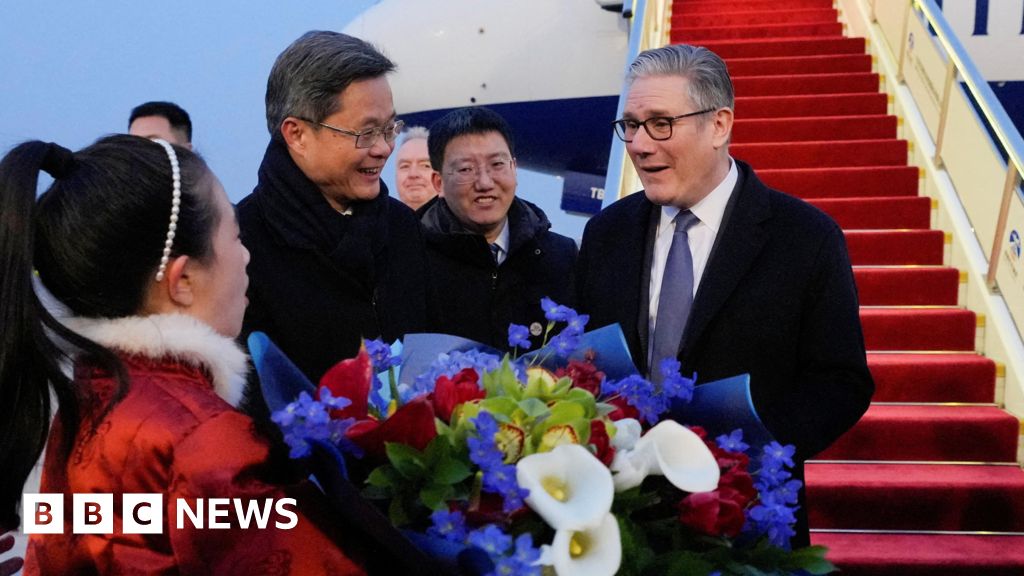
Labour has allowed China to get a 'stranglehold' over critical minerals that could hinder Britain's plans to rearm, the Tories warned today.Keir Starmer has been accused of failing to counter Beijing's dominant position in the production and sale of materials vital for everything from drones and missiles to smartphones and electric car batteries.Shadow national security minister Alicia Kearns said that politically-manufactured shortages of critical minerals, which include metals like lithium, cobalt and nickel, are already being felt on the battlefield in Ukraine.China spooked the global economy last year when some industries nearly ground to a halt after Beijing imposed export curbs on permanent magnets made of rare earths, an episode which highlighted how reliant Western supply chains in the energy, defence and technology sectors are on these goods.Writing for the Daily Mail amid a furious row over Labour's willingness to invest in national security, Ms Kearns warned that 'without a steady supply, a nation’s military cannot fire on all cylinders'.Ministers have recently moved to decrease UK reliance on Chinese imports, last week pledging £50 million to boost domestic production.It has also sought to diversify access through partnerships with allies including the United States and South Korea.But the issue was only mentioned once in the Defence Investment Plan, released yesterday, which aims to set out the UK's military spending priorities. Ms Kearns, a former chairwoman of the Foreign Affairs Committee and a longstanding China hawk, said the chaos in government around Sir Keir's resignation and expected replacement by Andy Burnham meant progress was too slow.'The Chinese Communist Party has spent years furthering its stranglehold on critical mineral supply chains, from mining to refining,' she wrote. Shadow minister Alicia Kearns warned that without a steady supply of critical minerals 'a nation’s military cannot fire on all cylinders' China retains a dominant position in critical minerals, accounting for about 70 per cent of rare earth mining and 90 per cent of refining'This hostile monopoly now allows them to simply squeeze the supply chains, and bend nations to their will. 'Where global supply chains were once seen as an opportunity, they must now be recognised as a vulnerability.'China retains a dominant position in critical minerals, accounting for about 70 per cent of rare earth mining and 90 per cent of refining.In October, plans for a rare earth refinery in Yorkshire were axed.UK-listed firm Pensana had planned to build the £190million Saltend site near Hull, employing 126 people, to process raw materials used in technologies such as electric cars and wind turbines.But the prospect of huge subsidies from Donald Trump's administration prompted it to ditch the idea and move its refining operations to the US.Pensana's decision came after Mr Trump's government signalled its willingness to pay a guaranteed price for rare earths from an American mine, Mountain Pass, protecting producers from the prospect of cheap Chinese imports pushing prices down.'Infighting and chaos have been the orders of the day. It has left us slow, unambitious, and the Foreign Office in a state of gridlock at a time when we should be taking this issue much more seriously,' Ms Kearns wrote. And so, we have fallen behind our allies. The US has signed 12 new Critical Mineral Partnerships this year alone. 'The EU has begun setting out plans to start stockpiling critical minerals alongside the US’s ''Project Vault''. And France has rolled out an ambitious plan to ramp up domestic production.'Last week Industry minister Chris McDonald said critical minerals were 'vital for our national security' as he announced the new investment.The new funding will be split across three pillars, including £20 million for a rare earth magnet hub, £25 million for an accelerator programme to help scale projects, and up to £5 million for a platform to aggregate industry demand and unlock private investment.This Government is in paralysis. It is unable to take the necessary steps to protect us As this week has proven, this Government is in paralysis. It is unable to take the necessary steps to protect us during these deeply unstable times.This incompetence runs deep and core and unfortunately goes much further than the underfunded Defence Investment Plan. The Government is failing to end China’s control over critical minerals.The conflicts with Iran and in Ukraine are real-time proof of the importance of critical minerals. Allied war machines have been deeply affected by a dwindling supply of these minerals, which are essential for everything from missiles to satellites to anti-drone technology. Without a steady supply, a nation’s military cannot fire on all cylinders.More concerningly, a lack of supply also impacts economic growth and energy security.Critical minerals are essential for technological innovation, such as phones and batteries, as well as for rolling out clean energy to end our reliance on fossil fuel imports.Critical minerals in the 21st century are arguably becoming the equivalent of oil in the first half of the 20th. The world is not running out of critical minerals; the shortage is political, not geological. These minerals - essential to everything from F-35s to the battery in your phone - are abundant in the earth's crust, but China made a decades-long strategic choice to dominate their extraction and, crucially, their refining, while the West chose cheap dependence. As I said when the Foreign Affairs Committee did a landmark report on the issue: the issue with critical minerals is primarily about power, not trade - more a geopolitical issue than a geological one, which means the vulnerability was manufactured, and can be unmade.The Chinese Communist Party has spent years furthering its stranglehold on critical mineral supply chains, from mining to refining. This hostile monopoly now allows them to simply squeeze the supply chains, and bend nations to their will. Where global supply chains were once seen as an opportunity, they must now be recognised as a vulnerability.Whether it is openly utilising export controls to force Donald Trump to weaken his effort to limit China’s trade war, or by silently contributing to the global shortage of interceptor missiles, which was part of the reason for the Iran-US ceasefire, China is using its control of critical minerals to manipulate global events.The UK’s Critical Mineral Strategy - which was published last year after being heavily delayed by Labour - was meant to provide a roadmap to at least loosen Chinese dominance.Its primary goal was to ensure no nation controlled more than 60 per cent of a particular mineral’s supply chain. This requires a mixture of ramping up domestic production, stockpiling, recycling, and signing free trade agreements and critical mineral partnerships with allies.But Labour has failed to deliver. Infighting and chaos have been the orders of the day. It has left us slow, unambitious, and the Foreign Office in a state of gridlock at a time when we should be taking this issue much more seriously.And so, we have fallen behind our allies.The US has signed 12 new Critical Mineral Partnerships this year alone. The EU has begun setting out plans to start stockpiling critical minerals alongside the US’s ‘Project Vault’. And France has rolled out an ambitious plan to ramp up domestic production.The opportunity is out there for Britain. A prime example of a deal begging to be signed is with Chile for lithium and copper – under my chairmanship the Foreign Affairs Committee visited Chile specifically to make the case for a stronger relationship.Although we have signed some deals with Chile, we should build on them with a dedicated critical mineral partnership agreement to ensure a constant and steady supply of lithium for batteries, military equipment, and clean energy projects. This is arguably more important than ever since plans for Imerys British Lithium stalled. Equally, Greenland is another open yet wasted opportunity. We should offer them the expertise of our Nottingham-based UK Critical Minerals Intelligence Centre who can help Greenland map out and plan how to extract and deploy their critical minerals.Which brings us to the next failure: ramping up domestic production.Labour doesn’t understand how to manage the economy and back industry. Its inability to set the right economic conditions, investment framework, and get a grip on skyrocketing electricity bills has left nascent mining and refining companies in the lurch.Potential investors are going elsewhere, leaving the UK reliant on the kindness of our allies for critical minerals and missing out on private capital that could boost our economy and help roll out nuclear, wind, and solar to help bolster our energy security.The Government needs to get a grip. Destroy your own party all you want, but you must not continue to let the Chinese Communist Party consolidate its control over resources that are vital to Britain’s security. Ministers need to break out of their Sino-reverie, start stockpiling key minerals, get moving on international co-operation, and create the right economic conditions to ramp up production.Alicia Kearns is the Conservative MP for Rutland and Stamford and shadow national security and safeguarding minister
China's 'stranglehold' on critical minerals 'leaves UK vulnerable'
Keir Starmer has been accused of failing to counter Beijing's dominant position in the production and sale of materials vital for drones and missiles.
1,474 words~7 min read