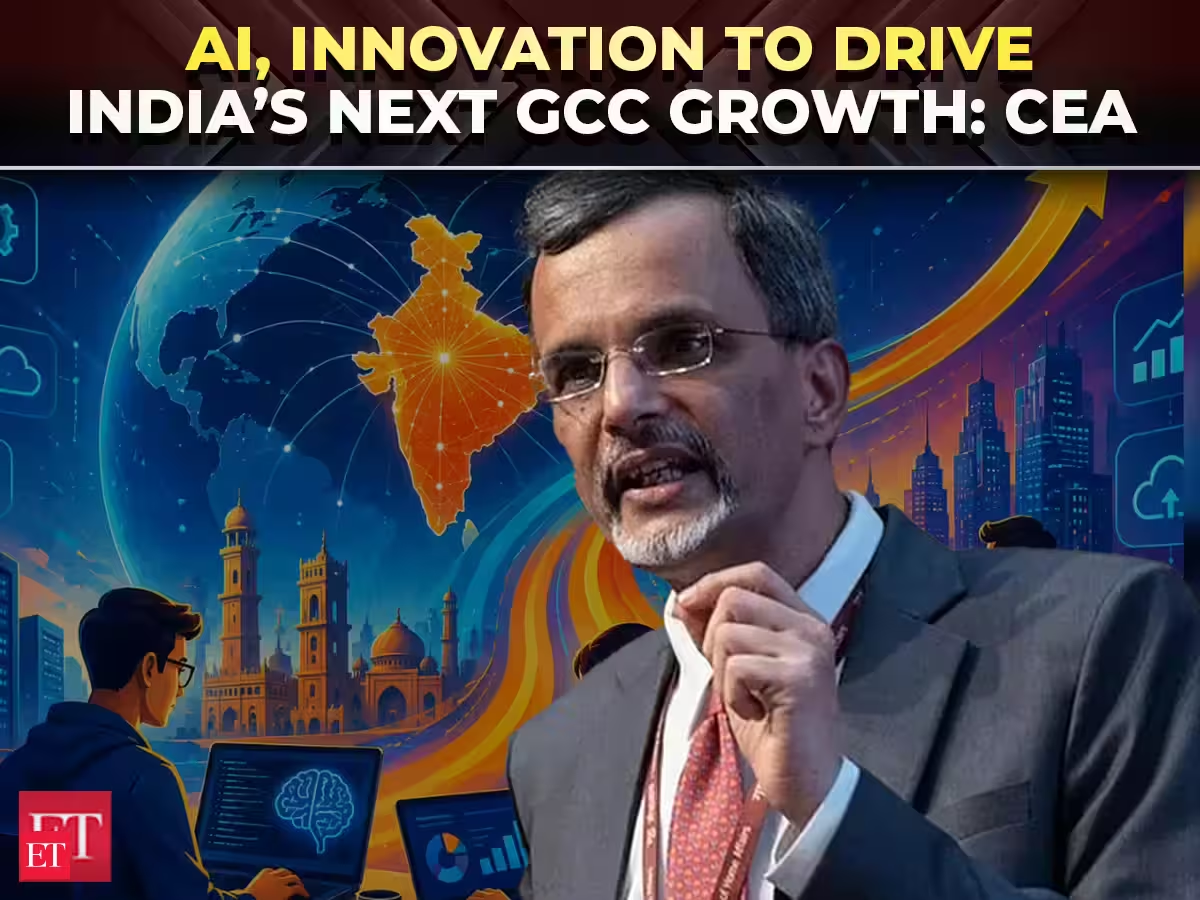
India's overall white-collar hiring remained subdued in June, with the foundit Insights Tracker (fit) reporting a 5% month-on-month and 9% year-on-year decline. In contrast, the country's global capability centre (GCC) ecosystem continued to expand, with hiring increasingly focused on artificial intelligence (AI).Nearly two in three GCC roles created in 2026 (64%) require AI, data science or intelligent automation skills. Technology and software, and banking, financial services and insurance (BFSI), together account for 56% of all GCC hiring.India recorded 227,991 GCC hires in the first half of 2026, up 11% from a year earlier, taking the number of GCCs operating in the country to nearly 2,120.GCC hiring is projected to reach 510,452 jobs by the end of 2026, up 12% from 2025, as multinational companies continue to expand their India operations into strategic innovation and capability hubs.“Companies are no longer setting up GCCs simply to reduce costs,” said Tarun Sinha, CEO, foundit. “They are building them to develop the AI, engineering and product capabilities that run their global businesses. India offers the depth of talent to do this at scale, and the growing pull of tier-2 cities shows how far that capability now extends beyond the traditional metros."India's GCC hiring has grown 3.4-fold since 2021, representing a 27.4% compound annual growth rate over five years. The number of GCCs has increased from about 1,600 to around 2,120 during the period, driven by new centres and the expansion of existing ones.The share of GCC roles requiring AI capabilities has risen from 11% in 2021 to a projected 64% in 2026. AI, data science and analytics is now the fastest-growing function within GCCs, expanding 38% year on year.Technology and software remains the largest hiring sector, accounting for 35% of GCC recruitment, followed by BFSI at 21%. Healthcare and life sciences account for 11%, manufacturing and industrial 9%, retail and consumer 7%, automotive and mobility 6%, telecom and media 5%, logistics and supply chain 4%, and energy, chemicals and other sectors 2%.Hiring is concentrated in four technology-focused functions—IT and software development; AI and data science; engineering and product research and development; and cloud and cybersecurity—which together account for more than three-quarters of all GCC roles.Professionals with four to 10 years of experience remain the most sought-after, accounting for 56% of GCC hiring. Those with four to six years make up 34% and professionals with seven to 10 years account for 22%, reflecting demand for specialists capable of leading engineering, AI, cloud and digital transformation initiatives.Early-career professionals with up to three years of experience account for 30% of hiring and are the fastest-growing segment, expanding 18% year on year, supported by GCC expansion into tier 2 cities. Professionals with 11-15 years of experience account for 10% of hiring, while those with more than 15 years represent 4%.Bengaluru continues to lead GCC hiring with a 30% share, up 10% year on year, followed by Hyderabad at 15% (up 15%), Pune at 12% (up 11%), Mumbai at 11% (up 8%), Chennai at 9% and Delhi NCR at 8%.Tier-2 cities account for 15% of GCC hiring and are growing the fastest, with recruitment rising 23% year on year—almost twice the pace of metro cities. Coimbatore, Jaipur, Kochi, Ahmedabad, Indore, Bhubaneswar and Visakhapatnam are attracting investment in engineering, analytics and AI-enabled operations, supported by strong talent availability and attrition rates of 8-12%, compared with 18-22% in tier-1 cities.
AI skills power nearly two-thirds of new GCC hiring in India
India's white-collar hiring saw a dip in June, yet its Global Capability Centres (GCCs) are booming, especially in AI. GCCs are shifting from cost-cutting to innovation hubs, with technology and BFSI sectors leading the charge. Bengaluru remains the top hub, but tier-2 cities are rapidly emerging as key talent centers, showcasing India's growing strategic importance for multinational corporations.
559 words~3 min read