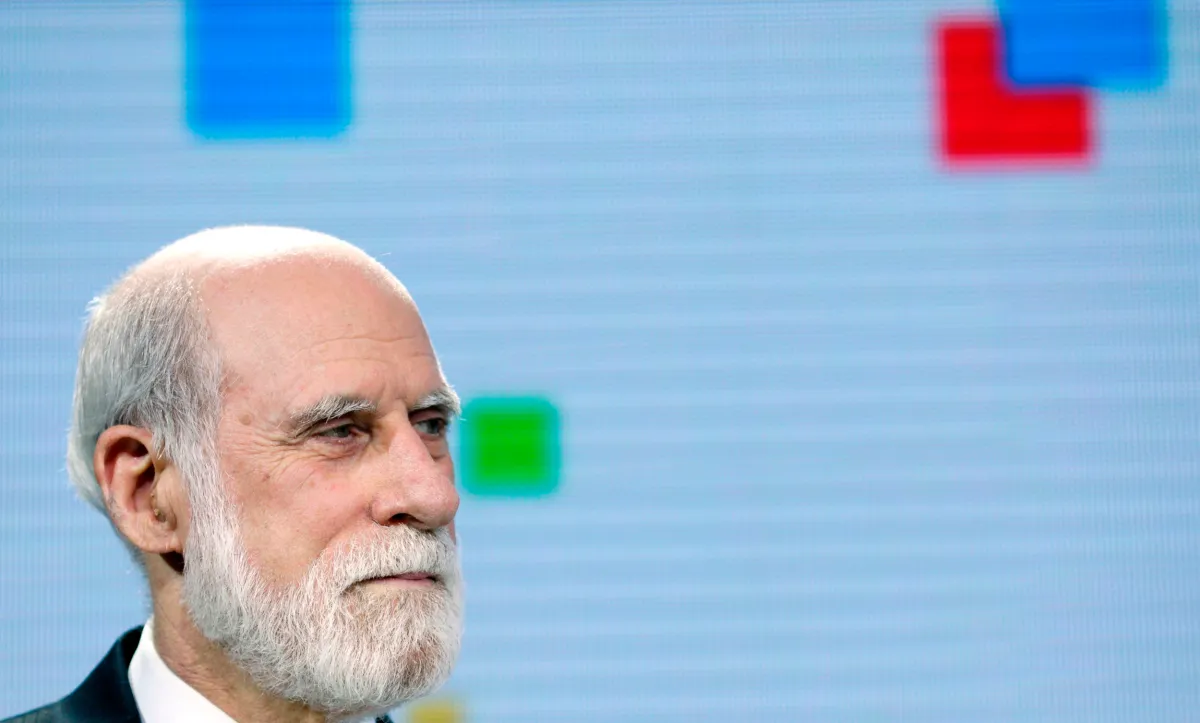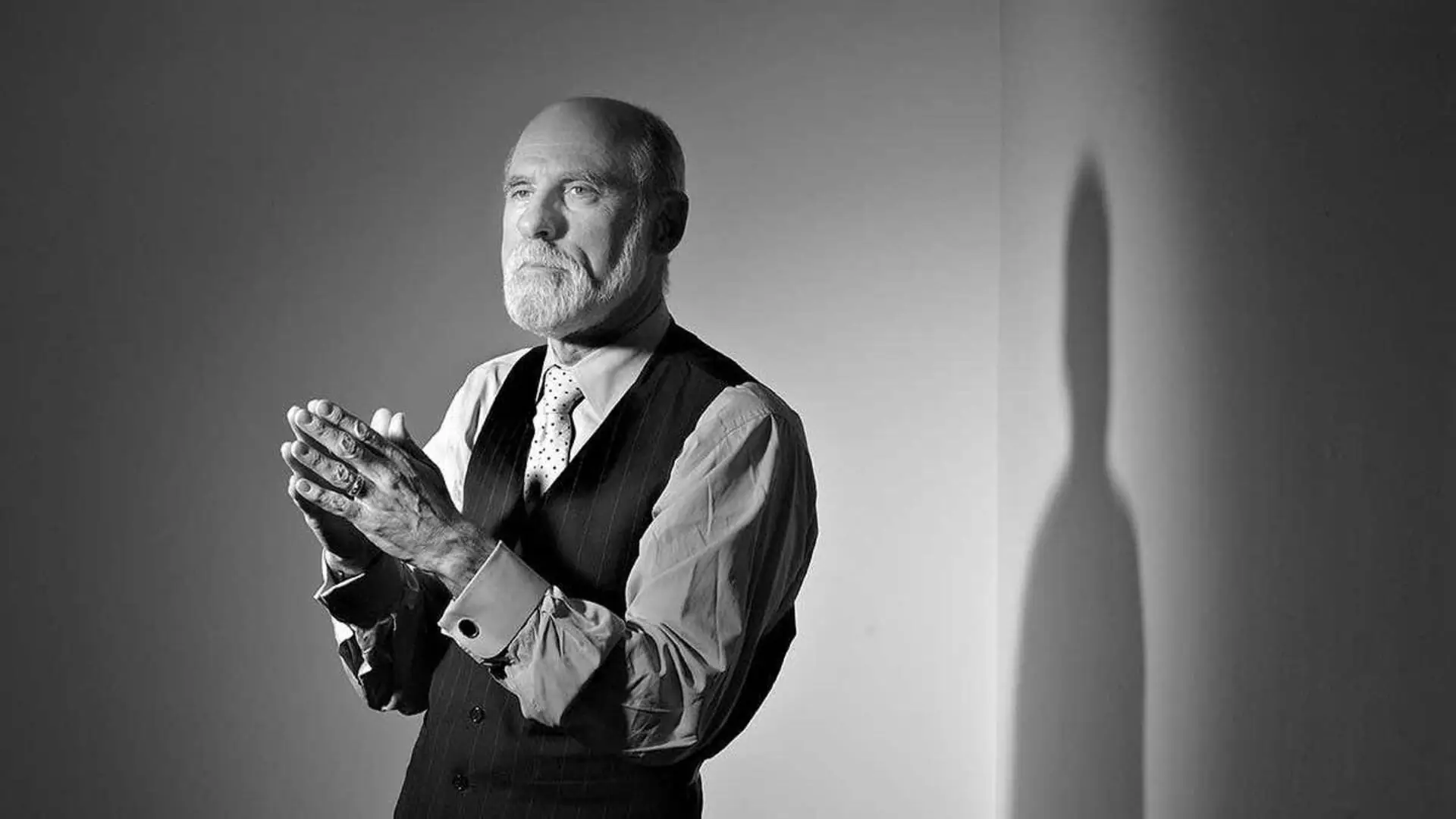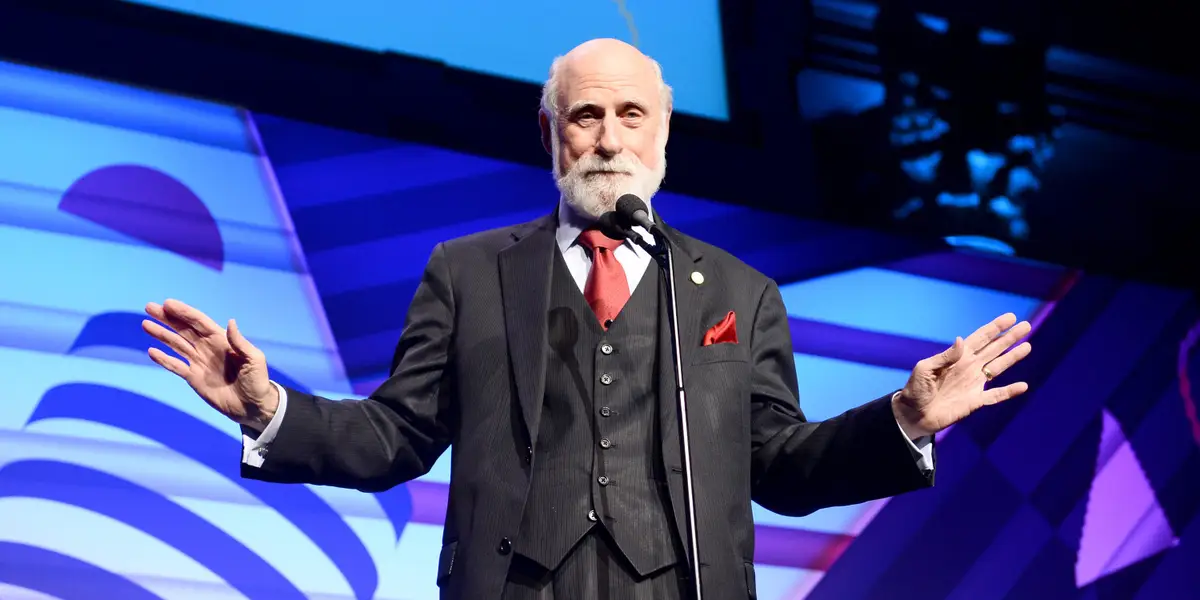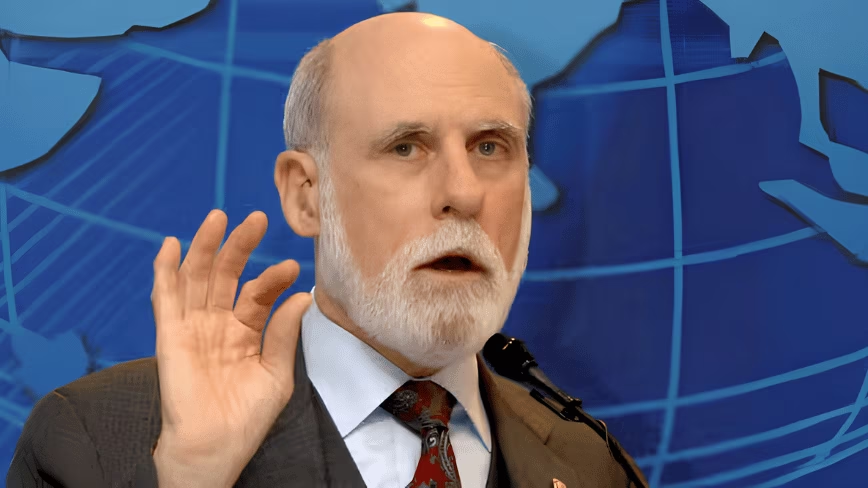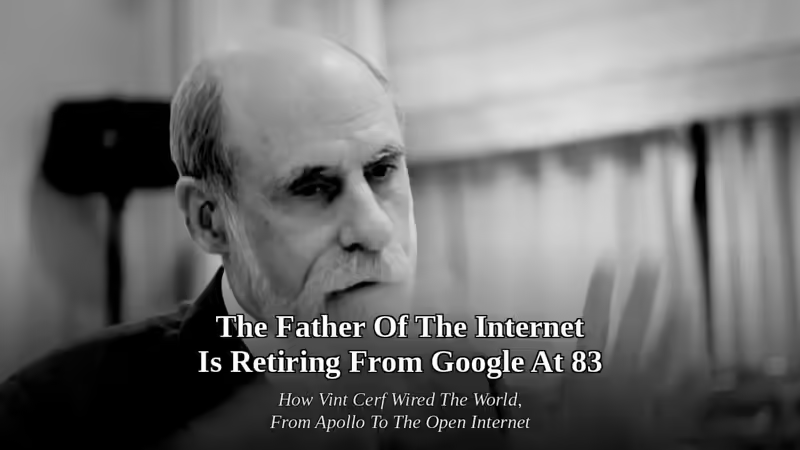
The news arrived, fittingly, over a network.On 30 June 2026, on a video feed piped into the Laude Institute's Open Frontier conference, an 83-year-old man in a three-piece suit listened while Dave Patterson — the Berkeley computer scientist who helped invent the RISC chip — turned to the room and marked the moment. Vint Cerf had been at Google more than twenty years, Patterson said. He would retire a week from that day. The room ought to give him a hand for what Patterson, deadpan, called a relatively good career.The room did.It was a dry send-off for a dry man, and the understatement was the joke. The career in question produced the technical grammar underneath almost every digital act a modern human performs: every search, every payment, every video call, every message that crosses from one network to another and arrives intact. Patterson also recalled meeting Cerf in the 1970s, a graduate student who showed up to a computer lab in a shirt and tie, and pronounced him the best-dressed computer scientist he had ever met. Cerf owned it. He had worn a vest even then, he admitted, because he wanted to stand out, and where his peers reached for long hair, he reached for tailoring.That is the whole man in one exchange. The self-effacement, the wit, the suit — and beneath it, an achievement so foundational that the people using it every second rarely think of it as an invention at all. Water takes its pipes for granted. And there is a second joke folded into the timing, one Cerf himself pointed at from the same video feed: he is leaving at the exact moment the industry is arguing about whether the open, interoperable world he built can survive the age of artificial intelligence.To understand why that argument matters, start where he started. With a rocket.Key TakeawaysVint Cerf, 83, will step down as Google's Chief Internet Evangelist next week, closing a twenty-year run at the company and a career that shaped the internet itself.With Robert Kahn, Cerf co-designed TCP/IP in the 1970s — the rulebook that lets separate computer networks talk to one another — and shares the title "father of the internet".His honours include the Turing Award, the Presidential Medal of Freedom, the Queen Elizabeth Prize for Engineering, and 29 honorary degrees.Beyond Earth, Cerf spent nearly three decades building an interplanetary internet with NASA's Jet Propulsion Laboratory, designing protocols that survive the delays of deep space.He leaves carrying a warning about a digital "dark age" — the risk that civilisation's memory rots as the formats holding it fall obsolete.His parting prediction: the rise of AI agents will push the industry back toward the open, standard protocols that made his internet durable.From The Launch Pad To The LabBefore the internet, there was ignition.As a teenager at Van Nuys High School in Los Angeles, Cerf shared classrooms with Steve Crocker and Jon Postel — two names that would later sit beside his in the founding mythology of the internet, three future architects of a global system loitering in the same Southern California hallways, each still oblivious to what they were queuing up for. It reads like a screenwriter's contrivance. It happened.Cerf's first brush with real engineering came at Rocketdyne, where, for six months while still in school, he helped write statistical software for the non-destructive testing of the F-1 rocket engine — the monstrous powerplant that would soon hurl Apollo astronauts off the planet. Hold that image, because it becomes the arc of a life. A young man doing the maths that helped light the biggest engines ever flown would spend his final decades trying to build a network that could reach the worlds those engines were pointed at. He started at the launch pad. He is ending somewhere past Mars. The thrust, in between, was information.The academic path ran through Stanford, then a mathematics degree, then a doctorate and the research culture of the early 1970s, when a Defense Department agency called ARPA was funding a strange experiment: could geographically scattered, mutually incompatible computers be made to share a single conversation? The machines of that era were islands. Each vendor spoke its own dialect, guarded its own borders, refused to acknowledge the existence of the others. Getting them to cooperate was less an engineering problem than a diplomatic one. It needed a shared tongue.Cerf was about to help write it.The Grammar Of A Connected WorldThe foundation everyone stands on was poured by two men.In 1973, Cerf and Robert Kahn — an engineer at ARPA with a problem and the sense to find the right collaborator — began designing a way to knit separate networks into one. The result, published in a 1974 paper with the unglamorous title A Protocol for Packet Network Intercommunication, was TCP/IP: the Transmission Control Protocol and the Internet Protocol, a pair of rulebooks so quietly powerful that they still govern the network you are reading this on.The genius was architectural, and it lay in restraint. Rather than build one giant, centrally-managed network, Cerf and Kahn designed a set of rules for building a network of networks — a common load-bearing standard that any system could adopt while keeping its own internal structure intact. The protocol was the steel frame; what each network hung on that frame was its own business. Data would be chopped into packets, addressed, and sent hop by hop across whatever links existed, reassembled at the far end. The network itself stayed deliberately dumb. The intelligence lived at the edges, in the machines doing the sending and receiving. Robustness came from simplicity. A structure with few assumptions is a structure that rarely collapses.That design choice — keep the core minimal, push the cleverness outward, demand only that everyone agree on the protocol — is the single most consequential decision in the history of digital infrastructure. It is why the internet could absorb the web, then streaming, then smartphones, then video calls, then the whole apparatus of modern life, the original foundation staying exactly where Cerf and Kahn poured it. The building kept getting taller. The footings held.The system took a decade to move from blueprint to occupancy. Cerf has a wry line about it: the tasks he chooses, he has said, tend to have really long timelines. He and Kahn started in 1973. The internet, as a live thing running his protocols, switched on in January 1983 — the flag day when the old scheme was retired and TCP/IP became the law of the network. Ten years from idea to ignition. He was patient then. He has stayed patient since.Below is the load-bearing chronology of a fifty-year career.YearMilestone1943Born in New Haven, Connecticut, on 23 June1960sTests Apollo F-1 engine software at Rocketdyne while at Van Nuys High1973Begins designing TCP/IP with Robert Kahn1974Publishes A Protocol for Packet Network Intercommunication1982–86Vice president at MCI; helps launch MCI Mail1983The internet switches to TCP/IP on 1 January1992–95Founding president of the Internet Society1998Appointed a Distinguished Visiting Scientist at NASA JPL; begins the interplanetary internet2000–07Chairman of the board of ICANN2004Wins the Turing Award with Robert Kahn2005Joins Google as vice president and Chief Internet Evangelist; receives the Presidential Medal of Freedom2026Retires from Google after twenty yearsPreaching An Open Network To The WorldBuilding the cathedral was step one. Filling the pews was the rest of his life.A protocol that only governments and universities may use is a private club, and for its first years the internet was exactly that — a research network fenced off from commerce. Cerf helped open the gate. As a vice president at MCI in the mid-1980s, he championed MCI Mail, one of the first commercial email services, and pushed to let it connect to the wider internet that had been reserved for the public sector. The barrier came down. Systems once sealed off from one another were suddenly interconnected, he later explained, and once people could send a message across the boundary of any single provider, the shape of the future clicked into place. You know the rest of the story, as Cerf likes to say. Everyone reading this is living inside it.He then spent decades as the network's diplomat, and the roles read like a foreign ministry: founding president of the Internet Society; chairman of ICANN, the body that governs the internet's names and numbers; a seat on the UN's broadband commission; testimony before the US Senate on net neutrality, where he argued that a handful of dominant broadband carriers should be prevented from throttling rivals or charging tolls on the open road he had helped pave. His concern was always the same, whatever the venue: keep the network a commons. Keep the borders open. Keep the lingua franca free for anyone to speak.His title at Google made the vocation literal. When he joined in 2005, he took the role of Chief Internet Evangelist — a job description he embraced with a preacher's zeal for spreading the gospel of connectivity to the billions still offline. He leaned into the bit. On an early day at the company he reportedly turned up in the ceremonial academic robes of a Spanish university, playing the part of the missionary in vestments; the colleagues old enough to catch the reference laughed, and the younger ones simply gave the strangely-dressed elder a wide berth. He raised the average age at Google considerably by joining, he liked to note. He was in his sixties. He would stay for two more decades.Twenty Years As Google's Elder StatesmanWhat does the father of the internet actually do at a search company for twenty years?Less product management than conscience. From inside Google, Cerf became the industry's most quoted forecaster and its most patient advocate for the unglamorous work that keeps the network healthy — the migration to IPv6 to expand the internet's dwindling supply of addresses, the defence of open standards against the pull of walled gardens, the steady insistence that access itself is the point. He wrote and spoke relentlessly, a one-man think tank in a waistcoat, filing columns and predictions on everything from the internet of things to the future of television to the risks of the very AI boom now reshaping his old employer.And he made the mission personal in a way few technologists do. Cerf is hard of hearing; his wife Sigrid was deaf for much of their marriage before a cochlear implant restored her hearing, a moment he has described as one of the most affecting of his life. For him, accessibility stayed a lived fact, well beyond an abstraction on a slide. He pushed for real-time captioning, speech enhancement and hearing technology with the conviction of a man who needed them, arguing that the same network built to connect computers had an obligation to connect people the world too often designs around. The evangelist's gospel, it turned out, had a clause about the last person in the room.That is the terrestrial Cerf — the builder, the diplomat, the advocate. But the most quietly astonishing chapter of his career points away from Earth entirely.The Internet That Reaches For MarsIn 1998, he looked up.That spring, nine people gathered at NASA's Jet Propulsion Laboratory to ask a deceptively simple question: what would space exploration need twenty-five years from now? The answer, as Cerf tells it, became obvious — a backbone network to support human and robotic missions across the solar system. He was appointed a Distinguished Visiting Scientist at JPL and set about a problem that made the terrestrial internet look easy.Space breaks his own protocols. TCP/IP assumes a low-latency, always-on connection, the comfortable conditions of a wired planet. Deep space offers the opposite: signal delays measured in minutes, links severed for hours as planets rotate and orbits drift, a vacuum where the tidy assumption of an end-to-end path simply dissolves. So Cerf co-led the design of something new — Delay and Disruption Tolerant Networking, or DTN, built around a Bundle Protocol that behaves less like a phone call and more like a chain of trusted couriers. Each node holds a bundle of data until a path to the next node opens, then passes it along, one patient hop at a time.He explains it with an image that captures the whole philosophy. A packet bound for Jupiter might reach a relay near Mars only to find Jupiter out of position. He frames it as a question of thrift: hold the data until Jupiter swings back into view, then send it on. Store, wait, forward. It is a message in a bottle for the age of the Deep Space Network, and it works. NASA improvised a version of it in 2004 to rescue data from the Spirit and Opportunity rovers, reprogramming Mars orbiters into store-and-forward relays. DTN reached the International Space Station in 2016. His long-standing dream is stranger and grander still: to repurpose spacecraft that have finished their scientific missions into permanent relay nodes, dead probes given a second life as the buoys of an interplanetary sea.The same protocols have found uses closer to home — tracking reindeer herds across the roadless north of Sweden, where connectivity is as unreliable as it is between planets. And the timeline, of course, is vintage Cerf. The work began in 1998. Nearly three decades on, he is still nudging spacecraft-makers toward adopting it, betting that a future Moon or Mars programme will finally make his patient network the standard. He started designing for the year 2023 back when dial-up modems screeched. The man simply thinks in longer units of time than the rest of the industry.Which is exactly why his other late-career obsession should frighten anyone paying attention.The Man Who Fears The World Will ForgetHe built the machine that remembers everything. He is terrified it will forget.For more than a decade, Cerf has warned of a digital dark age — a slow catastrophe in which the sheer abundance of digital information becomes its own undoing. Storage is the easy part. The hard part is legibility across time. A document, image or dataset is only as durable as the software, operating system and hardware needed to open it, and all three fall obsolete on a schedule measured in years, while civilisation measures itself in centuries. A photograph printed in 1890 is still a photograph. A file written in 1995 may already be an unreadable smear of bits, its decoder ring long since discarded. We are, he warns, at risk of becoming a century whose records dissolve faster than its descendants can read them.His proposed answer has a medieval name: digital vellum. Just as monks preserved the ancient world by copying it onto treated calfskin durable enough to survive a thousand years, Cerf argues, the digital age needs a way to preserve both its data and the means of interpreting it — a curated, self-describing archive that a reader two hundred years hence could still decode. As recently as April 2026 he was co-authoring papers on exactly this, mapping the barriers to long-term preservation and sketching a framework for what he calls communicating with the future.There is a poetry to where he has chosen to sit while making this case. Cerf has served for years on the board of governors of the Folger Shakespeare Library — the institution that guards the largest collection of the First Folio, the 1623 book that saved half of Shakespeare's plays from vanishing. The custodian of the network built to remember everything sits on the board of the library dedicated to remembering the deepest cultural memory the language has. The scriptorium and the server farm, the folio and the format, the same anxiety across four centuries: how does a civilisation hand its mind to the ones who come after? He has spent a lifetime on transmission. This last problem is about preservation. They are the same problem, viewed from opposite ends of time.And now, as he leaves, both arrive at once — because the thing about to inherit his network is also the thing that could break it.Why His Exit Lands In The Middle Of The AI FightHe is signing off just as his central idea goes back on trial.The Open Frontier conference where his retirement surfaced was, by design, a debate about a worry: that the most powerful AI is pooling inside a handful of enormous, well-funded laboratories, a concentration that stands in pointed contrast to the sprawling, decentralised, permissionless internet Cerf's protocols made possible. The open network won the last era precisely because it stayed ownerless — a commons. The question hanging over the room was whether the AI era would belong to a few.Cerf, characteristically, offered a reason for optimism rooted in his own life's work. The agentic model of AI — many autonomous agents, built by many different companies, negotiating and transacting with one another — will, he argued, force the industry back toward composability, interoperability and shared standards. Agents can only work together when they can understand each other, and the moment you need machines from rival makers to cooperate, you need a common protocol. It is the same pressure that birthed TCP/IP, replaying half a century later. The islands are back. Something will have to teach them to talk.The stakes in that observation are enormous, and the history is the warning. Whoever defines the standards for how AI agents interoperate could inherit the kind of quiet, structural power that shaped the internet's early decades — the influence that flows to whoever writes the rulebook everyone else has to follow. Cerf and Kahn wrote theirs and gave it away, and the giving-away is why it endured. Whether the companies racing to wire together the agentic economy make the same choice, or a different one, will decide whether the next network is a commons or a toll road.That is the argument he leaves on the table. It is a fitting one. The father of the internet spent his career insisting that the most durable systems are the open ones, that intelligence belongs at the edges rather than the centre, that a good protocol is a gift you hand to strangers. As artificial intelligence tempts the industry toward exactly the concentration he spent fifty years designing against, his final contribution may be the reminder that the open way already won once — and could again.He walks away in a three-piece suit, the best-dressed man in a field that dressed down by habit, having wired one planet and drawn the map for the next. The applause in that conference room was for twenty years at Google. It should have been for fifty years of a simple, radical proposition that turned out to be the foundation of the modern world: that separate things, given a common language, can become one.The network he built will carry the news of his retirement to every corner of the Earth within seconds. He would appreciate the symmetry.FAQWho is Vint Cerf and why is he called the father of the internetVinton "Vint" Cerf is an American computer scientist who, with Robert Kahn, co-designed TCP/IP in the 1970s — the core protocols that let different computer networks connect and exchange data. Because that design became the technical foundation of the internet, Cerf and Kahn share the title "fathers of the internet".Why is Vint Cerf retiring from GoogleCerf, 83, is stepping down as Google's Chief Internet Evangelist after twenty years, a departure revealed on 30 June 2026 at the Laude Institute's Open Frontier conference. He has framed it as the close of a long career rather than a response to any single event; Google declined to comment when the news broke.What did Vint Cerf do at Google?Cerf joined Google in 2005 as vice president and Chief Internet Evangelist, a role focused on spreading internet access, shaping technology policy, and championing open standards. He advocated for IPv6 adoption, net neutrality, accessibility technology, and long-term digital preservation, and became one of the industry's most quoted voices on the future of the network.What is the interplanetary internet Vint Cerf worked on?Since 1998, Cerf has worked with NASA's Jet Propulsion Laboratory on a network to connect spacecraft across the solar system. It uses Delay and Disruption Tolerant Networking (DTN), which stores data at intermediate nodes and forwards it when a path opens — a design built to survive the long delays and frequent disconnections of deep space.What is the digital dark age Vint Cerf warns about?Cerf has cautioned that much of today's digital information could become unreadable as the software, formats and hardware needed to open it fall obsolete. His proposed answer, "digital vellum", is a method of preserving both data and the means to interpret it, so future generations can still decode the records of our era.What awards has Vint Cerf received?Cerf's honours include the Turing Award (2004, with Robert Kahn), the US Presidential Medal of Freedom, the National Medal of Technology, the Queen Elizabeth Prize for Engineering, the Marconi Prize, the Japan Prize, membership of the National Academy of Engineering, and 29 honorary degrees.What did Vint Cerf say about AI when announcing his retirement?At the Open Frontier conference, Cerf predicted that AI agents from many different sources interacting with one another will force the industry back toward composability, interoperability and shared standards — the same open-protocol approach that made his internet durable.end of article
Vint Cerf Wired The World: The Father Of The Internet Is Retiring From Google At 83
From the Apollo rocket engines he tested as a teenager to a network meant to span the solar system, Vint Cerf spent fifty years teaching the world's computers to speak one language. He leaves Google at 83 with a parting argument: the age of AI agents will need his life's work more than ever.
3,533 words~16 min read