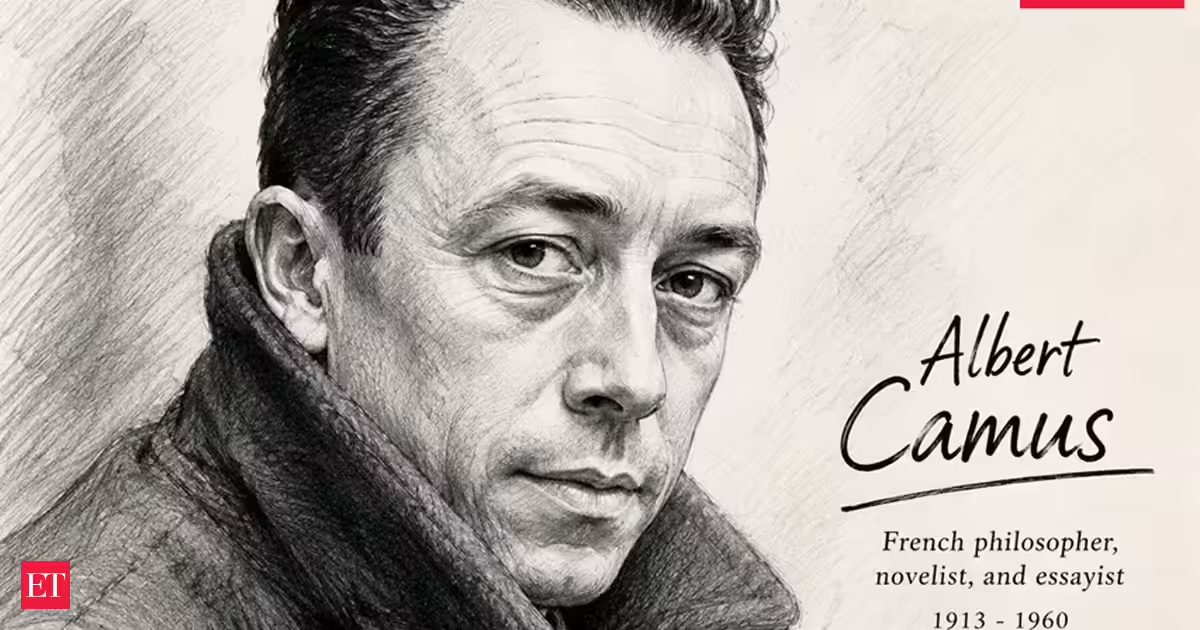
One of the most unforgettable moments in David Fincher's 2008 fantasy romantic drama The Curious Case of Benjamin Button isn't that Benjamin grows younger as the years pass. For many film critics, it's a realization that, despite living life in reverse, he understands something many people never do. Age changes the face. Experience fills the calendar. But neither guarantees that a person truly knows themselves.But we are neither in fantasy nor in movies and life doesn't move backward like Benjamin's, yet it often feels just as bewildering. We spend our twenties chasing promotions, collecting achievements, trying to become the version of ourselves the world seems to admire. We learn to answer interview questions, meet expectations, and wear confidence like a well-tailored suit. But somewhere between birthdays, deadlines, and responsibilities, an unsettling question waits for when we seek the inner us: If everything else disappeared, would you still recognize the person you've become?Perhaps growing older was never the real milestone. Perhaps learning to live honestly with yourself always was as per one of the twentieth century's most influential philosophical writers and a A master of the aphorism, Albert Camus.Quote of the Day by Albert Camus: “At 30 a man should know himself like the palm of his hand, know the exact number of his defects and qualities, know how far he can go, foretell his failures - be what he is. And, above all, accept these things.”Also Read: Quote of the Day by Mother Teresa: ‘Some people come in our life as blessings; some come in your life as lessons’ - why not everyone is meant to stay in your life explained by Saint Teresa of CalcuttaWhy Albert Camus' quote on self-awareness matters todayLife, a mosaic of sporadic experiences, constantly encourages comparison. Social media celebrates achievements, workplaces reward constant ambition, and society often measures success by external milestones. In such an environment, many people know more about others than they know about themselves.Camus reminds us that real maturity comes from honest self-awareness. Understanding our strengths is important, but recognizing our weaknesses, limitations, and recurring mistakes is equally valuable. Accepting those realities isn't giving up; it's the foundation for making better decisions and building a more authentic life.What Albert Camus' quote means in real lifeCamus isn't suggesting that people should stop growing once they reach 30. Instead, he argues that adulthood should bring clarity. By this stage of life, a person should have enough experiences to recognize their patterns, what motivates them, what repeatedly causes them to fail, and where their natural abilities truly lie.The final line of the quote is perhaps its most powerful lesson: acceptance. Accepting yourself doesn't mean abandoning ambition. It means refusing to waste energy pretending to be someone else. Once people stop fighting reality, they are often better equipped to improve what they can and peacefully live with what they cannot change.Albert Camus' quotesSome of Albert Camus's most memorable quotes include the following:"You will never be happy if you continue to search for what happiness consists of. You will never live if you are looking for the meaning of life""In the depth of winter, I finally learned that within me there lay an invincible summer ""I may not have been sure about what really did interest me, but I was absolutely sure about what didn't ""Autumn is a second spring when every leaf is a flower ""Nobody realizes that some people expend tremendous energy merely to be normal""But in the end one needs more courage to live than to kill himself "About Albert CamusAlbert Camus (1913–1960) was a French writer, philosopher, journalist, and playwright born in French Algeria. Raised in a working-class family, his early experiences profoundly shaped his ideas about justice, morality, and the human condition. Although he developed a deep interest in philosophy, financial hardship prevented him from pursuing a full academic career.During the Second World War, Camus joined the French Resistance and later became a columnist for the newspaper Combat. Beyond journalism, he earned international recognition through works such as The Stranger (1942), The Myth of Sisyphus (1942), The Plague (1947), The Fall (1956), and Exile and the Kingdom (1957). In 1957, at the age of 44, he was awarded the Nobel Prize in Literature for illuminating "the problems of the human conscience in our times." He died in a car accident on January 4, 1960.Albert Camus' legacyCamus remains one of the twentieth century's most influential literary and philosophical voices. His writings examined themes such as the absurdity of existence, moral responsibility, freedom, and human dignity. Rather than encouraging despair, he believed people should face life's uncertainties with honesty, courage, and compassion.Decades after his death, Camus' essays, novels, and quotations continue to resonate with readers navigating personal struggles, career decisions, and questions about identity. His reflections on self-awareness and acceptance remain especially relevant in an age where external validation often overshadows genuine self-understanding. Albert Camus's booksAlbert Camus' most celebrated works include The Stranger (1942), The Myth of Sisyphus (1942), The Plague (1947), The Rebel (1951), and The Fall (1956). Other notable works include Exile and the Kingdom (1957), Nuptials (1938), Reflections on the Guillotine (1957), A Happy Death (published posthumously in 1971), and the unfinished autobiographical novel The First Man (published posthumously in 1994). His writings continue to be widely read for their exploration of the human condition, freedom, and the search for meaning.
Quote of the Day by Albert Camus: ‘At 30 a man should know himself like the palm of his hand, know…’ - Men’s search for meaning simplified by the French philosopher
Quote of the Day by Albert Camus highlights the profound importance of honest self-awareness. True maturity, he suggests, lies not in accumulating years but in understanding our inner patterns, strengths, and weaknesses to build a more authentic existence. This wisdom remains vital today as acceptance becomes a challenge.
890 words~4 min read