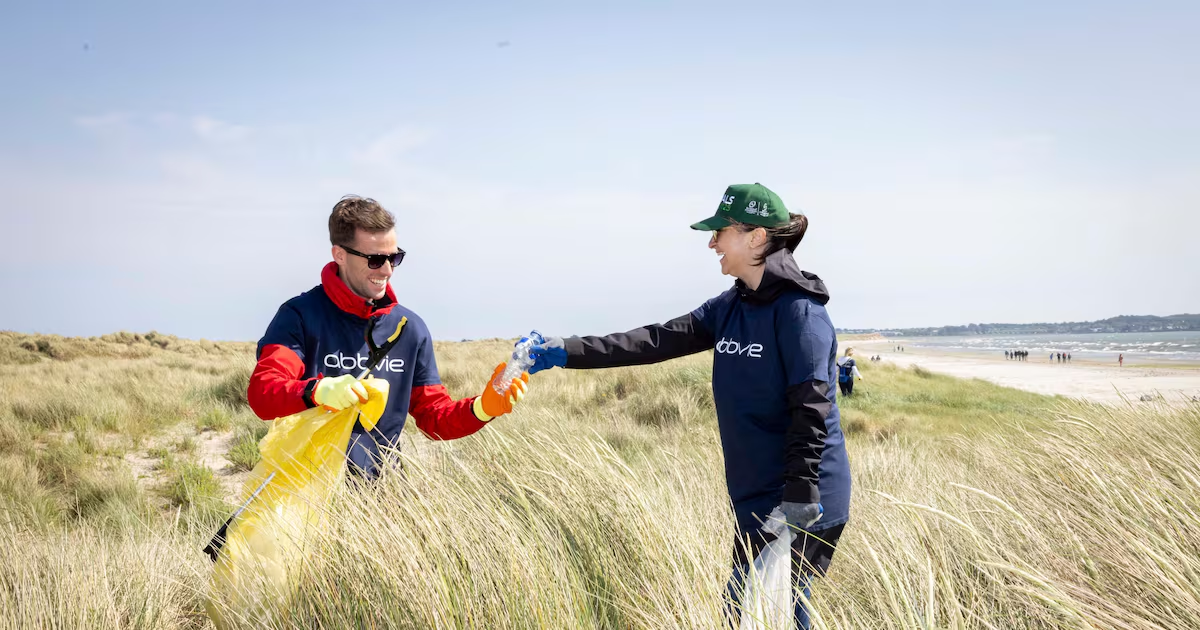
Corporate Ireland’s economic contribution is well known, but it also makes a hugely important societal contribution in the form of corporate social responsibility (CSR) activities across a range of areas including education, sport, community development and support for local and national charities. “We have witnessed a major shift over the past 25 years in how Irish companies engage with communities,” says Tomás Sercovich, chief executive of Business in the Community Ireland, a non-profit organisation specialising in advice and guidance to leading companies on corporate responsibility and corporate community involvement. “From the old style of the chequebook charity and a scattergun, once-off approach, we leapt towards initiatives that are truly strategic, multiannual, aligned to business goals and making a real difference to people.” Sercovich notes that community engagement has moved from large, blue-chip companies to any business organisation. “We have seen relations between businesses and communities evolve from passive giving to mutually beneficial, and this win-win is the mark of success and impact.” Tomás Sercovich. CEO, Business in the Community Ireland Most of the initiatives Business in the Community Ireland have brokered combine financial giving with employee volunteering, especially skills-based volunteering, as well as in-kind donations. “This multifaceted approach is ideal to engage employees, build a strong culture [and] facilitate charities’, and other organisations’ access to resources they could not normally afford, such as legal or technology support,” says Serkovic. Unicef receives no funding from the United Nations’ regular budget, depending exclusively on the generosity and support of a wide network of contributors. Owen Buckley, head of corporate partnerships at Unicef Ireland, says its partnerships with the private sector can make a “transformational difference” for children the charity helps. “This may be through strategic programmatic funding, by leveraging a company’s core expertise and networks or by working with industries to promote child-rights principles in responsible business practices,” he explains. Unicef’s multiannual corporate partnerships, Buckley says, are strategic, long-term collaborations designed to integrate a business’s philanthropic, marketing and ESG (environment, social, governance) objectives with Unicef’s global mission. “Unicef collaborates with businesses from a multitude of industries who are aligned with our values and mission.” In Ireland, Unicef has multiannual international partnerships with two of the country’s biggest companies. Its partnership with construction company CRH launched in 2024; through this partnership, Buckley notes, Unicef has been able to deliver more than 22 million vaccine doses, reaching more than six million children and pregnant women in fragile and conflict-affected regions. Unicef’s relationship with Primark (Penneys) began eight years ago, with Primark supporting the organisation across a range of areas, including education in Cambodia, India and Sri Lanka, emergency responses in Ukraine and the Turkey-Syria region, and Unicef’s global programmes and humanitarian responses. Owen, Buckly, head of corporate partnerships, Unicef Ireland “In 2025 there were over 440 humanitarian crises around the world,” Buckley says. “Primark’s support of our children’s emergency fund allowed Unicef to prepare and preposition emergency supplies in advance of a sudden-onset disaster or conflict so Unicef can deliver aid to affected areas immediately.” These partnerships are mutually beneficial, going far beyond tick-box activities, he adds. “Forging a strong partnership with Unicef can drive impact at scale for businesses. Plus, it is underpinned by a sense of higher purpose, which can ripple through a business. It can trigger dividends across revenue, new business, recruitment, employee engagement and inclusion.” Trócaire has a similar ethos in its corporate partnerships, preferring long-term collaboration based on solidarity and innovation. “Companies like Aerogen, a Galway-based medtech company, continue to partner with us to help build a fully equipped hospital in Dollow, Somalia,” says Seán Farrell, chief executive of the charity. Led by Aerogen founder John Power, that project has significantly improved healthcare in one of the world’s most at-risk regions. Merlon Developments, another supporter of Trócaire based in Kildare, is supporting the project by helping deliver renewable energy solutions for the local hospital. “The hospital now treats around 2,500 patients each month, providing essential care for mothers and malnourished children,” says Farrell. “Irish businesses are demonstrating what genuine partnership looks like.” This form of corporate support has never been more important, he adds. “Across the globe, governments are reducing their international development budgets at a time when humanitarian needs are reaching record levels.” At Barnardos, CSR partnerships play an increasingly important role in sustaining frontline services and responding to the rising levels of need among vulnerable children and families across Ireland, says Mary Gamble, director of fundraising, marketing and communications with the children’s charity. Barnardos works with a broad range of businesses through long-term strategic partnerships and employee-led fundraising initiatives, she explains. “While some partnerships begin as one-off events or campaigns, many evolve into deeper collaborations grounded in a shared set of values and a common ambition to deliver meaningful social impact.” Corporate support can take many forms, including fundraising events, payroll giving, sponsorship, volunteering, pro-bono expertise and cause-related marketing campaigns. These partnerships help to fund and strengthen critical services including prevention and early intervention programmes, child and youth mental health supports, educational wellbeing initiatives and integrated family and community services, says Gamble. Barnardos Ireland worked with more than 35,000 children and families during 2025 across schools and communities, and in its dedicated centres nationwide. “Against a backdrop of increasing demand and rising operational costs, we view corporate partnerships as an important source of both financial support and wider organisational sustainability,” says Gamble. For many businesses, partnerships with charities such as Barnardos are no longer viewed solely as philanthropic activity, but as part of broader social-impact and sustainability strategies. Gamble says she has seen the social pillar of ESG becoming increasingly important as the corporate world seeks to demonstrate meaningful contributions in areas such as mental health, equality of opportunity, education and community wellbeing. “We are seeing growing expectations from employees, consumers and stakeholders to demonstrate authentic and measurable social impact. As a result, partnerships are being built around shared values, long-term outcomes and community engagement rather than traditional sponsorship alone,” she says. “Businesses supporting early intervention services, educational wellbeing and intensive family support programmes can clearly demonstrate practical impact in areas that directly affect children and communities across Ireland.” Biopharmaceutical company AbbVie employs about 2,900 people across six sites in Ireland. Its CSR activity is “community focused and employee led”, says Gary O’Mahoney, director of HR at AbbVie Ireland. “It includes volunteering, charity partnerships, community clean-ups, fundraising and activities that support education, health, inclusion, and wellbeing,” he says. “We try to create opportunities for employees to support their communities in ways that are practical, hands-on and locally embedded.” Last year, AbbVie employees worldwide volunteered more than 44,000 hours during its weeklong “Week of Possibilities” global volunteering programme. In Ireland, volunteer activities took place across several sites with employees volunteering their time and skills to support local schools and community spaces. For example, 266 volunteers spent 1,016 hours transforming St Brid’s Special School in Castlebar, with work including painting, lighting upgrades, sensory room improvements, garden enhancements and staffroom refurbishment. This year will mark AbbVie’s 11th time running the volunteering event. The programme focuses on key projects that made a visible difference to local environments and created lasting benefit for students, staff and communities, O’Mahoney notes. “Week of Possibilities is a great example of AbbVie’s commitment to volunteering and community impact,” he says. “It gives our 2,900 employees across Ireland the chance to step away from their day-to-day roles and support causes that matter to them, while also creating real value for charities and our local communities. The benefit is mutual: our communities receive practical help and support, while our people gain a stronger sense of connection, purpose and teamwork.” Sercovich says it is hard to quantify the impact that CSR activity has on the communities and organisations it helps. “Given the diversity of approaches adopted, measuring the full scale of corporate contributions remains difficult, though it is vast,” he says. New sustainability disclosure rules will require large organisations to report on community giving, but Sercovich says it will be hard to compare the data or to assess their impact beyond inputs. Yet it is his belief that the business case is well proven. “When well designed, communicated and integrated, these partnerships deliver clear benefits: businesses enhance their social legitimacy and brand; community organisations gain transformative financial and non-financial support; employees access meaningful volunteering opportunities and develop new skills; and society benefits from stronger, more connected communities.”
Beyond the bottom line: how corporate Ireland gives back to communities
Where an annual cheque once ticked a corporate social responsibility box, some of the most progressive Irish businesses now commit to longer-term community supports
1,398 words~6 min read