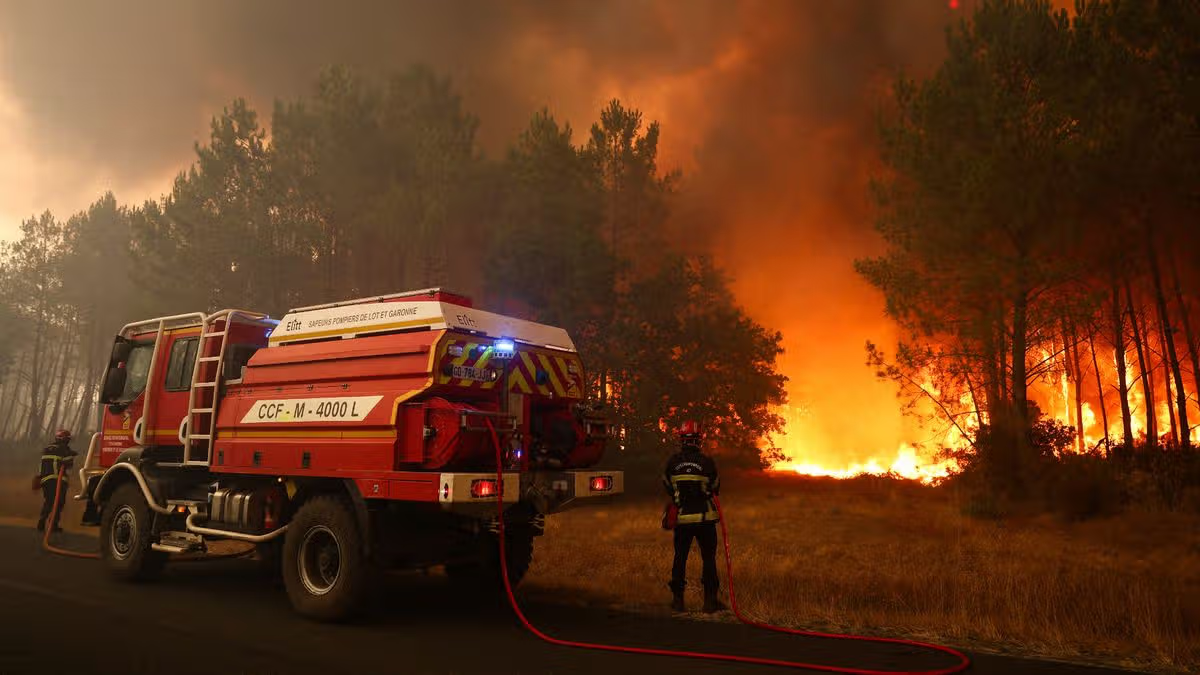
Sir, – Fintan O’Toole is right to decry the decades-long failure of politicians, policymakers and voters to heed the warnings of climate scientists (“Feel the heat. We are living in the future we were warned of,” June 30th). He writes that we now live in the future we were warned of. However, the science suggests worse is still to come if we fail to address emissions fast enough, and yet our policies and politicians remain weak, beholden to various interest groups, and inadequate for the task.The media bears its share of responsibility too. Climate change has largely fallen off the national and international agenda, surfacing only briefly when extreme weather events – such as those currently affecting Europe – force it back into view. Too few outlets have made the case that the disruption and cost of the necessary energy transition is a price worth paying.The Irish Times could do its part by treating O’Toole’s article as an essential public service and lifting it from behind the paywall, so it reaches the widest possible audience. – Yours, etc,CHRIS GARVEY,Glasnevin,Dublin 9. Sir, – In his excellent article on climate change, Fintan O’Toole says that, “At a fundamental level, we do not believe what we are experiencing: the catastrophic effects of global heating.” I tend to agree with him, as it is difficult to find any better explanation for the way in which so many people are continuing with their usual lifestyles and daily habits “as normal”, and even direct experience of extreme weather events which are clearly abnormal seems to make little or no impression. They are not “joining the dots,” whether because they are simply oblivious to the existence of the dots when it come to climate change, or because they are waiting for someone to put a pen in their hand and help them with this exercise. Recent examples of this were those who flew off one their usual “sun holiday” and, finding themselves, instead, in a furnace, simply started making plans for their next flight, but this time for a so-called “cool-cation” in some other part of the world.O’Toole mentions that he himself attended a conference in Germany during a heatwave. I don’t know if he flew there, but I assume that most of those attending probably did. Were there no other alternatives?O’Toole concludes his article saying “it is not too late to stop this madness. The sun itself is sending us its message: protest and survive.” I hope his optimism is justified, but we do not need to wait for the protest; we need to take individual responsibility for our actions now. If we can’t be bothered to do that, I doubt we’ll be bothered joining any protests anyway, unless we happen to like shouting a lot, waving flags and then going home to resume business as usual. Perhaps the message the sun is sending us is in fact: “You’re toast.” – Yours, etc,KATHERINE QUIRKE,Dún Laoghaire,Co Dublin.Sir, – While a firm believer in the reality of climate change, I’d still love to know how a record-breaking temperature of 33.3 degrees was reached at Kilkenny in 1887? – Yours, etc,BRIAN AHERN,Clonsilla,Dublin 15.
Climate science suggests worse is to come
Global warming has largely fallen off the national and international agenda, surfacing only briefly when extreme weather events force it back into view
524 words~2 min read