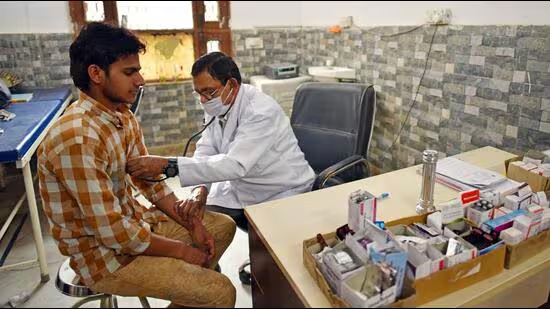
India is experiencing an unprecedented diagnostic boom. Annual health check-ups, home-sample collection services, wearable health devices, and increasingly sophisticated imaging have become routine parts of urban healthcare. The growth has brought genuine benefits. Tests that were once expensive or difficult to access are now available to millions. Earlier diagnosis, greater health awareness, and improved disease detection are all real achievements.Health (HT file photo)Yet an uncomfortable question remains largely unasked: When does more testing improve health, and when does it simply produce more findings? Physician depend on laboratory investigations every day. Modern medicine would be impossible without them. The issue is not testing itself. The issue is how testing is increasingly used and understood.India's diagnostic boom has created a paradox. At one end of the healthcare system, growing numbers of people are subjected to extensive investigations, incidental findings, and cascades of follow-up tests that may offer little clinical benefit. At the other end, millions of Indians with genuine disease remain undiagnosed. We are simultaneously confronting over-investigation and under-diagnosis.A recent patient illustrated one side of this paradox. A routine executive health check-up identified a borderline electrocardiographic abnormality in an otherwise healthy middle-aged professional. The initial finding triggered a cascade of further investigations. Weeks later, every test proved normal. The problem was not a mistake. Each step was individually defensible. Yet the final outcome was striking: a healthy man had temporarily come to see himself as a cardiac patient.This phenomenon is not unusual. When normality is defined as the range encompassing 95% of population values, five per cent of healthy individuals will fall outside that range for any given test. A panel of 20 investigations, therefore, has a high probability of yielding at least one abnormal result in an entirely healthy person. This is not necessarily a diagnostic signal. It is simply arithmetic.A major Cochrane review found that general health check-ups increased diagnoses without improving major health outcomes. More testing did not necessarily translate into better health.Clinicians are not immune to these pressures. In an environment where missed diagnoses carry professional, legal, and reputational consequences, there is often a powerful incentive to order one more test rather than one less. At the same time, direct access to laboratory reports, internet searches, and sophisticated AI-generated interpretations means that findings once contextualised within a consultation are now frequently interpreted in isolation. A result that a physician might explain in minutes can become a source of prolonged anxiety before any clinical discussion occurs.The consequences extend beyond individual patients. Excessive testing contributes to the growing medicalisation of healthy people, transforming individuals into patients-in-waiting because modern diagnostics can identify ever-smaller deviations from statistical normality. Yet the larger challenge facing India may be the opposite problem.While urban populations are exposed to extensive screening packages, millions of Indians with common chronic diseases remain undiagnosed. According to data from the ICMR-National Institute of Epidemiology, one in four Indians with diabetes remains unaware of the condition, and most of these individuals live outside major urban centres.This raises an important question about priorities.Every health care system must decide where to deploy resources. When substantial capital, equipment, and professional attention are repeatedly devoted to screening low-risk populations, less remains available to identify and treat disease where it is most likely to cause harm. The challenge is not simply expanding access to diagnostics; it is ensuring that diagnostic capacity is directed where it creates the greatest health benefit.The impact extends beyond resource allocation. It is also reshaping how Indians think about health.Increasingly, health is measured through reports rather than behaviours. A normal report becomes a certificate of wellness. An abnormal report becomes proof of illness. The space in between, where exercise, nutrition, sleep, stress, vaccination, tobacco use, alcohol consumption, and long-term risk reduction operate, is often neglected.This misunderstanding has important consequences. A normal health check-up cannot compensate for years of physical inactivity. It cannot neutralise chronic stress. It cannot replace healthy habits. Testing can identify risk. It cannot, by itself, reduce it.India's health burden is already being reshaped by chronic diseases linked to ageing, urbanisation, obesity, and metabolic risk. Recent NFHS-6 findings underscore the scale of the challenge: obesity now affects nearly 30% of women and 27% of men, while diabetes prevalence has reached 17.8% and 20.9%, respectively. These are not future challenges waiting on the horizon; they are present realities already placing enormous pressure on individuals, families, and the healthcare system. Addressing them requires more than sophisticated diagnostics. It requires stronger primary care, better preventive programmes, greater public health investment, and sustained support for behaviour change.A better policy is possible. Screening programmes should be guided by evidence-based national standards rather than commercial package design, and preventive care should be tailored to individual risk rather than sold as a one-size-fits-all package. The question facing India is not whether we need more diagnostics.The question is whether we are using them to improve health or merely to generate findings.The most useful thing I did for that anxious executive was not to order another test. It was simply to close the folder, look him in the eye, and tell him he was well. I advised him to return to the gym that very week, and to do so with confidence.That, after all, is what preventive medicine means: not only the detection of abnormalities, but the reassurance of the well, the identification of genuine risk, and the wisdom to recognise the difference.(The views expressed are personal)This article is authored by Dr Rajiva Gupta, senior consultant, Internal Medicine, CK Birla Hospital, Gurgaon, Founder, Upchaar Wellness, Gurgaon.
Does more testing mean better health?
This article is authored by Dr Rajiva Gupta, senior consultant, Internal Medicine, CK Birla Hospital, Gurgaon, Founder, Upchaar Wellness, Gurgaon.
916 words~4 min read