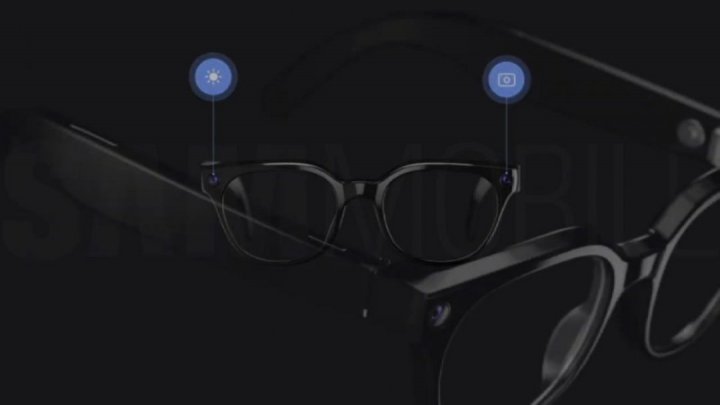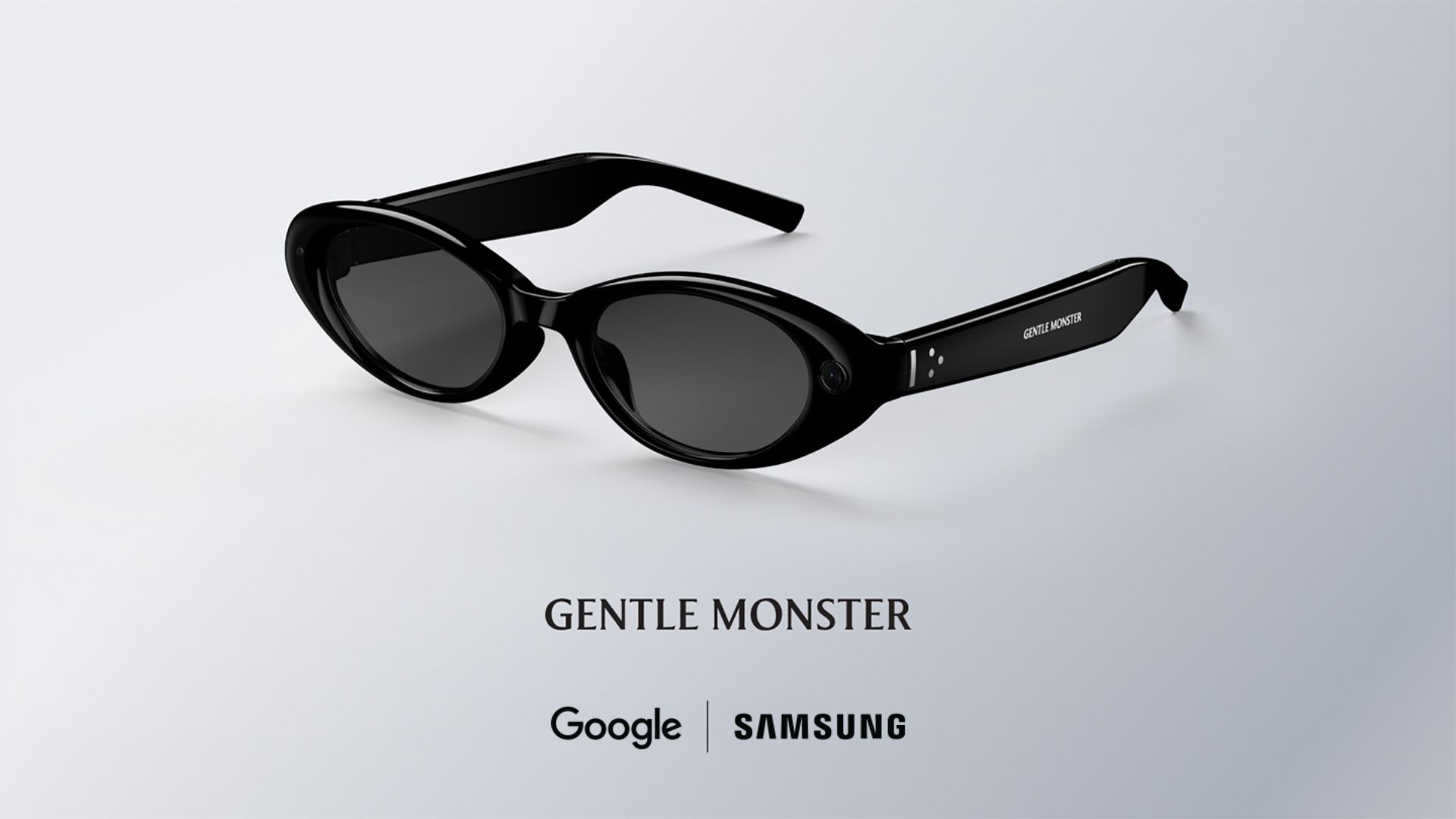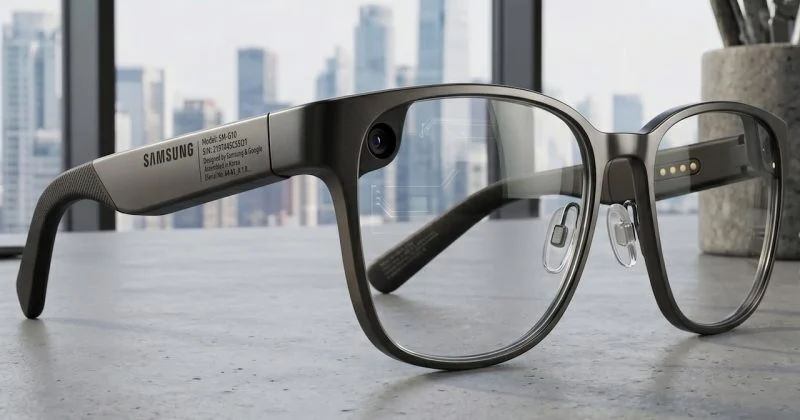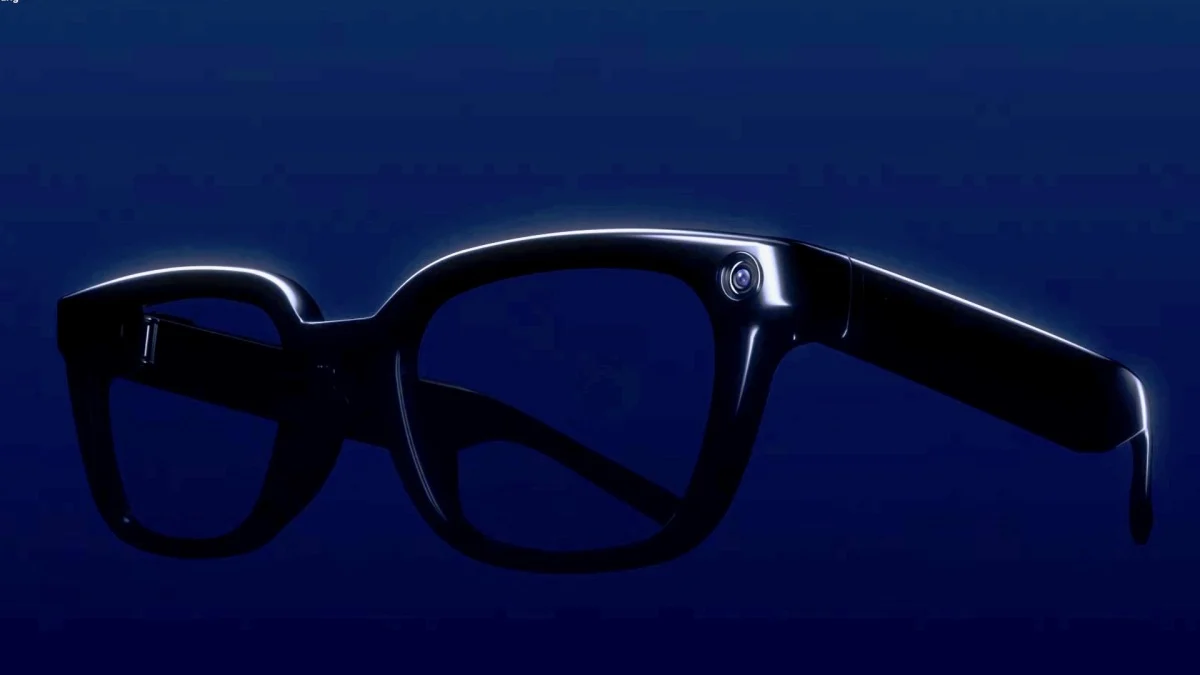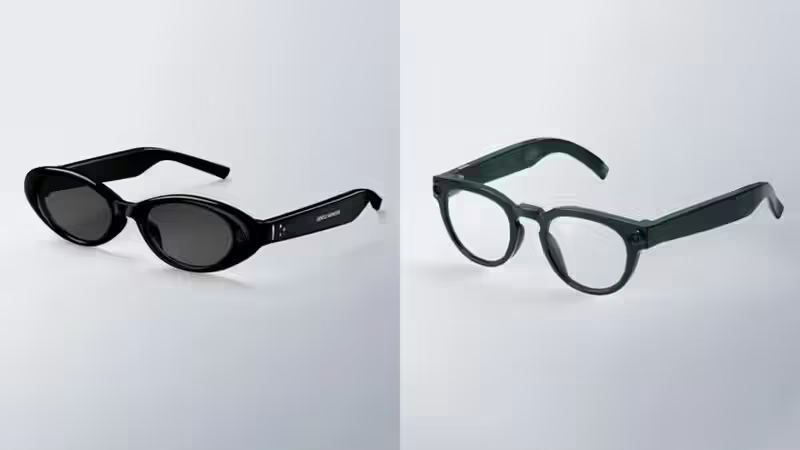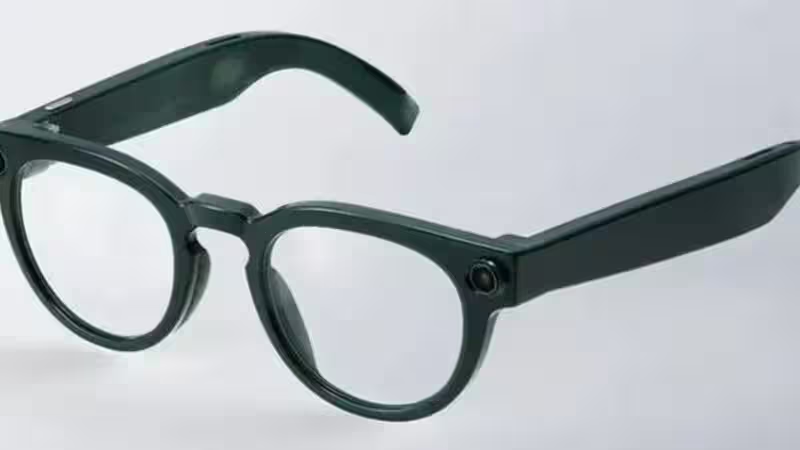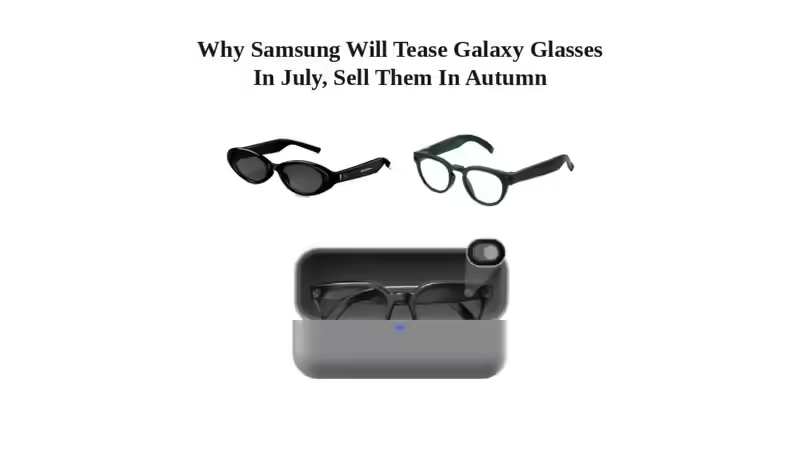
Watch a magician for long enough and you learn the trick lives in the timing, seldom in the reveal itself. When the hand moves, when the eye follows, when the thing you were promised finally arrives — which lands almost anywhere except the moment it first appeared. Samsung has been running exactly this act with the Galaxy Glasses, and the summer of 2026 is where the sequence pays off.Here is the short version, because the reader who reads only this paragraph should still walk away informed. Samsung will very likely show its Galaxy Glasses at a Galaxy Unpacked event reported for 22 July in London. Samsung will very likely make you wait to buy them until the autumn. The distance between those two moments — the reveal and the register — is deliberate, it has a precedent, and it explains more about Samsung's smart-glasses strategy than any single spec on the leaked sheet.The reason this question is live right now: the day before this piece, on 30 June, the unreleased Galaxy Glasses Manager app leaked, showing the hardware and its charging case for the first time. A finished companion app signals a finished product waiting in the wings. The groundwork is laid. The only real question left is when Samsung chooses to move — and that answer splits into two very different dates.Key TakeawaysSamsung's summer Unpacked is widely reported for 22 July 2026 in London, though Samsung has yet to officially confirm the date as of 1 July. Teaser activity has already begun.The Galaxy Glasses are expected to appear at that event — but as a tease, with the actual on-sale date landing in "fall 2026" (roughly September to November), mirroring the Galaxy Ring's 2024 playbook.Two different Samsung glasses sit on the roadmap: an audio model (codenamed Jinju, no display, this year) and a display model (codenamed Haean, micro-LED screen, 2027).These grew out of a four-way partnership revealed at Google I/O in May: Google's AI, Samsung's hardware, Qualcomm's silicon, and frames from Gentle Monster and Warby Parker.The glasses share the July stage with three foldables and two smartwatches, which shapes when and how loudly Samsung can launch them.Meta already sells Ray-Ban glasses in India from Rs 29,900, giving Samsung a hard price and availability benchmark to clear.The Date Everyone Is CirclingFirst, the event itself. Multiple reports place Galaxy Unpacked on 22 July 2026, in London — a venue that would mark Samsung's first summer Unpacked held outside Korea or the US. The date originated with South Korean outlets Korea Economic Daily TV and Seoul Economic Daily in May, and has since been corroborated by FCC certification filings for the devices expected to share the stage.The corroboration matters, because FCC paperwork is the least glamorous and most reliable tell in the business. A company files it because it has to, on hardware that is genuinely close to shipping. When the Galaxy Z Fold 8, Z Flip 8, and Galaxy Watch 9 series all clear US certification in the same window, the event around them stops being a rumour and starts being a logistics reality.Samsung has begun the pre-show choreography, too. Fresh visuals inside the Samsung Members app show an under-preparation stage lit in blue and green, with a "2 days to go" countdown pointing at the official invite — the kind of teaser Samsung runs roughly two to three weeks before the doors open. Add that gap to the calendar and a late-June-into-July invite lines up cleanly with a 22 July show.One honest caveat, held up front rather than buried: as of 1 July, every piece of this remains officially unconfirmed by Samsung — the date, the venue, and the full device list alike. Each data point above traces to supply-chain reporting, regulatory filings, and Samsung's own oblique teasing. The direction is about as solid as pre-announcement reporting gets, and the multiple independent sources converging on the same week lend it real weight. The specifics stay provisional until Samsung says the words on an official invite.The Move Behind The MoveNow the part that actually answers the question. Even if the Galaxy Glasses walk onto the 22 July stage, that appearance and their arrival in your hands are two separate events on two separate clocks.Google settled the outer boundary at I/O in May. The first intelligent eyewear — the audio glasses — is scheduled to launch this fall, with more details promised in the coming months. In Northern Hemisphere retail terms, "fall" means September through November. So the widest the window gets is a July reveal followed by a launch anywhere up to three months later.Why would Samsung split the two? Because it has done precisely this before, and the last time it worked. The Galaxy Ring is the template. Samsung teased it in January 2024, showed it behind glass at MWC that February, and only fully launched it at the July 2024 Unpacked — where it went on pre-order on 10 July and on sale on 24 July. From first tease to shelf: roughly six months of controlled anticipation. Nearly every outlet covering the Glasses draws the same parallel, and the logic is identical. As Engadget noted, Google already placed the audio glasses in fall, so a buyer should treat the Unpacked appearance as a preview and expect the purchase moment to arrive later.The strategic reasoning behind the delay is worth sitting with, because it reveals how Samsung thinks about a new category. A brand-new product class — a ring, a pair of camera glasses — carries a different risk profile than the eleventh Galaxy foldable. The foldable sells itself on a spec sheet the audience already understands. The glasses need the audience to be taught what they are for, and teaching takes time and air. Bolting a from-scratch category onto a launch day already carrying three foldables and two watches would bury it. Giving it a tease in July, a full teaching campaign through late summer, and a clean solo-ish launch moment in autumn lets the glasses breathe. In chess terms, Samsung is developing the piece before it commits it to the centre of the board.There is a cynical reading and a generous one, and both are probably true at once. The generous read: a new category deserves its own runway. The cynical read: a July tease captures the pre-Apple news cycle while the autumn on-sale date quietly absorbs whatever manufacturing and pricing headaches remain unsolved in July. Samsung gets the headline now and the invoice later.Why London, Why July, Why At AllThe venue and timing carry deliberate intent. They form a chessboard position aimed at a specific opponent who has yet to make a move of its own.Apple's first foldable iPhone is widely expected in September. Samsung holding Unpacked in London on 22 July puts its entire new lineup — foldables, watches, and the Glasses — into the market roughly two months before Apple changes the subject. London specifically, rather than Seoul or New York, plants the flag in Europe, the most competitive market on earth for premium foldables and a proving ground for whether stylish smart glasses can sell beyond the early-adopter core. The choice reads as a statement that Samsung intends to define these categories on its own terms, in its rival's backyard, while it holds the calendar to itself.For the Glasses, the pre-Apple timing carries a second edge. Apple's own smart glasses sit further out than its foldable — reports point to 2027 at the earliest, with Bloomberg's Mark Gurman suggesting the iPhone-replacing version may slip as far as 2028 to 2030. That gives Samsung and Google a genuine head start of a year at minimum in the display-free AI-glasses category. A July tease is Samsung claiming that ground loudly, on record, while the most dangerous competitor remains two years from the table.Two Glasses, One Roadmap — And They Answer Different QuestionsHere the story needs a clarification that most coverage flattens, because there are genuinely two Samsung glasses on the roadmap and they answer different questions.The distinction traces back to the platform itself. At I/O, Google was explicit that there would be two types of intelligent eyewear: audio glasses that offer spoken help in your ear, and display glasses that show you the information you need. The audio type ships first, this fall. The display type follows later.Samsung's own two-model plan maps directly onto that split:First modelSecond modelCodenameJinjuHaeanDisplayNone — audio, camera, GeminiMicro-LED in-lens displayTimingFall 20262027Rumoured price~$379–$499~$600–$900The 2026 model is deliberately screen-free. It is an ambient device rather than an augmented-reality one — Gemini in your ear, a camera on the frame, help delivered by voice while your phone stays in your pocket. The display-equipped Haean, the one that actually paints information onto the lens, is a 2027 story and a separate launch. Treating them as one product produces a muddier picture than the two deserve. When Samsung shows glasses in July, it will be showing the audio type — the opening move, with the endgame held back for a later board.That sequencing is itself a strategic choice worth reading. Leading with the simpler, cheaper, screen-free model lets Samsung establish the category, learn from real buyers, and refine the far harder display technology in public view before it commits to shipping it. Meta walked a version of this path — audio-and-camera glasses first, a display model second — and it worked. Samsung is following the same escalation, one rung at a time, rather than gambling everything on the technically riskier product in year one.What The Leaked App Told Us About The HardwareThe 30 June app leak, courtesy of SammyGuru working with leaker @evowizz, filled in the texture. Two caveats travel with every detail: the hardware shown in the app is the Warby Parker model rather than Samsung's own-brand frame, and everything remains pre-release.The Manager app is the control centre — it lets you manage settings, install software updates, and enable or disable features. Opening it walks you through pairing and surfaces a splash screen for One UI XR, Samsung's skin over Google's Android XR platform. The dashboard carries menus for Camera, AI assistants, Read notifications aloud, Advanced features, Accessibility, and Find my glasses.The charging case is the standout, and the part that breaks from the Meta template most sharply. Rather than a slim fabric pouch, it looks like a supersized earbuds charging case — a chunky clamshell you drop the glasses into, with internal contact points that charge them by touch alone, sparing you any wire threading into the frames, plus an external LED broadcasting pairing and battery status, just like your Galaxy Buds. Picture a Galaxy Buds case scaled up to swallow a pair of folded glasses, and you have it.The Ecosystem Is The Actual ArgumentSamsung's spec sheet, on the leaks, essentially matches Meta's Ray-Bans — same Qualcomm Snapdragon AR1 class of chip, a 12MP Sony IMX681 camera, a small 155mAh battery, Bluetooth 5.3 and Wi-Fi, roughly 50 grams on your face, and photochromic lenses that darken in sunlight. On raw hardware, this is a close fight. Samsung's edge lives elsewhere: in everything else you might already own with a Galaxy logo on it.The app's code exposed how deep that integration runs. Hidden strings — com. samsung. android. ring. GESTURE_ACTION, ACTION_GLASSES_START, ACTION_GLASSES_STOP — point to Galaxy Ring gesture control, where a pinch of the fingers wearing the Ring triggers the glasses' camera. There is also a dedicated Galaxy Glasses Controller app built to ship pre-installed on Galaxy Watches, turning the watch into a remote for the glasses. Photos and videos captured on the frames import automatically to your phone and surface in the Now Bar, previewable and reframable at a glance.That loop — pinch a ring to shoot a photo through your glasses, review it on your watch, find it already on your phone — is the single most compelling thing in the leak, and it is precisely the kind of trick that stays out of Meta's reach while Samsung holds a spread of wearables Meta lacks. On privacy, the glasses reportedly carry two indicator LEDs: one facing outward to signal to others that recording is live, one facing inward to remind the wearer. That dual-light approach is a direct answer to the backlash that has trailed camera glasses since the category began.The whole apparatus reflects the partnership underneath it, unveiled at I/O in May. Google supplies the AI and the Android XR platform; Samsung is responsible for the hardware engineering, while Google supplies the AI via Gemini. Qualcomm co-built the platform silicon. And two fashion houses handle the frames — Gentle Monster presents styles with disruptive yet refined aesthetics, while Warby Parker showcases refined and timeless designs. Samsung's Jay Kim, EVP of the Customer Experience Office in the mobile division, framed the glasses as further expanding the Galaxy device ecosystem — which is the honest thesis of the entire product. The glasses are less a standalone gadget than a new node on a network Samsung has spent a decade building.The Crowded Stage ProblemThe Glasses share July with a great deal of other hardware, and that crowding shapes their launch as much as any strategy memo.The 22 July slate is dense: a Galaxy Z Fold 8 in a new wider format, a Galaxy Z Fold 8 Ultra as the traditional tall successor, a Galaxy Z Flip 8, and a Galaxy Watch 9 series that may include a Watch Ultra 2. Pre-orders are expected to open the same day, with general availability targeted for early August on the foldables and watches. That is a lot of hardware competing for one keynote's worth of attention.A brand-new product category struggles to win a share-of-voice fight against three foldables and two watches on a single morning. This is the practical mechanism beneath the "tease now, sell later" pattern — decoupling the on-sale date shields the Glasses from being drowned out on the very day they debut. Samsung gets to point at the Glasses in July, let the foldables carry the immediate sales cycle, and then hand the Glasses their own clean moment when autumn arrives and the stage stands empty. Good theatre saves the debut act for a slot when the headliner has already taken its bow.The View From IndiaFor an Indian buyer, the timing question comes wrapped in a pricing and availability question, and the honest answer is: temper the calendar expectations further still.Samsung's global "fall 2026" launch window is explicitly for select markets, and India rarely sits in the first wave for a genuinely new device category. The Galaxy Ring, again, is the cautionary tale — global buyers had it in July 2024, and India waited months for a formal launch. A realistic read for Indian buyers: even a smooth global autumn rollout could mean a late-2026 or early-2027 India arrival for the Glasses, and that assumes Samsung prioritises the market at all for a first-generation product.The competitive benchmark, though, is already here. Meta sells its Ray-Ban glasses in India from Rs 29,900, with the Gen 2 model at Rs 39,900, available through Ray-Ban India, Amazon, Flipkart, and Reliance Digital — complete with Hindi voice support and UPI Lite payments on the way. That is the number and the availability Samsung has to clear. On the leaked $379–$499 pricing, the audio Galaxy Glasses would land in broadly the same territory once Indian duties and taxes apply, which puts the decision squarely back on the ecosystem question: a buyer already living inside Galaxy phones, watches, buds, and possibly a ring gains a reason to wait for Samsung that a Ray-Ban buyer simply lacks.The deeper Indian context is a market that has quietly warmed to face-worn tech faster than expected. Meta's India launch proved there is an audience willing to wear a camera on their nose in public, and Gemini's tight hooks into Google Maps, Search, and Android apps give Samsung's pitch a functional edge for the enormous base of Indian Android users who already live in Google's services. The glasses pair with both Android and iPhone, so the addressable market is wider still.The Price Wildcard Nobody ControlsOne force could unsettle every number in this piece, and it sits outside Samsung's hands entirely. A structural global shortage of mobile memory has pushed DRAM and NAND prices to record highs through 2026, with analysts pointing to relief arriving only after 2027. That pressure is already reshaping the rest of the Unpacked slate — leaked pricing puts the top Galaxy Z Fold 8 configuration above earlier expectations, with premium storage tiers absorbing much of the increase.Smart glasses use far less memory than a foldable, so the Glasses sit more insulated than the phones sharing their stage. Yet the rumoured $379–$499 band was set months ago, and the same component inflation squeezing the foldables leaves Samsung little room to price the Glasses aggressively below Meta. The realistic expectation is a launch price that lands at or slightly above the leaked range, which sharpens the ecosystem argument further still. Should Samsung and Meta arrive at broadly similar prices, the deciding factor becomes what each pair connects to — and that is the ground Samsung has spent a decade preparing.A second wildcard hangs over the catalogue itself: whether Samsung's own-brand frames, distinct from the Warby Parker and Gentle Monster designs, arrive alongside the fall launch or trail it. The leaked app supports multiple frame partners, which suggests Samsung wants a range on shelves rather than a single style. A wider launch catalogue would strengthen the India pitch in particular, where buyers of face-worn tech weigh fashion as heavily as function.So When, Actually?Strip away the hedging and the picture resolves into a clean sequence. A tease at Unpacked, reported for 22 July in London, remains the strong bet — the FCC filings, the teaser choreography, and the finished companion app all point the same way, with Samsung's official confirmation the only missing piece. The on-sale date lands in autumn, September to November, for the audio model in select markets first, with India plausibly trailing into late 2026 or early 2027. The display-equipped model is a 2027 conversation entirely, a separate product on a separate clock.The magician's hand has already moved — the app leaked, the stage lights are up, the invite is days away. What remains is the timing of the reveal, and then the longer wait for the register to ring. Samsung has run this exact act before, and the Galaxy Ring proved the audience will wait through the pause if the payoff is worth it. The Galaxy Glasses are the company's biggest bet on a new category since that ring. The pause, this time, is the point.FAQWhen will Samsung launch the Galaxy Glasses?The Galaxy Glasses are expected to be teased at Galaxy Unpacked, reported for 22 July 2026 in London, but the actual on-sale date is projected for autumn 2026 (September to November) in select markets. Samsung has yet to officially confirm any of these dates as of 1 July 2026.Will the Galaxy Glasses go on sale at the July Unpacked event?Most likely a tease rather than a sale. Samsung used this pattern with the Galaxy Ring in 2024 — teased early, shown at Unpacked, then sold later. Google has confirmed the audio glasses arrive in "fall 2026," so a same-day July purchase is improbable.What is the difference between the two Samsung glasses models?The first model (codenamed Jinju) is an audio device with a camera and Gemini but no display, expected in fall 2026 at a rumoured $379–$499. The second (codenamed Haean) adds a micro-LED in-lens display and is expected in 2027 at a rumoured $600–$900.Who is making the Samsung Galaxy Glasses?They come from a partnership revealed at Google I/O 2026: Google supplies the Gemini AI and Android XR platform, Samsung handles hardware engineering, Qualcomm provides the silicon, and eyewear brands Gentle Monster and Warby Parker design the frames.How much will the Galaxy Glasses cost in India?India pricing remains unannounced. The rumoured global price of $379–$499 for the audio model would translate to a comparable band after Indian duties and taxes. For reference, Meta's Ray-Ban glasses already sell in India from Rs 29,900.What else is Samsung launching at the July 2026 Unpacked?The event is expected to feature the Galaxy Z Fold 8, Galaxy Z Fold 8 Ultra, Galaxy Z Flip 8, and the Galaxy Watch 9 series, alongside the Galaxy Glasses tease. Pre-orders for the foldables and watches are expected the same day, with availability in early August.Do the Galaxy Glasses have a camera?Yes. The leaked companion app shows camera controls, and the glasses reportedly use a 12MP Sony IMX681 sensor with two recording-indicator LEDs. Both the audio and future display models are expected to include cameras.end of article
Why Samsung Will Tease Galaxy Glasses In July, Sell Them In Autumn
Samsung will show the Galaxy Glasses in July. The purchase date waits until autumn — and that gap is the whole strategy.<br />Everything points to a Galaxy Glasses appearance at Samsung's 22 July Unpacked in London. Little suggests they go on sale that day. Here's the timing, the two-model split, and what Indian buyers should actually expect.
3,435 words~16 min read